

The Baton has been passed: Dermot Flanagan on Mayo's long-awaited Glory

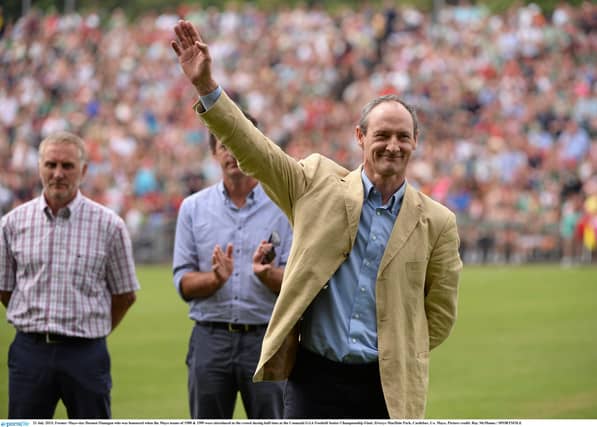

Former Mayo Captain and All Star Dermot Flanagan speaks to The Mayo News about the healing power of sport and seizing the moment
For decades, Mayo football has carried a story that felt destined to remain unfinished. So when the county finally lifted Sam Maguire, few people in Ireland understood the weight of that moment better than Dermot Flanagan.
A former Mayo captain, two time All-Star, and proud son of Ballaghaderreen, Flanagan comes from a family stitched into the fabric of the county's footballing history — his father Sean before him, who captained the Green and Red to the 1950 and 1951 All-Ireland victories.
Between them, the Flanagans have watched Mayo rise, fall, and rise again more times than most families ever will.
Now, with the county's breakthrough finally delivered by a new generation, Flanagan reflects on what it means to hand over a baton his family held for so long — and on the strange, healing power of a whole community falling in love with its team at the same time.
"The Good, the Bad, and Everything In Between"
Flanagan doesn't pretend the road here was easy, or that it belongs to any one generation. When he met the wife of Mayo's current manager and proud Ballaghaderreen man, Andy Moran, in the aftermath of the win, he found himself summing up decades of history in a single sentence.
"My family has handed over the baton to you," he told her, "the good, the bad, and everything in between."
It's a line that captures the Flanagan family's relationship with Mayo football better than any highlight reel could. Between them, Dermot and his father built up a remarkable shared record: seven All-Ireland final appearances (including a replay), four winners' medals and two runners-up medals, and 12 Connacht title medals combined.
Add to that two Sigerson Cup medals — one each, won with their respective universities — two National League medals for Sean, three club league medals for Dermot, and two All-Stars for Dermot himself, while Sean's playing days predate the awards and instead earned him a place in the All-Star Hall of Fame.
Dermot played in the 1989 final while his father Sean was still alive — a man, Dermot says, who was "very much hoping" that Mayo would finally do it, and hoping his son would be part of it too. That hope didn't arrive in Sean's lifetime, or in Dermot's playing days. It has taken until now.
But there's no bitterness in how Flanagan talks about it. Only relief, and a kind of quiet joy shared across a family and a county. "We're all just enjoying it," he says simply. "Everyone is just enjoying it. It's just a lovely thing."
Why sport heals
Ask Flanagan why an All-Ireland win matters so much to a place like Mayo, and he doesn't reach for football clichés. He reaches for something closer to philosophy.
For Flanagan, sport at community level taps into something more fundamental than scorelines — spirit, heart, soul. And he's acutely aware of what ordinary life looks like away from the pitch: financial pressure, job worries, welfare concerns, families coping with illness or hardship, physical and mental challenges of every kind. Against that backdrop, he says, a week like Mayo has just had is "pure humanity" — a stretch of time where people can step outside their daily struggles and simply enjoy something together.
He even sees it playing out in households across the county. In the glow of the win, he jokes, there's hardly a cross word to be found — maybe a minor row over someone missing curfew, nothing more. "In the bigger picture of things," he says, moments like this become a release valve, a way of letting go of tension that's built up over years, even generations.
"There's a little bit of a philosophical moment about this too," he reflects. "That's a lovely, lovely thing."
Expressing yourself
Flanagan's admiration for this Mayo team isn't just about the result — it's about how they got there. Watching the final, he was struck by the way the players carried themselves, even when the game wasn't going their way early on.
"I really applaud them," he says. "The way in which they performed, the way in which they expressed themselves as human beings — I thought it was wonderful."
Even seven points down in the first half, Flanagan didn't see a team playing badly, just one whose execution hadn't quite clicked yet. Then, almost imperceptibly, something shifted. Mayo found a gear "slightly above" where the game had been sitting, and suddenly they were creating what Flanagan calls "a wonderful form of chaos" up front — the kind of unpredictable, front-foot football that left the Kerry defence unable to anticipate what was coming next.
"It was just a great experience," he says. "The match was sort of the full catastrophe. It says everything."
Shakespeare, Sean, and Seizing the Moment
History looms large over this Mayo team, and Flanagan brings it into the present through his father's own words. The night before the 1950 All-Ireland final, Sean Flanagan turned to his players and reached for Shakespeare, quoting the famous line from Julius Caesar: "There is a tide in the affairs of men, which, taken at its flood, leads on to fortune."
For Dermot, the message his father was delivering to that team still resonates decades later. It was about recognising the moment when it arrives — seizing it fully, rather than letting it slip past — because that single decision can define everything that follows.
Flanagan pairs his father's Shakespeare with a piece of poetry of his own choosing: a favourite passage by the poet Rumi, describing a field that exists beyond the ideas of right and wrong — a place where the ordinary noise of language and judgment falls away, and people can simply meet each other as they are.
For Flanagan, that image captures something true about Mayo this week. The normal preoccupations of daily life have quietened, replaced by a shared emotional current running through the whole county — a sense of togetherness that doesn't need explaining, only felt.