

Mayo native Dr Norah Patten on her journey to becoming Ireland's first astronaut
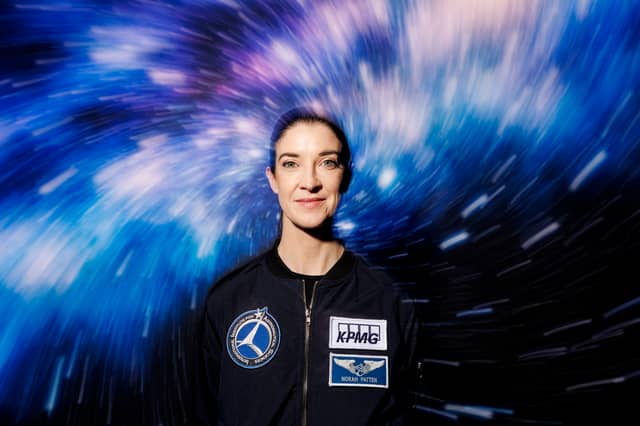

Inspired by a family visit to NASA, the Mayo engineer is preparing to make history while hoping to inspire the next generation to reach for the stars.
The sky was never the limit for Dr Norah Patten. The Mayo native is set to become the first Irish person to travel to space. And it all began when 11-year-old Norah visited NASA in Cleveland, Ohio.
“When we went to NASA on that family trip and got to walk around the hangar, see the aircraft and the wind tunnel, I just thought, 'Wow, this is fascinating,'” she told The Mayo News.
A later visit to what Norah describes as 'Disneyland for adults' truly sealed the deal for her.
“When I visited Kennedy Space Centre at 15, I said, 'Space is the only thing I want to do,'" she says. “Seeing the Saturn V rocket hanging above you, the scale of it, the engineering, the creativity - it was absolutely fascinating.”
Once she had found her dream, encouragement came from an unexpected source.
“I've often referred to my Junior Cert art teacher. It's funny because it wasn't a science teacher - it was my art teacher who really encouraged me,” she laughs.
“He told me, 'Don't worry about what the space industry looks like today. In ten years, there will be new opportunities. If that's what you want to do, go for it.'”
Disadvantage
Although her path was becoming clearer, attending an all-girls school, where there was less access to technical subjects, meant she felt at a disadvantage when she began studying Aeronautical Engineering at the University of Limerick.
“Coming from an all-girls school, we had less access to some of the technical subjects than many of the boys entering engineering, so I definitely felt behind in first year,” she says.
However, that setback only strengthened her belief that people should never be limited by what they think is possible.
“I always tell students not to be limited by what they think they can do. Even if your path isn't straightforward, there are ways to progress into the career you want,” she says.
After completing an undergraduate degree in Aerospace, Aeronautical, and Astronautical Engineering, Norah went on to earn a PhD in Engineering Research and Aeronautical Engineering. It is a field she hopes will attract many more women in the years ahead.
“It's been really encouraging to see the number of initiatives that now exist to support girls and young women in STEM,” she says. “Compared to when I was their age, there's definitely been a shift in the amount of support available.”
But she believes there is still more to be done.
"We also need to continue supporting women already working in STEM through career progression and mentorship," she says.
Space journey
While Norah has spent almost 30 years working towards her childhood dream, she is adamant that the opportunity to travel to space is something she will never take for granted.
“It's an enormous honour to have the opportunity to live out your childhood dream. It's something I don't take for granted for one second.”
While spaceflight presents unique opportunities to conduct microgravity research, Norah is equally excited about the impact the mission can have back on Earth.
“I think about not just the research, but the education and the impact of being a national first. How can we create a wave of interest in STEM and space as a result of it?” she says.
“Science communication is key. We'd love people to learn more about the mission and get excited by it.”
Although many people will only see the launch, Norah says the journey to space involves years of preparation.
“Since our flight was announced in June 2024, we've had an incredibly action-packed two years,” she says.
“People see the best bits, but there's a huge amount of work behind the scenes—planning, preparation and paperwork.”
Scientific research
As one of the few people who will travel to space, Norah and her team have received submissions from researchers and institutions around the world hoping to fly experiments on the mission.
“For us, it's about maximising the research, the scientific communication, the science diplomacy, the education, and the outreach,” she says.
One experiment in particular, focusing on women's health, is especially significant to her.
“We've partnered with an incredible obstetrician and gynaecologist to lead our female health studies,” she says.
Following the publication of their first paper examining how the female microbiome is affected by microgravity and hypergravity, Norah says preparation for every experiment is meticulous.
"You want everything rehearsed before launch day - from the equipment and timing to storage and staffing - so that every aspect of the research is ready," she says.
The IIAS-02 mission will include Dr Norah Patten, Kellie Gerardi, and Dr Shawna Pandya.
The crew will fly on a suborbital research mission aboard Virgin Galactic's next-generation Delta-class spacecraft, carrying a portfolio of Irish-designed payloads and experiments to study the effects of microgravity.