

Weaving heritage with modernity: Designer Helen McAlindin’s FOXFORD story
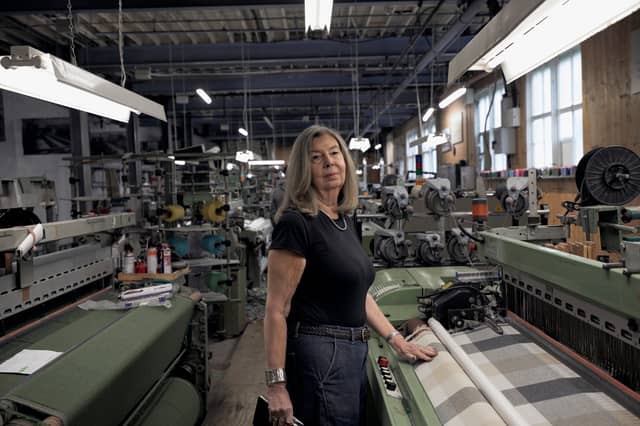

“Tourists still have expectations of something ‘touristy’, but there’s a way of doing that well - making the colours work and making it look good.” - Designer Helen McAlindin
When Irish designer Helen McAlindin was first approached by FOXFORD, she was adamant about bringing change to the historic brand.
In 2003, the Belfast-born designer first met with the now Managing Director of Foxford Woollen Mills, Joe Queenan.
“At that stage, FOXFORD was almost one hundred percent tourist - tartan and throws,” she tells The Mayo News.
However, through a shared vision, both sides recognised that it was time for change.
“At that stage, they had taken over in the late 80s, and this was fifteen years later. They wanted to pivot the whole business and make it much more modern.”
And so began a relationship that has now lasted more than two decades.
Designing the first new range
The designer got to work immediately, introducing new elements to the historic brand, including graphic stripe designs and neutrals.
“I designed about six or eight more modern throws. There were no tartans, so it was a complete change of direction for FOXFORD,” she says.
Following a positive reception, Helen continued to work with the brand, bringing further elements of modernity to its collections.
While change was underway, it was clear to McAlindin that she could not forget the traditional tourist market.
“What I introduced to FOXFORD was more aligned with Irish tradition, very simple grey-and-white windowpane patterns, things inspired by the Mayo countryside, stone walls and landscapes,” she says.
While there was still an expectation for something “touristy”, she is adamant that it should be approached in the right way.
“Tourists still have expectations of something ‘touristy’, but there’s a way of doing that well - making the colours work and making it look good,” she says.
While she admits that the bed linen and wider collection position FOXFORD as a contemporary homeware brand, there is still one element that remains constant.
“We have to respect the tradition of the mill and the heritage of the company. The ethos of FOXFORD is elegant simplicity. Simplicity of design. That’s what it has always really been about,” she says.
While McAlindin has produced multiple collections with FOXFORD, she has seen certain products remain popular throughout her journey with the brand.
“If you look at our neutral palette of throws — the minks and whites, the geometric designs - that’s something I did at the very beginning, and they’re still really good sellers,” she says.
There is another aspect of FOXFORD that has remained consistent: its storied products.
“During the centenary celebrations, we found photographs showing Michael Collins with a FOXFORD throw. We recreated that throw around 2016, and it has become synonymous with FOXFORD.”
She says this storytelling approach has also found its way into FOXFORD’s bed linen collections.
“We’ve created designs inspired by French toile patterns but rooted in places like the Wild Atlantic Way and Foxford village itself,” she says.
McAlindin is certain that there is a huge appetite for nostalgia, even more so than twenty years ago.
“Cottagecore and that aesthetic are very popular. Just look at TikTok - that’s what people want.”
She says FOXFORD has a design ethos that is simple and modern, but always mixed with an element of nostalgia.
“There’s a big difference between hype and a trend.”
She is focused on trends rather than hype.
“We know about hype, we look at it, but we ignore it. We focus on trends,” she says.
“In the early part of the 21st century, interiors were very minimalist. In the last five years, they’ve become much more maximalist, nostalgic and colour-drenched,” she adds.
“People are really into sustainability now, and they used not to be,” she says.
Helen is convinced that building a wardrobe for your bed is worthwhile.
“We keep our core colours and occasionally introduce a new colour, so customers can build on what they already own rather than replace everything.”
She believes there has been a positive shift towards sustainability, with consumers becoming more conscious of making use of what they already have.
“Five or ten years ago, everything was fast fashion. You bought things, got tired of them and got rid of them.
“Now people buy things, get tired of them, and put them on vintage platforms. It’s a circular economy,” she says.
The new FOXFORD Spring/Summer Collection was launched last week and includes the Ochre Stripe, Maeve Collection and Daisy Collection.
Speaking about the materials, McAlindin says the most premium range is made from 100 per cent washed linen.
“Linen is the most sustainable fibre. It comes from the flax plant and is harvested in Europe. It’s moisture-absorbent, strong, cool in summer, warm in winter and excellent to sleep in,” she says.
She also spoke about their newest introduction: a linen-Tencel blend. Tencel is the brand name for Lyocell, a fibre made from wood pulp.
“It makes the linen softer, improves drape and makes it a little more affordable. Of all the man-made fibres, Tencel is the most sustainable,” she says.
Helen says she hopes customers will invest in something beyond the product itself.
“I hope they’re investing in something that will enhance their home, their décor and their quality of life. This is a lifestyle brand. We want it to make them feel good. That’s it,” she says.
MORE
See www.foxford.com