

Margaret Loftus raises concerns over Garda handling of domestic abuse cases with Human Rights Watchdog

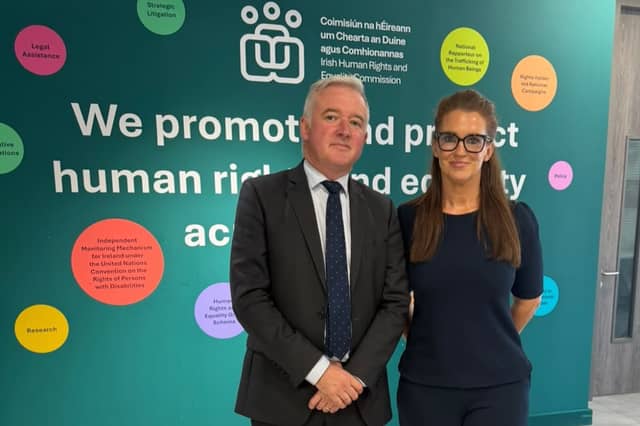

Margaret Loftus, a former Garda and domestic abuse campaigner, met with the Chief Commissioner of the Irish Human Rights and Equality Commission to discuss systemic failures facing victims of domestic abuse in Ireland, including concerns over Garda handling of such cases.
Former Garda and domestic abuse campaigner Margaret Loftus met with the Chief Commissioner of the Irish Human Rights and Equality Commission (IHREC) on Monday morning.
During a wide-ranging discussion on the systemic failures facing victims of domestic abuse in Ireland, Ms Loftus raised the question of "What good is legislation if the people entrusted to enforce it can themselves be perpetrators?"
Failures at every stage
The Mayo woman told the Chief Commissioner, Liam Herrick, that victims of domestic abuse in Ireland can be let down at numerous points in the system — from their first report to gardaí, through prosecution, and into family law proceedings where decisions are made about children and contact arrangements.
She raised particular concern about how well domestic abuse and coercive control are understood within the family courts, warning that abusive behaviour is too often treated as a routine family dispute rather than part of a broader pattern of control.
According to Loftus, the justice system does not always stop the abuse when a relationship ends — for many victims, it simply changes shape, continuing through litigation, financial pressure, and repeated court applications concerning children.
"A courtroom must never become an extension of the perpetrator's power and control," she said, calling for a closer examination of whether Ireland's legal system can properly recognise when child-contact disputes and repeated litigation are being used as tools of ongoing abuse.
When the enforced is the perpetrator
One of the most serious issues raised at the meeting concerned members of An Garda Síochána who are themselves accused or found to have perpetrated domestic abuse.
Loftus argued this raises fundamental questions of public confidence and institutional accountability. A garda who abuses a partner, she noted, holds a position of power, an understanding of policing procedures, and potential access to professional networks unavailable to other perpetrators — all of which can make it harder for a victim to seek protection from the very organisation meant to provide it.
She said the State carries a particular responsibility to ensure that such cases are identified, investigated and addressed, rather than treated purely as matters of individual misconduct.
A System of Gaps
The Pollavaddy native framed the discussion within Ireland's broader human rights and equality obligations, arguing that policing, prosecution, family law and child safeguarding cannot be treated as separate silos when a failure in one can have serious consequences in another.
She pointed to the "gaps" between these systems as the real danger: reports of abuse that fail to inform later decisions, coercive control that is recognised on paper but not in practice, and abuse histories that get minimised as ordinary disputes.
"We cannot continue to congratulate ourselves on having some of the strongest legislation on domestic abuse while failing to ask whether that legislation is actually protecting women and children on the ground," Loftus said. "A law sitting on a page is worthless to a victim if the system does not enforce it."
She added: "We must be prepared to confront the uncomfortable reality that when the perpetrator is a member of the very institution entrusted with protecting the public, the potential for institutional failure becomes even more serious."
Accountability
Ms Loftus raised the need for a fundamental examination of whether Ireland’s systems are sufficiently equipped to recognise when litigation, child-contact disputes and repeated legal proceedings are being used as instruments of continued abuse.
She underlined that the stakes go beyond individual cases.
"Human rights are not theoretical," she said. "They mean a woman has the right to live free from violence, intimidation and coercive control, and that the State has a responsibility to protect her when those rights are threatened."
The meeting comes shortly after Loftus made a submission to the European Commission as part of its work on the next EU strategy for victims' rights, and marks what she described as a significant step in pushing questions of domestic abuse, coercive control and institutional accountability further into Ireland's human rights debate.