

Living with an invisible illness: Karen Kelly opens up about life with ulcerative colitis
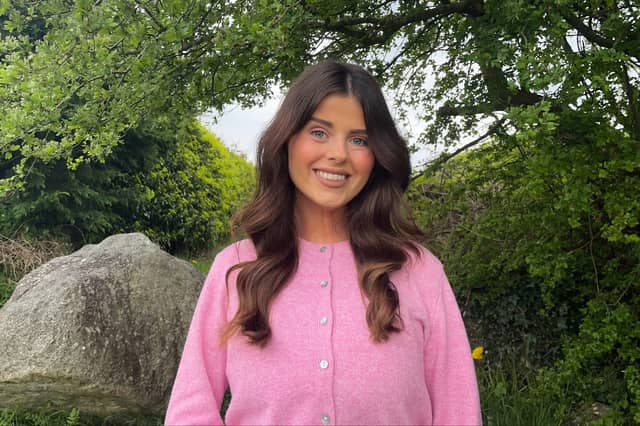

For years, Karen Kelly suffered in silence. Now the 25-year-old from Ballina is sharing her story to raise awareness, challenge stigma and remind others living with inflammatory bowel disease that they are not alone.
At first glance, life appears busy and full for Karen Kelly. A social care worker supporting teenagers in residential care, the Bonniconlon Rose 2025 enjoys travelling, walking and embracing new challenges.
But behind the scenes, the Ballina woman has spent much of her life navigating the unpredictable reality of exhaustion, pain and uncertainty — symptoms of ulcerative colitis, a chronic form of inflammatory bowel disease (IBD).
Diagnosed at just 14 years old, Karen says her symptoms had begun long before doctors found answers.
“My symptoms first started around the age of nine,” she recalls. “I was constantly tired, had sore bones, stomach pain and was passing blood. I was always at GP appointments trying to understand why I felt unwell.”
At the time, those symptoms were often explained away as growing pains or menstrual issues, but Karen knew something wasn’t right. Even everyday illnesses affected her differently.
“If I got a cold or flu, I was much sicker than everyone else,” she says.
After repeated GP visits over the course of a week, Karen was advised to attend A&E, where a doctor quickly noticed how pale she looked and began asking more detailed questions. That encounter led to a referral for a colonoscopy.
“The procedure confirmed I had ulcerative colitis,” she says. “I was only 14.”
For a teenager, the diagnosis was difficult to comprehend.
“Much of my teenage years feel like a blur,” Karen explains. “I found it incredibly hard to process being told I had a lifelong illness.”
Like many people living with invisible conditions, Karen quietly carried the burden while trying to maintain a normal adolescence. Flare-ups meant missing school, falling behind socially and academically, and feeling disconnected from other teenagers.
“Sleepovers or even going out with friends became stressful because I was constantly worried about symptoms or when a flare-up might happen,” she says.
Rather than speak openly, Karen kept her diagnosis private.
“It’s something I kept to myself for years,” she says. “I felt embarrassed and didn’t know how to explain it, especially as a teenager.”
Now aged 25, Karen’s condition is reasonably well managed through biologic medication, which she self-injects every two weeks. But ulcerative colitis, she says, affects far more than the digestive system.
Last year, her health took a frightening turn.
“What started as what we thought was a chest infection lasted months,” she explains. “Despite medication, I got worse and worse.”
Eventually, severe chest pain and breathing difficulties sent her back to hospital, where doctors discovered inflammation around her heart.
“Being in ICU made me realise ulcerative colitis is not just a bowel disease,” she says. “It can affect other parts of the body too.”
The experience was overwhelming and frightening, but it also marked a turning point.
While she once kept her diagnosis hidden, Karen now speaks openly about her condition, including sharing her story through media interviews and fundraising.
Last year, she completed a charity skydive in support of Crohn’s and Colitis Ireland and publicly shared her story for the first time.
“I realised there was no reason to feel ashamed,” she says. “This is part of my life, and accepting it helped me grow.”
For Karen, sharing her story and raising awareness matters because many people still misunderstand the reality of living with chronic illness.
“IBD is often invisible,” she says. “Someone can look perfectly healthy on the outside while dealing with pain, exhaustion or complications behind the scenes.”
Outside of health challenges, Karen continues to live life fully. She is a social care worker supporting teenagers in residential care, a role she describes as deeply rewarding. She was also crowned Bonniconlon Rose 2025, an experience she describes as a huge honour.
Above all, Karen hopes sharing her experience will foster understanding.
“For the public, I want people to understand that IBD is often invisible,” she says. “Awareness, understanding and support make such a difference.
“And for people living with IBD — don’t be embarrassed and don’t suffer in silence. If you need support or urgent access to a toilet, you should feel able to say so openly, without fear or judgement.”
Living with ulcerative colitis, Karen adds, has taught her resilience.
“Despite the uncertainty, hospital appointments and daily management, I continue to challenge myself,” she says.
And in sharing her story, she hopes others facing invisible illness feel something she once struggled to find herself — understanding, support and the reassurance that they are not alone.