

Survey finds sheep and septic tanks the main risk to Mayo oyster farms



A sanitary survey of waters around oyster farms in Achill found that septic tanks and sheep are the principal contamination risks
A sanitary survey conducted by the Sea Fisheries Protection Authority (SFPA) of waters near west Mayo oyster farms found that septic tanks and sheep are the principal contamination risks for the production area.
The SFPA published the results of a comprehensive Sanitary Survey for Achill South undertaken to meet EU legislative requirements relating to the classification of shellfish production areas.
The Bivalve Mollusc Production Area (BMPA) within Achill South covers an area of 10.18 km between the Michael Davitt Bridge in Polranny and the area around Currane and Cloughmore.
The key findings of the survey found that the predominant sources of faecal pollution were attributed to the widespread use of domestic septic tank systems and the extensive agricultural activity in the catchment, particularly sheep farming.
At present there are 13 active shellfish licences in the production area all of which are listed as producing Pacific oyster with a single site with combined Manila clam and a single site for the production of Atlantic salmon.
The BMPA is divided into two distinct production areas - Corraun and Balfarsad – and the most recent annual classification found that it listed as Class A, which is the highest microbiological safety classification awarded to shellfish production and harvesting areas.
The sanitary survey combined a desk-based assessment determining how pollution can potentially travel to shellfish production sites in the area and an SFPA-led shoreline survey, and bacteriological sampling of key inflows and runoff points. The shoreline survey took place over two dates in October 2025.
During the shoreline survey a total of 43 observations were recorded during the shoreline survey and all of the observation sites were sampled for bacteriological analysis.
The survey found that bacteriological water sampling results across the surveyed area demonstrated varying levels of contamination, with E coli concentrations measured at all 43 locations.
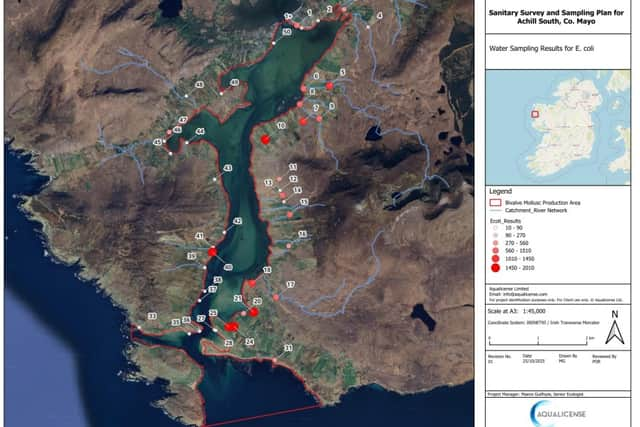
Low contamination levels were identified at 13 stations indicating minimal faecal contamination. These sites covered mainly streams, rivers, and surface waters across the northern and western section of the production area, showing limited bacterial input under dry conditions.
Elevated concentrations were recorded at eight sampling stations and these were generally associated with streams and rivers flowing into the bay, particularly along the central portion of the production area.
The highest recorded concentrations of E coli occurred at four sampling locations. These sites are mainly streams and surface waters entering the bay near piers and drainage outflows in the southern and eastern production area.
“Although the survey data offers an invaluable snapshot in time of the conditions during the sampling period, it is noted that the results may be affected by seasonal factors, including variations in rainfall, river flow, and agricultural activity, all of which may influence contamination patterns over time. Consequently, the sampling effort does not capture the variations that may occur at other times of the year. These seasonal effects should be considered when devising a suitable sampling plan,” the conclusions of the survey read.
Following the findings of the survey, the SFPA recommended that the BMPA remain divided into two distinct production areas, Corraun and Balfarsad, each with its own individual Representative Monitoring Point (RMP).
“The distinct circulation patterns and localised contamination pressures in each area justify maintaining separate production areas, each with its own standalone RMP. Accordingly, it is recommended that the existing structure of two production areas—with individual RMPs—be retained to ensure monitoring remains accurate, robust, and truly reflective of microbiological water quality conditions,” the survey recommended.