Remarkable historical exhibition focuses on remote west-coast communities – and on a scientific practice that had catastrophic consequences

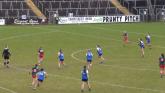
Inishbofin, 1893. The anthropologist Charles Browne is using a craniometer to take a measurement while a police sergeant of the RIC notes it down. Local people are on the left, sailors from Britain on the right.?
Pic:Trinity College, Dublin
Head hunting in the wild west
A remarkable exhibition at the National Museum of Country Life opens a lens on some of our most remote communities and on a scientific practice that had catastrophic reverberations.Aine RyanHEAD HUNTERS roaming round the remote coastal communities of the windswept west of Ireland. It is certainly a rather alien concept today. Even 120 years ago our impoverished forebears must have been taken-aback by the arrival of strangers wielding weird instruments and cameras while measuring heads and earlobes, chins and noses.
Fortunately, The Irish Head Hunter exhibition, presently on-show in the National Museum of Ireland – Country Life, at Turlough Park, Castlebar, explains the rather strange practise.
Indeed, ethnographer Charles Browne’s wonderful photographic exhibition, curated for the museum by Dr Séamas Mac Philib, makes a significant anthropological, sociological and cultural contribution about life in these peripheral areas in the 1890s. As Browne notes in one of his papers written for the Royal Irish Academy, this was a time of seismic changes in farming practises and structures of dwellings – due to the establishment of the radical Congested Districts Board – and therefore a pivotal time for such research.
So both his camera and his recordings capture snapshots of the customs, housing and modes of transport of a disappearing way-of-life.
Moreover, on a much broader note, Charles Browne’s photographs, and his observations, help contextualise a scientific movement that would ultimately take a sinister turn in Nazi Germany, as well as in Sweden and the United States.
Anthropometry – measuring humansTHE HEAD HUNTER exhibition is comprised of 63 photographs, both the originals and restored copies, of people from Clare Island and Inishturk, Ballycroy, Erris and the Inishkea Islands, Inishbofin and Inishark, the Aran Islands and Connemara, as well as Dún Chaoin and the Great Blasket Island in County Kerry.
These photographs were collected by Charles R Browne (1867-1931), a medical doctor and anthropologist from Dublin, as he surveyed communities from the Dingle penninsula to Erris between 1891 and 1900. While the results of his detailed surveys, for the Royal Irish Academy, have been available in the interim, the important archive of photographs only came to light in recent times after Browne’s daughter gifted them to Trinity College.
This collection is not only important for its human and socio-scientific interest but because Browne applied an anthropometric method – using craniometers, sliding rules and steel tapes – in an attempt to classify those studied as ‘racial types’. Unsurprisingly, some of the subjects were unwilling participants in this rather intrusive procedure of measuring, which may explain the presence of an RIC officer in one of the main photographs.
Unfortunately, this rather crude method of defining human beings contributed to a new science of human breeding, called Eugenics, which became quite influential in the US in the 1890s, where certain mentally ill people were forbidden to marry. Later sterilization programmes were forcibly imposed in both the US and Sweden. Indeed as we all know now, the practice of eugenics, in many sordid forms, was taken to an extreme in Nazi Germany, with widespread experimentation, ethnic cleansing and ultimately the mass extermination of the Jews.
Dr Mac Philib explains that Browne was not a racist and his ethnographic surveys for the Royal Irish Academy are proof of his objectivity and fairness. However, in a bid to further develop its potential, Mac Philib decided to enhance the original Head Hunter exhibition, generated by CiarΡn Walsh at Ionad an Bhlascaoid Mhóir, by contextualising it within this broader movement, which had so many political ramifications in Europe during the early decades of the last century.
“The Victorians were frightened by Darwinism and its theories about the origin of the species. It was comforting for them to think that they were ‘white and superior’ and they liked to classify the thousands of Irish emigrants as savage simians. Just think about the many such cartoons and caricatures in contemporary Punch magazines,” says Séamas Mac Philib.
He says: “There is one important point about this that I think is relevant in Ireland today. Obviously, we are coping with significant immigration in recent years and it is a major challenge for a country with a small population in serious recession. However, the lesson of the ‘simian’ Irish of the cartoons of the 19th century might be that the Irish at least, might not look on the immigrant groups as some sort of sub-human or lesser beings.
“A central message from this exhibition is that there was nothing inherently wrong with anthropometric work and its racial and ethnic strains but it is the way it was abused by colonists and political fanatics.”
What Charles Browne wroteAbout the Clare islanders: “The people on the whole are good-looking, especially when young; many of the girls and young women are very handsome, but they appear to age rapidly and early become wrinkled’.
About the camera: “The addition of the hand camera to our appliances has proved to be a great advantage, enabling portraits of unwilling subjects to be taken.”
Charles Browne’s photographs featur farm labourers and road builders of Erris; the Kings of Inishkea and Inishark; Myles Joyce, the schoolmaster on Inishbofin.
MORE ‘The Irish Head Hunter, Searching for the Irish Race’ will be on show until June.
www.museum.ie