

“No commitment to a national review,” Mayo Cllr says Minister’s response falls short on railway crossing safety
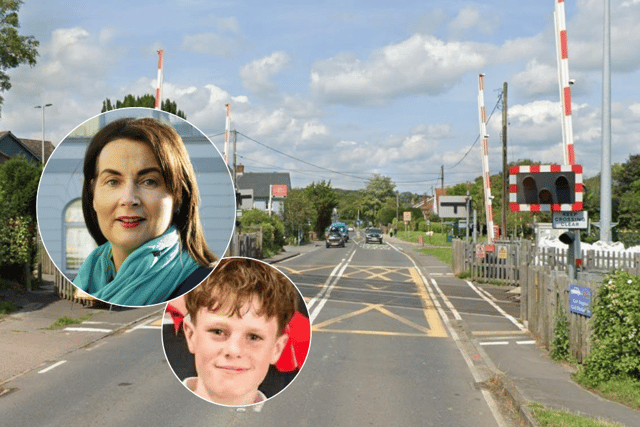

Councillor Alma Gallagher renews her call for national review of user-operated crossings following death of 12-year-old Eoin Doyle at Kiltybo
Mayo councillor Alma Gallagher has expressed disappointment with the response from Minister for Transport Darragh O’Brien to calls for an urgent national review of user-operated railway level crossings, following the death of 12-year-old Eoin Doyle at Kiltybo, outside Ballyhaunis, on September 3.
Cllr Gallagher brought a motion to Mayo County Council in September seeking a full review of user-operated crossings, with priority given to locations where fatalities or serious incidents have occurred. The motion, which received unanimous support from councillors, also called for an examination of replacing manually operated gates with automated barriers and modern safety systems.
In a response dated October 22, Minister O’Brien outlined existing safety procedures, inspections and risk assessments.
However, Cllr Gallagher said the response did not include a commitment to a new national review, a clear programme for introducing automated barriers or confirmation that Kiltybo would be prioritised for further safety improvements.
“While I acknowledge the Minister’s response, I am disappointed that it does not go far enough in addressing the fundamental concerns raised in my motion, which received the unanimous support of Mayo County Council,” she said.
653 user-operated crossings across Ireland
Minister O’Brien confirmed that there are 853 level crossings on the Iarnród Éireann network, of which 653 — approximately 76% — are user-operated and unattended.
Of those 653 crossings, 80 have been equipped with Decision Support Systems (DSS), which provide train-activated warning lights and audible alarms.
The Minister also confirmed that the Kiltybo crossing was fitted with a DSS in February 2022 and was last surveyed in May 2026.
Cllr Gallagher said the information raised questions about whether existing safety arrangements were sufficient, particularly where members of the public must manually open and close gates to cross a live railway line.
“What concerns me most is that Kiltybo already had a warning system installed. Yet the crossing continued to rely on members of the public physically opening and closing gates to cross a live railway line,” she said.
“We need to ask whether this is an appropriate long-term arrangement, particularly at crossings used by motorists who may be unfamiliar with the area or the operation of railway gates.”
She said technological advances meant automated barriers and other modern safety measures should be examined to determine whether they could reduce reliance on human intervention.
“The fact that a warning system is installed does not mean that every reasonable safety improvement has been exhausted,” she said.
Calls for national review without delay
Investigations into the Kiltybo tragedy are ongoing involving the Railway Accident Investigation Unit, the Commission for Railway Regulation and Iarnród Éireann.
Cllr Gallagher said she respected the independence of those investigations and the need to establish the facts surrounding Eoin’s death. However, she argued that a wider review of railway crossing safety should not have to wait until the investigations are completed.
“One investigation must establish what happened at Kiltybo. A national review should examine whether our existing approach to railway crossing safety remains appropriate and what improvements can be made for the future,” she said.
The Fine Gael also pointed to previous railway accident investigations that had raised concerns about user-operated crossings and recommended additional safety measures.
“We have had previous incidents and safety recommendations,” she said. “We need to establish what lessons have been learned, what recommendations have been implemented, and whether enough is being done to address the risks associated with manually operated crossings.”
Calls for investment in safer crossings
The Minister’s response also outlined an ongoing programme of level-crossing closures and eliminations, with a further 11 closures projected by the end of 2026.
Cllr Gallagher said that more needed to be done to improve safety at crossings that remained necessary for rural communities.
“Closing crossings may be appropriate in certain circumstances, but it cannot be the only solution,” she said. “Where crossings are required to provide access for rural communities, we need to examine how they can be made as safe as reasonably possible.”
The local councillor is now seeking a commitment from the Minister to commission a national review of user-operated public-road railway crossings, including an assessment of the feasibility and cost of introducing automated barriers.
She also wants confirmation that Kiltybo will be specifically considered for further safety improvements, together with details of the risk assessment carried out there in May.
Cllr Gallagher finally said Eoin’s death had deeply affected the Ballyhaunis community and that efforts must now focus on preventative action.
“At the heart of this issue is a young boy who tragically lost his life and a family who have suffered an unimaginable loss,” she said.
“No review or safety measure can undo what has happened, but we have a responsibility to ask difficult questions and to ensure that every reasonable opportunity to improve safety is properly examined.”
Cllr Gallagher confirmed she would write again to the Minister seeking specific commitments on a national review, the potential introduction of automated barriers and the prioritisation of Kiltybo.
“We owe it to Eoin’s memory, his family and every community living alongside our railway network to ensure that this issue receives the serious attention it deserves,” she said.