

COUNTRY SIGHTS AND SOUNDS: The promise of high ground
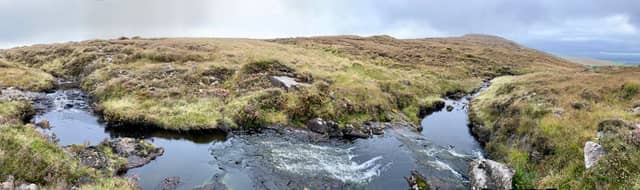

At first sight the high ground between Croagh Patrick and Tourmakeady appears empty – apart from the scant few sheep that pick a desultory living from the sour land, that is. After enduring adverse conditions for so many months these look poor enough to be heading into the winter. For many it will be their last.
These are resilient, hardy animals that were specially bred for their ability to endure west of Ireland weather. Tomás, while he was still alive, saw them as a valuable part of Irish heritage. ‘Connemara blackface’, he called them, before telling me how valuable they must have been when all a man could rely on was a few acres of bog far too wet for horse or for cow.
Rich lowland pasture, where grass grows lush over limestone, might support a few sheep per acre. Up here on the heights we have thousands of acres before us, with just a light scattering of livestock. Perhaps the ground was richer once, with grouse under waist-high heather, mountain hares and wild goats on rocky slopes, together with a more dense population of live-saving blackfaced hornies. Is it any wonder that outward migration left this place empty? And whose heart would hanker for this wide, open, windswept wilderness? Who would fight for the home place and the right to return?
We walked a short section of upland looking for stems of heather, some of which hold oval blooms of a rich purple hue. Amid the bell heathers grow ling and cross-leaved heath, most of which are nibbled back to the edge of existence.
This is almost a desert. Stretching from horizon to horizon, north, south, east and west, the same sorry tale is told. It is one of overgrazing, of pulling every last grain of good from the ground until it has nothing more to give.
Yet in a small fold, on the bank of the stream which hurries down the hill, we found a patchwork of green with the remains of a stone cottage. The door is missing, the glass long gone from the window. What may have been a sod roof is now tin and red with rust. A small garden is attached. It must have once been fenced; now, apart from a thin line of stones that suggest a thrown down wall, the place is open to the elements as well as to the few sheep that dwell here.
The garden still wears the scars of love’s labour in the form of so-called lazy beds, those side-by-side parallel ridges that highlight cultivated areas and make them plain to see. I imagine the man of the house with his hand-me-down clothes and worn out boots, turning the thin scraw as best he could to make some kind of living for his family, while his woman pulled her shawl about her shoulder and imagined herself in finery that never came.
This is a hard enough thought, one which I must leave lest the land swallow me with its sadness.
We found the stream and followed downhill, pausing to take in the ancient curve where water ate into rock and the deeply eroded chasm where it found a fault. It is impossible to know how many years the stream had taken to find and follow the course of least resistance. That the hills were once wooded is plain to see, for we have a forest of roots left behind. What must it have been like, when the place was covered with tall pines?
We can see, where the bog has been cut away or otherwise been eroded, there was never much in the way of topsoil. Much of what we now find is a thin covering of glacial till at best, with bare rock jutting through taut skin like the sun-bleached bones of a long-dead beast.
Perhaps things are not as simple as I imagine they could be, but wouldn’t this be the perfect place to start a natural regeneration of native woodland? If Scots pine grew well before, surely it would do so again.
By general consensus the climate of Ireland suffered a rapid decline about 4,000 years ago, when cooler and wetter conditions gave birth to the bog which still lies draped over these hills. Vast areas of oak and pine woodland died in a short time. All that remains of the forest of old are those roots. They give an insight into the past; they also give a glimpse of the future.
The wild awaits, if that is what we wish for.