

OUTDOORS: Graced by butterflies from afar
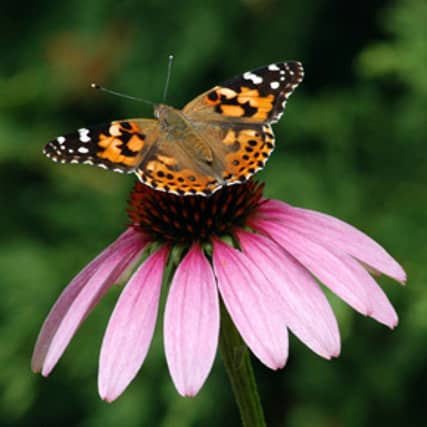

The countryside has come alive with the orange and black hues of painted ladies, butterflies from north Africa and the Mediterranean.
Graced by butterflies from afar
John Shelley
A scatter of brown leaves rose through the haze and swept over the reed bed to settle on the poor grassland on the sunny side of the hedge. In a moment they were aloft again, rising as a thin, twisting spiral over my head, then around my shoulders and down to the pink and white riot of geranium colour, though no longer as the leaves I had taken them for, but as butterflies. Painted ladies to be exact.
This little orange and black beauty is probably the world’s most widely distributed butterfly, appearing almost everywhere that other butterfly species appear. It has a summer range that extends from the Pacific coast of North America, right across Europe as far north as the permafrost of Iceland and Finland, and throughout Africa and Asia. We might conclude there to be nothing remarkable in being common in almost all corners of the earth, yet the way this humble insect disperses itself to so many parts of the globe is quite extraordinary.
The painted ladies that entertained me last bank holiday weekend began their lives in Africa, north of the Sahara Desert, during the time of year that corresponds to our winter. They had hatched in vast numbers from grey chrysalids suspended from the leaves of the thistles and related plants upon which they had feasted as caterpillars. Feeding and breeding were their immediate priorities, but before long, strange forces got to work in their tiny heads and the urge to migrate drove them from their homeland.
Many thousands, perhaps millions, including those now with us, began to move to the north into southern France and Spain, as successive generations do each year. As they travelled they left a trail of eggs behind them; when these hatch and mature they too will drift further in the same direction and will also multiply as they move. Now they are here, watch out for them, for they are only passing through, stopping off for a while.
In the northern hemisphere, this spring migration tends to follow established lines of flight, with only a relatively few painted ladies reaching the shores of Ireland. The numbers that set out across the Mediterranean also vary, according to conditions there, but 2009 appears to have been a notably good year for them. Indeed, I think I have never seen so many painted ladies. When we visited Belmullet on the final day of May we saw hundreds. They were everywhere.
The strong winds that blew over much of continental Europe recently have obviously facilitated the movement of the butterflies. It is unlikely that as many would have arrived here on their own strength. Nonetheless, that such fragile creatures should undertake such an endeavour and arrive intact is remarkable, and all the more so when we consider that not one of these butterflies has done this before.
Their journey and discovery of new lands leads ultimately to their death. A return migration has never been properly documented. Although in recent years small numbers of painted ladies have been observed traversing certain Pyrenean passes and moving offshore from the Mediterranean coast of Spain, these would not be the same insects that are around earlier in the year, but their offspring.
Irish winters are too damp and much too long for the poor painted lady to survive. She will die long before the first frost, when the autumn storms cripple her wings and she can no longer find enough flowers to feed on. Then we must wait for the next generation.
The sight of so many butterflies this early in the season has excited the minds of some, causing them to wonder if it could be a sign that we have an especially good summer ahead of us. Well, we are certainly due a spell of settled weather, but the only thing this current invasion of painted ladies can tell us is that conditions were right for them to travel. Rather than so many falling victim to contrary winds, they were helped along the way, and now we can get to enjoy them for a while.
The widespread use of herbicide will account for too many, as they feed on wild flowers that have been poisoned. After undertaking such a monumental journey they are surely entitled to a better welcome. Put the spray away, and get the mower out instead.