

NATURE Mermaid’s purses on our beaches
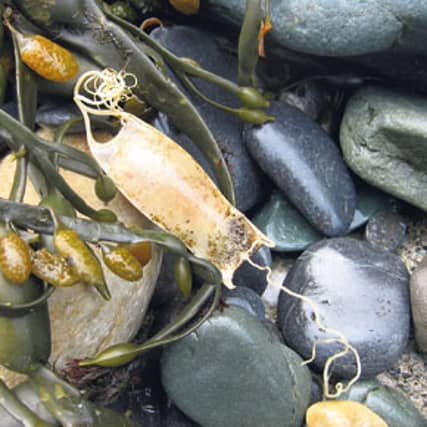

The secrets of mermaid’s purses – little pouches or egg cases that were once home to infant skate, ray and shark
The treasures inside a mermaid’s purse
John Paul Tiernan
Placed high and dry upon the clean blue pebbles by a spring tide, the mermaid’s purse I found last week was not hard to spot. Another purse some months ago was easier to miss, dark and unlovely as they are, and cast as it was amongst the deposited kelp of similar leathery brown shades.
That relationship of camouflage was once so necessary underwater, when the four-pronged purse held a tiny shark, skate or ray and the kelp held to the rock and provided cover for the purse until its inhabitant was ready to leave.
How curious that now, far from those dynamic undersea worlds, they defiantly continue this relationship as they desiccate together on the still shore, the kelp now concealing the purse from the eyes of hurried beach walkers.
The purses, egg cases that once protected a fertilised embryo, are the unremarkable reproductive clue to species like the dogfish, our smallest and most common shark. But not all sharks reproduce like this. Mayo’s legendary basking shark (mysterious enough to be labelled a sea monster as Gaeilge – An LiabhΡn Mór), is still almost a mystery to scientists in this regard. These sharks are believed to give birth to live young, but a pregnant female has only ever been seen once, and nobody knows when or where or how many young are born.
Porbeagle sharks which have been landed in Clew Bay definitely do give birth to live young, usually four at a time. And although hammerhead sharks won’t be found in Clew Bay anytime soon, its worth noting the female of the species gave birth in a zoo in the US in 2001 – despite no male contact in three years. However, while sharks may be capable of ‘virgin births’, such immaculate feats, which only occur in extreme circumstances, are bad for genetic diversity.
The un-immaculate mermaid’s purses are not so dramatic. The almost-blind dogfish, which spends 23 hours a day dozing on the seafloor, is no hammerhead, but there is still useful information to be gleaned from them. Compiling records of their distribution can provide valuable information on the location of shark, skate and ray nursery areas. Many of these fish are severely threatened. For example, the (now ironically titled) common skate, which was once found throughout European waters, is only found in a few select locations. Purse Search Ireland are one group who have undertaken the task of compiling this info, and provide a user-friendly online form at www.marinedimensions.ie for you to log your report.
SHARK BITES
- Sharks, skates and rays are related and together make up the Elasmobranch class of fish, a very ancient class dating back 400 million years. They are different to other fish, as they have cartilage skeletons instead of bone.
- The dogfish (Sycliorhinus canicula) is found all around our coastline in sandy bays and off-shore. It feeds mostly on prawns, crabs and occasionally fish. It breeds annually, and nine months after mating, the female lays approximately 25 eggs, which develop inside mermaid’s purses for nine months.
- The basking shark (Cetorhinus maximus) is a filter feeder, passively filtering small fish, invertebrates and zooplankton near the surface with its gaping mouth open. Recent satellite tagging studies have confirmed that the same sharks undertake huge migrations in winter. They were almost fished to extinction in the west of Ireland until the 1970s but are now believed to be making a recovery.
John Paul Teirnan, Louisburgh, runs www.irishmarinelife.com, a website dedicated to the creation of knowledge of our marine ecosystems. He is currently studying for an MSc in Marine Science.