

Knock connectivity
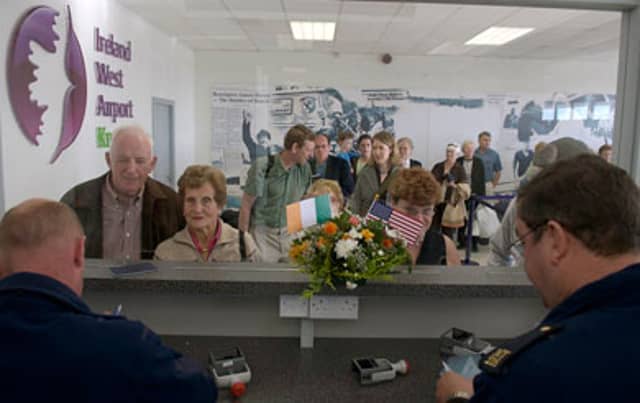

County View If connectivity is vital to Shannon, surely the same connectivity must be equally important here.
PROGRESSIVE STEP Passengers arriving on the first flight from New York into Ireland West Airport Knock, in May. Pic: Keith Heneghan/Phocus
Why no connectivity here?
County View
John Healy
Perhaps it was pure coincidence, but RTÉ Radio listeners must have raised an eyebrow at the juxtapositioning of items on Sunday’s ‘This Week’ programme.
The opening topic – the Shannon controversy – featured a spirited defence by Minister Noel Dempsey of the Government’s stance in not interfering, together with a sharp rap on the knuckles for those of his own party who were showing signs of rebellion.
The programme then moved on to an extended report on the success which is Knock Airport, reminding listeners that what was once dismissed by the Dublin experts as a white elephant had developed into a huge asset for the west of Ireland. With passenger throughput of 600,000, with the airport turning a profit, and with several new projects in the pipeline, the national broadcaster was going out of its way to point out that there was more than one international airport in the west of Ireland.
From the cutting of the tape by Charlie Haughey through the early battles for a foothold and on to the new services to the US and the hoped-for link to Vatican Airlines, the ‘This Week’ programme did full justice to Knock. When the MD of Lionbridge Technologies explained that the airport was the key factor in the company’s decision to locate in Ballina, rather than on some other point on the globe, it summed up how the late Monsignor Horan’s vision was reaching its full bloom.
But there was too another side of the coin which, given the Shannon comparison, should have caused some of our Mayo public representatives, community leaders and lobby groups to pause and ponder. If connectivity to the outside world was of such vital importance to Shannon jobs and industry and investment – and nobody doubts that it is – surely the same connectivity must be equally important to jobs, industry and investment from Galway up to Donegal.
If the industries in the Shannon basin are to be choked to death by reason of the loss of the link to Heathrow, then where stand the industries and employers in Connacht which have had to exist over the years without a link to Heathrow?
Put another way, if connectivity is that vital to jobs and investment in Shannon, surely there is an equally sound case for jobs in the north west that Knock Airport should have a similar air access to the outside world.
Public representatives up and down the west have shown common cause with Shannon in the face of adversity; and that is how it should be. But our concern for Shannon should not let us forget that in Knock Airport there is a facility whose development is vital to the development of the west.
There are employers and industries in Mayo whose geographical location places them at a far greater disadvantage than that experienced in any other part of Ireland, including the Shannon region. The tourism and hotel industry in Mayo and the north west is suffering from a lack of access which makes it impossible to nurture and grow a tourism product worth the name (how many light years are we behind Killarney?).
It is only fair and just that the Shannon-Heathrow link be maintained, whatever it may take to secure that outcome. That is beyond dispute. But in pitching our support for Shannon, let’s not forget the bigger picture, or the lack of air access outside our own back door.
Having a western party
Apropos the above, the political fallout from the Shannon controversy has rippled the waters, even though threats of rebellion within the majority government party won’t amount to a hill of beans.
One suggestion which has been mooted is that all TDs west of the Shannon should in one fell swoop cast aside party affiliation and form a grand alliance of the west of Ireland, with the single purpose of advancing the western agenda.
Such a brave alliance, it has been suggested, would be a steamroller for delivery to the region.
But, predictably, the proposal has not gone down too well on the east coast. A slew of Dublin letters to the papers point out that a similar party, if it was set up in Dublin, would have 47 TDs, giving the capital ‘its rightful say within the State’.
One of the party’s first actions, it was claimed, would be the elimination of state subsidies to the west, ‘releasing urgent funds for the social and economic problems of the Dublin region’!
Justice too late
The tragic story of Peter Nielsen finally came to a bitter-sweet end in a Zurich court on Tuesday last.
Nielsen had been the solo air traffic controller on duty at Zurich Airport on the night of July 1, 2002. Just before midnight, he realised that a Russian passenger liner and a German cargo aircraft were on a collision course. He ordered the Russian aircraft to ‘sink’ so as to avoid the collision, not realising that the German pilot had begun to do the same thing, having received an automatic warning system.
What followed was the worst air crash in European history, with 71 people killed, their bodies and baggage scattered over the Swiss-German countryside. Among them were 52 schoolchildren going on holiday to Spain.
Two years later, Peter Nielsen was stabbed to death in front of his family at his Zurich home by the father of two of the dead children.
Last Tuesday, the Zurich court found that the four managers of the private air traffic central company were guilty of manslaughter, although they were not at work on the night in question, because of their ‘casual neglect’.
The team of four controllers, whom the managers sought to blame for the accident, were acquitted.
Among those whose name was cleared, and who was fully exonerated, was Peter Nielsen.
The last of the Quiet Man?
The news that the future of the famous Quiet Man Cottage in Cong is in doubt raises disturbing questions as to the way tourism is headed in this part of the country.
It is an ominous sign that such a landmark attraction, in such a landmark tourist village, is finding it hard to keep its doors open at the end of what its proprietors say was a very disappointing season.
Designed and modelled as an exact replica of the ‘White-o-Mornin’ cottage of the legendary 1951 movie, and owned and run by the Collins family over the years, it was one of Cong’s must-see attractions. Whether it is that the enduring magic of ‘The Quiet Man’ is finally beginning to fall, or that the volume of visitors is in decline, remains to be seen.
Sadly for the Collins family, in spite of promotion of the cottage, business has taken a turn for the worse. The American tourists who could once be relied on to pay the obligatory visit to the Quiet Man Cottage are not travelling across the Atlantic as before, partly due to the poor exchange rate they have to cope with. A new generation of visitors seem less impressed with a film which for decades made such an impact around the world.
Hopefully, some formula will be found to enable the Collins family to preserve what is truly a part of our cultural heritage.
Fair day, fair memories
For those of us brought up in a different era, fair day in small provincial towns was always special. Held once a month, and long before the advent of the cattle mart as the point of livestock sale, the fair day was when country came to town.
From early morning, carts lined the streets; bonhams ran amok; cattle and calves filled the footpaths; livestock and vegetables and eggs and butter were bought and sold; porter was spilled and arguments flared and bargains were struck with ritual palm-slapping. Travelling salesmen and clothes’ vendors set up stall to sell everything from frying pans to farmyard tools to Sunday suits and sturdy boots.
In Castlebar, the traditional market area centred on Linenhall Street, and central to that street was the home of the McNeely family, where the long-established tailoring business shared street frontage with Mrs McNeely’s bakery and confectionery.
This was the home of Fr Mattie McNeely, now living in happy retirement in Mulranny, but whose ordination to the priesthood in 1956 was the occasion of jubilation and celebration in Linenhall. It was also the year in which Fr McNeely undertook the task of keeping a photographic record of Fair Day, a tradition which he knew would not last forever and which, once gone, could not be repeated.
Now, 52 years later, the Linenhall is to be the appropriate venue for a talk and photographic display to be given by Fr Mattie under the title ‘Fair Day, Castlebar, 1956’. He himself is a storehouse of knowledge on the town, its people, its customs and the characters of the day, so this event on Monday, September 24, promises to be something to look forward to.
Those who attended the Linenhall Street weekend re-union of last year, at which Fr Mattie was a central figure, were fascinated by the stories he had to tell of old times on the street.
Rolling back the years in Ballinrobe
A sentimental visit to the grounds of Ballinrobe convent last month had a pleasant surprise for a New York visitor when she was re-united with a teacher she had not seen in 55 years.
Maureen Campbell, together with her husband, Bob, and granddaughter, Caitlín, had been re-tracing the steps of a ’golden summer’ she had enjoyed in Ballinrobe in 1952 when, as a young girl, she had spent a long holiday with her grandparents, Patrick and Louise Glynn, in Glebe Street.
Part of that holiday had involved several months of school at St Joseph’s Convent of Mercy, so a quiet visit to the school grounds was an obligatory part of the journey last month. Mrs Campbell could hardly have expected to come across anyone she knew, but to her surprise and delight, who was she destined to meet but Sr Columba Warde, the very teacher whose class she attended and who prepared her for her First Communion at St Mary’s Church.
The gap of 55 years had done nothing to dim Sr Columba’s razor-sharp memory and it took only a few seconds of recognition for her to ask the visitor ‘Is it Maureen Hanley [as she was then] I have here’.
Several cups of tea, many photographs and endless reminiscences later, it was time to go. Memories had been rekindled, names and faces of half a century ago had been fondly remembered, the chance but happy encounter filed away in the data bank of memory.
How fortuitous the timing. In the near future, St Joseph’s Convent is to be vacated, the community of Mercy Sisters transferred to a new residence in Castlebar, the old landmark building consigned to history. By the time of Maureen Campbell’s next visit, her old school will be no more, the landscape changed, and only the warm memories of Sr Columba’s classroom will remain.