

'Deflated' - Mayo voices react to McAleese departure

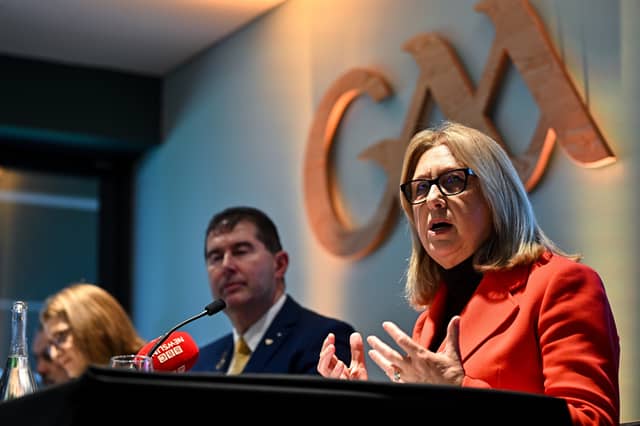

The integration of the three Gaelic games bodies seems to be hanging in the balance after former president Mary McAleese stepped down from her role as chair of the Integration Committee.
THE news came like a bombshell last Tuesday: Former President Mary McAleese stepped down from her role, and since then the whole country has been talking about it.
“They have blocked our progress. They have blocked our plan,” former President, McAleese said on RTÉ Radio Inside Sport, elaborating on her decision to leave her post at the head of the committee which is supposed to organise the amalgamation of the three bodies GAA, LGFA and Camogie Association.
McAleese continued: “And they have no other plan. I was shocked to hear, the current president of the GAA, Jarlath Burns, say that he really doesn’t support the idea, and that he would favour a federation. But federation wasn’t what we were asked four years ago to plan for. We were asked to deal with integration. It was a huge shock”
GAA director general Tom Ryan reacted to McAleese's allegations, and rejected any accusations of misogyny "in the strongest possible terms" after it was revealed the integration of Gaelic games' three bodies will not happen in 2027.
Ryan said a failure to reach agreement on "organisational structures" is the main reason behind the delay in the process.
It was news which shook the whole world of Gaelic games, and for a few days, the fact, that integration of the three sporting bodies might be hanging in the balance, has led to vivid debates. Mayo senior inter-county footballer, Carnacon stalwart Fiona McHale, has weighed in with her opinion on an eventful week.
“I was hugely deflated, when I heard Mary McAleese's interview,” McHale told The Mayo News: “I really believed that there was a commitment there from the three organisations from the outset back in 2022. I believed that this commitment would be followed through on. There had been rumblings, there was a lot of people that didn't believe it was going to happen based on the fact that the communication coming out of the group wasn't great, it was very vague and it was lacking at times.”
McHale was surprised to learn, that apparently finances have emerged as one of the main roadblocks on the road to integration. The Carnacon club woman states that there was some misinformed comments made regarding finances: “The kind of scaremongering figure that the expenses now are going to double and that the inter-county game is going to cost now 90 million, That's not true and it's disappointing that that came from somebody that was in the finance subcommittee.”
McHale stressed that everyone would have to remember how integration was mandated by the membership of the three organisations, GAA, LGFA and Camogie Association. It was voted in congress by over 90 per cent of all three combined.
“There were surveys done and the majority of people feel that this is a positive move for the overall Gaelic games family. So I believe that most people out there believe that it's important, they believe that it's the right thing to do,” she added.
Connacht GAA CEO John Prenty, himself a Ballyhaunis clubman, states that the whole amalgamation project is very complex. Bringing together three different organisations is a big task. Especially as there are a plethora of different club models, some genuine hurling or camogie clubs, some clubs do only either or, and have members on different committees, different responsibilities up to provincial and national level. Prenty feels, there should be a phased approach to integration:
“I would say that we need to amalgamate everybody at club level first. You cannot build a house without building the foundation. Not by trying to put the roof on without putting down the foundation. So we've got to build it from the bottom up. And that's one of the difficulties we've come across, because everybody wants to hold onto what they have when you move up the line.”
Prenty is pointing out logistical challenges, that would have to be addressed. For example simple board meetings would suddenly explode:
“Say they have 50 clubs and then maybe another 20 other people elected, that's 70 going to a County Board meeting. And you could add another 50 Ladies Football people and maybe 45 from the Camogie separate clubs all joined together. If everybody's of the same say, then you'd have 150 people at a meeting, which is impossible to have.”
The fact that 99% of the facilities of the association are owned by the GAA poses another problem, according to Prenty. He doesn't see a real issue with clubs that are already organised after the one club model:
“I don't see any major roles in the one club model clubs that the women aren't getting the same chance to be on the field as men. Where the big difficulty is, and something that you cannot expect, all of our GAA facilities were built in the days when there was only Gaelic football and hurling, so our facilities are designed to accommodate players playing these sports. The majority of our facilities do not have the toilets and showering facilities that are expected and required for ladies at this day and age. We don't have them. They're not designed for that purpose.”
The top GAA official does not believe, that a time line on integration would make sense.
Prenty wants 'the best organisation possible', and agrees, that a rushed and faulty amalgamation now, would spoil the idea for the future. He stresses the important role of women in the association already:
“If you look at the GAA, if you look at every club in Mayo, there's a huge amount of ladies involved in the administration of clubs, in the coaching of those clubs in Ladies Football, Gaelic football and hurling. The GAA is a community.”
When it comes to sharing facilities though, there are totally different stories out there. Some clubs implement an equal access policy, but some don't. And senior female players sometimes end up being treated like an after thought. The reason being: The GAA own the facilities.
Fiona McHale commented: “We have to remember that the only reason we as ladies footballers don't own the facilities is because when the GAA was founded, women and girls were not invited to be part of it. And we know of the amazing women over the years that have built the GAA, they have invested so much of their time, so much of their volunteership has gone into the GAA. We really need to have a hard look at ourselves.”