

NATURE: On seals, salmon and sustainability
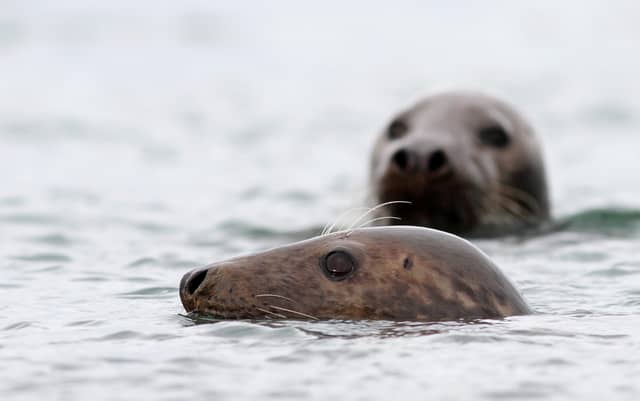

Amid talk of culling seals on the Moy, Michael Kingdon looks at the wider picture
FOR many in the Western world the final part of the 19th and early years of the 20th centuries had been prosperous and relatively peaceful, allowing many to indulge themselves with previously unattainable luxury goods. One material much in demand was seal skin, and so intent were the seal hunters on keeping the market satisfied that the grey seal, with which all coastal dwellers would have been acquainted, was hunted to the edge of extinction.
In response to public outcry the Grey Seals (Protection) Act of 1914 was passed and Halichoerus grypus (the hook-nosed sea pig), ‘rón glas’ in Irish, became the world’s first officially protected species.
More than a century later the population of grey seals is relatively stable, with between 8,000 and 10,000 around the coast of Ireland. In some coastal areas, such as the Blasket Islands off the coast of Kerry and Mayo’s own Iniskeas, there might at times be crowds many hundreds strong hauled out on the beaches, which must then resemble Keem Bay on a summer’s day. With the average weight of a mature male around 500 pounds (the equivalent of three well-fed sunbathing tourists) such colonies must be one of this country’s last remaining great natural wonders.
For the grey seal, this is pupping season. A walk around any remote rocky headland might reveal one or more white and fluffy grey seal pups apparently stranded and looking sorry for themselves. If the pups are alive they are likely not abandoned, no matter how appealing and forlorn those large, dark eyes seem, or how destitute the entire creature appears to be.
Their mothers know where their offspring are. Any attempt to approach a seal pup will likely drive it into the water. Until they are a month or even six weeks old these juveniles are unable to swim well and will surely perish if they are forced to try. So leave them alone. Give them a wide berth. Observe them from a distance, by all means, but please don’t harm them, for regardless of what some may say we actually need our seals.
I am saddened to hear the clamour for yet another seal cull, this time on the estuary of the world-renowned River Moy, where salmon numbers have been plummeting.
Make no mistake, the looming demise of the Atlantic salmon is one of Western Europe’s greatest ever environmental disasters. Anything that can be done to save this iconic fish from extinction should be welcomed.
In 2005, over 100,000 salmon were recorded as taken by drift nets off the Irish coast. The true figure is anyone’s guess.
On January 1, 2007, drift netting for salmon became illegal in this country. With so many extra fish getting into the rivers to spawn, our salmon would surely be saved! Not so. Despite the cessation of sea netting there has been no corresponding increase in fish numbers entering freshwater.
An anxious collective gaze has fallen on both the grey and the harbour seals that use sandy banks along the Moy estuary as haul-out sites. To witness these large, ungainly creatures packing together by the score is quite an experience, and to watch them bouncing seaward like so many giant rubber balls is nothing short of a spectacle. It is easy to forget that once in the water grey and harbour seals are highly efficient predators that eat nothing much but fish.
When it comes to a choice between flounder and wild salmon I think I know what most of us would choose. I’m sure the seals would make the same decision and dine on salmon every day of the week if possible.
Yet a recent study of seal diet revealed that while some salmon and sea trout were taken, by far the majority of food consumed consisted of flatfish, sand eels and small roundfish with little human economic value. Culling seals in the Moy estuary, or anywhere else for that matter, is not going to save our salmon. It is we who must change.
What might help is a more ethical approach to the fishing industry as a whole. Back in 2008 the World Wildlife Fund for Nature reported that a million tonnes of fish were being dumped in the North Sea alone, each year. Perhaps things have improved in that department, I don’t know. But in the world of super-trawlers there can be no winners.
We might look back a century with surprise at public appetite for seal skins and other unsustainable goods, but in reality we are no farther forward.
Michael Kingdon, a naturalist and keen fisherman, lives on the shores of Lough Carra, Co Mayo.