

NATURE: Must we badger our badgers?

LATE afternoon the sky was so clear as to be deep, offering a view of stars long before the onset of night. Even the lake caught their sparkle, while a cold, black line made a demarcation between their water-based reflection and the expanse which holds them.
The ground holds snipe, by the dozen. Last week I flushed the odd bird from the fen, sent them springing to air with fearful shrieks while a whirr of wings sent them this way and that in jinking flight.
In this cold they lie tight, being reluctant to move until a heavy step compels them. When one takes flight the rest are put on notice. I imagine them there, hunkered down on small, sedge-filled hummocks that rise above waterlogged ground, their legs elastic, compressed and ready to fling them skyward, across the bay and beyond.
It is only days now, before the first of the cock snipe begin their clever display in a trail of undescribed sound as they soar and dive their way to a new season. Those that moved here for the winter will soon return to their homes, leaving this wide lakeside fen to a sparse breeding population.
The birds are a distraction, for I came to find and feed the few badgers that still live locally.
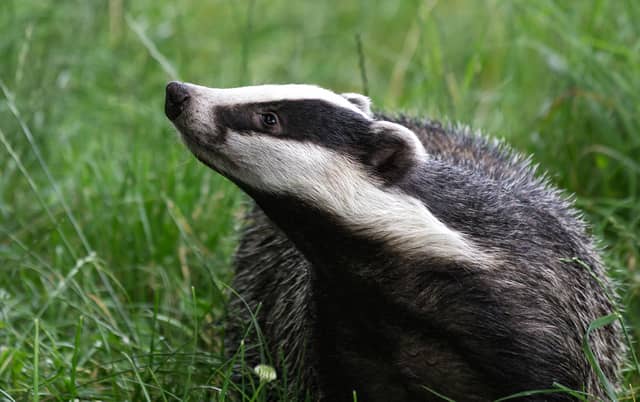
Despite bad press for so long, Old Broc can have no real complaints against his name. There is nothing sinister about him. He asks nothing more than quiet peace, a meadow wherein to hunt beetles and worms, a woodland retreat with a bank into which he may burrow and, I like to think, an occasional opportunity to show his smart dress and easy amble.
He fears nothing, apart from people almost all the time. And yet there have been moments spent in the close company of Broc without him being alarmed.
The best was soon after sunrise one summer morning in the south of England, long before most civilised folk would have thought about starting their day.
There was Brock (in England he is spelled with a K) happily meandering about his paddock, taking little heed of the cows that patiently waited their trip to the parlour. I fell in some eight or ten paces behind him and followed as he moved from grassy tussock to ageing cowpat, searching out earthworms, leatherjackets and the like.
More than once he raised his striped head to look back, showing elegance and grace most would never associate with his kind.
His long and grizzled coat is deceptive. We think his legs must be short, if barely there at all, and fail to grasp the enormous strength of those stout limbs. He appears myopic; in reality he sees very well. His ears are attuned to his environment, ready for the least alarm. And that nose that helps him find those mere worms that make his meal, it is more keen, more sharp than the mind of any man.
I had followed Brock so long as to make me late for morning milking. The moments that we shared stayed with me through the years, so that to this day I would be there again.
In this country, Broc has been persecuted far too long. Everywhere he goes there are eyes. He finds the most unwanted corner, where steep and rocky ground is out of bounds for cattle, and there sets his home.
Yet he is soon discovered, even there.
He limits his excursions to the hours between dusk and dawn, so as to cause no offence. His toilet is confined to a special latrine, outside of which nothing is soiled. He frequently changes his bed of ferns and dead grass, and leaves the old where not one could possibly mind.
Poor Broc has long been associated with Bovine tuberculosis, and as such has been the target of much wrath. Despite the most recent research absolving badgers of the spread of TB among cattle, men with dog and gun, with slick wire noose and camouflaged cage trap, remain unconvinced. There are few who tolerate badgers settling on their land, as if the land was really theirs at all.
Broc does have some friends. I think myself among them and leave peanuts where I know he goes, hoping that in the future either he or one of his will associate me with an easy meal. And then one moonlit night we shall meet, I on my rock and he shuffling at my feet.
Earned distrust keeps us apart. But it was he who brought me to the lake, who showed me snipe, who kept me patient through this winter dusk. Soon we shall have spring.