

MV Shingle artificial reef bringing new marine life and diving tourism to Mayo
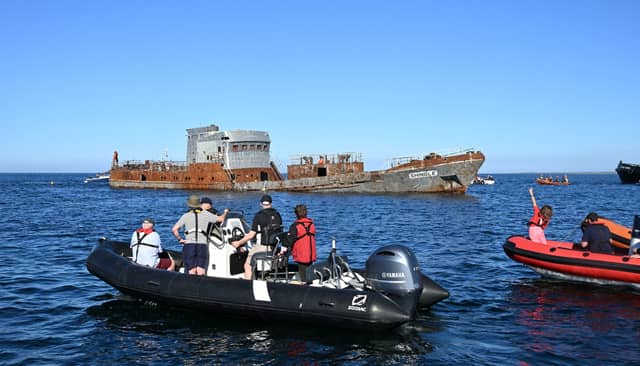

Two years after the former smuggling vessel was sunk off the North Mayo coast, marine life is beginning to colonise the wreck while diving tourism grows in the area
Two years after the MV Shingle was deliberately sunk in Killala Bay, the former smuggling vessel is beginning to fulfil its role as Ireland’s first artificial reef, attracting marine life and divers to the north Mayo coast.
The 60-metre steel-hulled ship now rests around 30 metres below the surface, approximately 4km offshore, where underwater footage has captured barnacles, sponges, sea squirts, worms and fish beginning to colonise the wreck.
The project was spearheaded by the Killala Bay Ships 2 Reef Group, with support from the Revenue Commissioners, Mayo County Council, Sligo County Council and other partners.
Cllr Michael Loftus, who was a driving force behind the initiative, said the project was achieving its original aims of improving diving opportunities while increasing biodiversity in Killala Bay.
He told The Mayo News lobsters, crabs and crayfish had been seen using the wreck as habitat, while fish life began appearing within weeks of the sinking.
“We've achieved a lot of our goals, and it's only getting better as the years go on,” he said.
The MV Shingle has a remarkable history. It was seized by the Revenue Commissioners in June 2014 after being intercepted near Drogheda with 32 million smuggled cigarettes and 4.5 tonnes of tobacco on board, with a potential loss of €14 million to the Exchequer.
Following court proceedings, the High Court ordered the forfeiture of the vessel to the State in 2017. It subsequently remained in Revenue custody for years before being donated to the Killala Bay Ships 2 Reef Group for the artificial reef project.
Before being sunk, the vessel underwent extensive preparation and cleaning to ensure it was suitable for use as an artificial reef. Cllr Loftus confirmed the ship had been cleaned to the required specifications to remove potential pollutants, while acknowledging the significant work and cost involved in preparing it.
“We actually were given the specific details that there were no pollutants on the ship, which would cause any problem in the community or the sea,” he said. “And that was done and done correctly.”
The wreck has also become a new attraction for divers. Cllr Loftus said a recent dive rally brought more than 220 divers to the area, with around 25 boats bringing visitors to the MV Shingle and other nearby dive sites.
He said the wider tourism impact was also becoming apparent, with divers and their families travelling to north Mayo and west Sligo.
“It is bringing tourists, diving tourism, to North Mayo and to West Sligo,” Cllr Loftus said. “We've estimated that even with just the 750 divers coming to the area—not counting their family members who come along—there is a conservative figure of over a thousand people a month coming to the area who wouldn't have come otherwise because of this.”
Looking ahead, he said he hoped the wreck would become increasingly covered in marine growth, including barnacles and sea anemones, with more fish using it as habitat.
He also believes the project could provide a model for further artificial reefs around Ireland, pointing to the potential benefits for biodiversity, diving and local economies.
“I firmly believe that instead of selling off military ships at a massive loss, we should look at sinking them as artificial reefs,” Cllr Loftus said. “It generates money for the local communities they are sunk in because it drives tourism. Artificial reefs have proved this around the world; for example, Malta has sunk about 14 ships to boost dive tourism, making a significant financial difference to the area. This is something that should absolutely be looked at around Ireland."
The MV Shingle project was first developed by Killala Bay Ships 2 Reef in 2008, with the group working for more than a decade to bring the plan to fruition.
“It took us 15 years to get this one thing, but in the end, it happened very quickly, because they wanted to get rid of that ship in Dublin,” Cllr Loftus explained.
Cllr Loftus concluded the long process had ultimately been worthwhile.
“It’s doing exactly what we asked for when creating our first artificial reef,” he said. “The more fish life will come in, the more marine life that you’ll have growing on the ship itself.”
The wreck is now expected to continue developing as an artificial reef over the coming decades, providing a new marine habitat while adding another attraction for visitors to the Mayo and Sligo coastline.