

What are the rules for dogs on Mayo’s Blue Flag beaches?

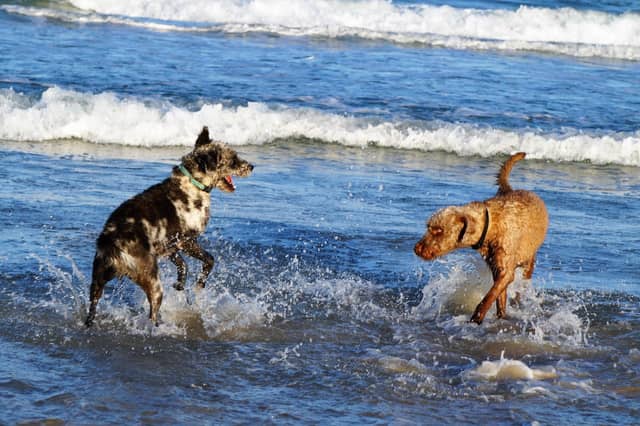

Mayo County Council is being urged to enforce no-dog zones on Blue Flag beaches to protect tourists and maintain the beaches' Blue Flag status
The importance of enforcing no-dog zones on Mayo's Blue Flag beaches this summer was raised by Westport councillor Peter Flynn at the most recent Environment and Climate Change Special Policy Committee meeting, amid concerns that many tourists remain unaware of the rules.
Cllr Flynn raised the issue at the recent council meeting, calling for effective implementation of bylaws around dogs on beaches and pointing to a lack of clear signage for visitors.
He has requested an update on the status of Blue Flag beaches, their management and the enforcement of bylaws at the next Environment and Climate Change SPC meeting.
Cllr Flynn also suggested that lifeguards should be given the authority to issue warnings to visitors who are unfamiliar with local rules, in order to help protect the beaches' Blue Flag status.
He noted that many tourists let their dogs off the lead, telling the meeting: "If we are putting in bylaws, then we should be implementing them."
Why the no-dog zones exist
Laura Mulligan, Dog Warden with Mayo County Council, explained that the no-dog zones on Blue Flag beaches are designed to give people who may be uneasy around dogs — such as young children, older people, or anyone with a fear of dogs — a space where they can relax without encountering animals.
The no-dog zone operates between the flags from 12pm to 6.30pm during the bathing season, which runs from the start of June to the end of August.
Tourists often unaware of the rules
According to Ms Mulligan, many of the difficulties arise because visitors travelling from towns and cities to rural beaches are simply not familiar with Blue Flag regulations, which don't apply on non-Blue Flag beaches.
"When we're in the area, we'll do spot checks," she said. If a dog is found in the restricted zone, wardens speak to the owner and ask them to move to the section of the beach where dogs are permitted.
To help address the awareness gap, new bilingual signage — in Irish and English, and "considerably bigger" than the current signs — is being installed at the entrances to Blue Flag beaches to clearly outline the no-dog zone rules.
Where lifeguards rather than wardens are present, Ms Mulligan said they take the same approach, having "a nice word" with dog owners and directing them to the appropriate area of the beach.
Ms Mulligan confirmed that where a dog is out of control in a public area, wardens can act under the Control of Dogs Act. "If you permit your dog to be out of control in a public area and it's not under effectual control, then yes, you can be issued an on-the-spot fine," she said, citing behaviour such as dogs running at people, jumping up, or stealing food as examples reported to the council over the years.
New environments
Reflecting on more than ten years in the role, Ms Mulligan said complaints about out-of-control dogs on beaches have fallen significantly since the no-dog zones were introduced on Blue Flag beaches, as they now give beachgoers who prefer not to be near dogs a dedicated space.
She stressed that dog owners are entitled to have their dogs off the lead once they remain under "effectual control" — meaning the dog returns immediately when called and does not become a nuisance to others. Most owners, she said, meet this standard.
Problems tend to arise, she explained, with owners who are new to a particular environment. A dog that behaves predictably at home or on a lead in town can become "overstimulated" by the unfamiliar sights, sounds and smells of a beach, and may not respond to commands it would normally obey. This is especially common among holidaymakers and newer dog owners visiting a beach for the first time with their pet.
Her advice to owners is straightforward: keep a dog on the lead until you are confident it will cope with the new environment and reliably come back when called. "It comes back to effectual control," she said, "and being aware that if your dog is out of control in this environment, then there are consequences."
Funded by the Local Democracy Reporting Scheme