

Mayo man wins prestigious international editorial award

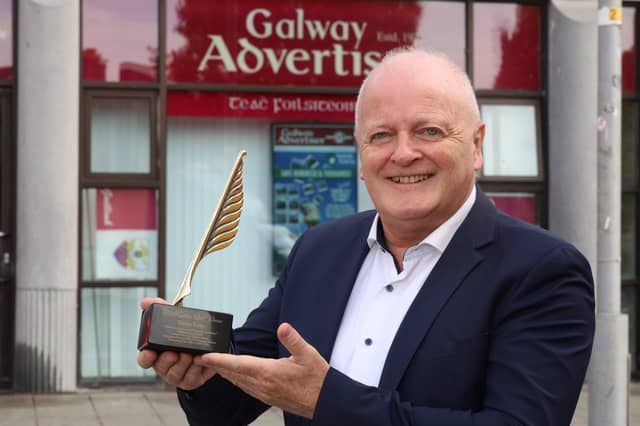

Ballinrobe native Declan Varley won the Golden Quill award for his editorial on the Tuam Mother and Baby Home
A Ballinrobe man has become the first newspaper editor from outside North America in roughly 70 years to win the Golden Quill, one of the most prestigious honours in weekly newspaper journalism.
Declan Varley, group editor of the Galway Advertiser, received the award from the International Society of Weekly Newspaper Editors (ISWNE) at the organisation's annual gala in Wales on July 18.
The Golden Quill is the top prize in the society's Golden Dozen competition, which recognises the year's twelve leading editorials each year. Varley, a five-time Golden Dozen winner, took the top honour for a piece he wrote on the Tuam Mother and Baby Home, in which he urged readers to look past the raw statistics of the case and focus instead on the dignity of those who died.
"It's great, and I think it's good for Irish newspapers to highlight just to the world our quality editorial is up there with the best," Varley said of the win.
Humanity
Varley said the editorial was written to remind readers that the 796 unrecorded deaths uncovered by historian Catherine Corless were not simply a number, but hundreds of individual lives.
"It's often easy just to go for the numbers and say, isn't it shocking?" he said. "But you have to look at the humanity behind it as well, and all the families that are affected. There are still a lot of families who had siblings in the homes, and there are people alive who had babies in the homes taken from them, or babies who died. So it's very raw for all those people."
READ NEXT: Mother of boys murdered in Mayo shares details of deaths 13 years on as father seeks parole
He said the story carried particular weight for the west of Ireland, as many of the children who passed through the Tuam home came from Mayo, Galway and Roscommon.
"Because of that, we have a greater responsibility to be the ones who can stand up and say this is right or this is wrong," he said. "People will look to us — if the Mayo News are saying it, then it carries greater weight. That's part of the privilege of being a journalist: you get to ask the questions, but you have to put your head above the parapet now and again and call out what's right and wrong."
Varley noted that his newspaper, along with others, published the names of the children who died at the home when the story first broke.
"They're all the old names — Johns and Marys and Nellies and Peggys and Sallys," he said. "If they'd gone on to live full lives, they would have grown up in Westport, Ballinrobe, Castlebar or Tuam and contributed to their communities. Unfortunately, they didn't get that chance."
Eavesdropping in Ballinrobe
Varley's path into journalism began as a teenager in Ballinrobe, where he and friends including Liam Horan and Elizabeth McConnell launched a homemade magazine called the Eavesdropper, printing roughly 500 copies every two weeks and selling them outside the church.
READ INTERVIEW: Oisín Mullin on return dream and cheering on Mayo from afar
"We were ahead of our time in one sense — we were serialising books, without getting the copyright, and carrying local news," he recalled. "This was before the internet, and it was very popular because it was a local publication. We bought a photocopier and hawked it around from house to house. It was great, and it kind of set us all on our way to journalism."
Now marking 26 years editing the Galway Advertiser, Varley said that although the tools of the trade have transformed many times over, the essentials of the job haven't changed.
"That has always been the way since man scraped drawings on cave walls," he said. "The story has been at the centre of everything. The technology has changed — from printing press to broadcasting to television to radio to internet, to AI — and it will keep changing. But the one constant is that a story needs to be at the heart of it all."