

The sneaky trip to a Mayo island to lift an ancient stone and end 60-year gap


Mayo man visits Inishturk where stone is lifted for the first time in nearly sixty years
It started with a text. “Inishturk tomorrow?”
The spontaneous trip to Clew Bay would see two friends achieve something that no one else had done in almost sixty years.
Kilmaine man Tiernan Canney received the text and was pessimistic about lifting it as the stone didn’t have great “handles”, which makes it harder to grip it.
“At 207kg, I thought I needed perfect handles to break it off the ground,” Tiernan tells The Mayo News.
His co-conspirator Andy Downes was more optimistic, but admits that prior to going out to Inishturk, he and Tiernan didn't know if lifting the stone was even possible.
With these stones, he explains, it's often not about the weight but the shape and grip - and this particular stone, at 207 kg, offered 'disastrous' grip, with very little to hold onto.
Still, the stone had been on his mind for about two years, ever since David Keoghan's documentary showed him struggling to lift it on a visit to Inishturk. Looking back at that YouTube video, Downes noticed a local - possibly the last man to have lifted it - showing David a certain technique, and even though David couldn't get it up that day, Downes felt he had a good idea of where the decent grips were just from watching the footage.
So, with less than twenty-four hours' notice, he and Tiernan planned a spontaneous trip out to the island.
The two friends arrived on Inishturk on that fateful Thursday and were walking over to the stone when it started raining.
Tiernan recalls saying: “Well that’s it, we’re f**ked now.”
‘Absolutely beserk’
Fortunately, the rain abated and this was crucial as rain ruins the chalk used in stone lifting.
Once there, Downes tried the grip he'd spotted but couldn't get the stone up after a couple of attempts.
Having felt the handles and cleaning the stone, Tiernan crouched down and tried to lift it.
“First attempt, I drove at it and it came up and I went absolutely berserk", Tiernan laughs.
Such was the excitement that people in the nearby shop came out to see what the commotion was, with one lady immediately realising that someone had finally lifted the stone after all these years.
Being from Mayo made the lift “that bit more special.”
Reflecting on the sixty year gap between someone lifting the stone, he says that “it’s great to be that next link in the chain, and now people from Inish Turk have actually seen someone lift it. I'm sure not many locals have seen it being lifted because there's not many alive that would have been of age to see it being lifted 60 years ago, or they've emigrated or whatever.”
Islander Tony O’Toole was the last man to lift the stone before Tiernan and jokingly notes that the stone is now easier to lift as it's dry, unlike when he lifted it in a muddy field.
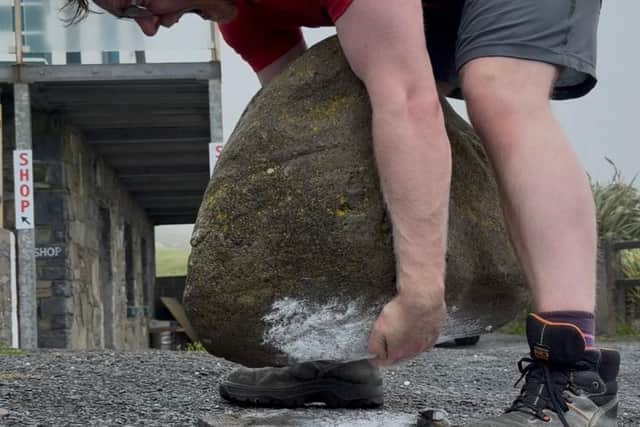
After Tiernan's success, Downes gave it another three or four attempts himself and finally got it off the ground, if only by an inch or two, though he notes that even that counts as a valid lift.
Beyond the stone itself, Downes speaks of Inishturk as a fantastic, stunning, and magical place, and hopes that with interest in stone lifting growing internationally - with people traveling from America, Scotland, and Iceland to lift stones around Ireland - his and Tiernan's trip might draw more attention to the island, which he feels deserves far more recognition.
Indiana Stones
Their shared passion in the ancient tradition of stone lifting was ignited by hearing the same interview with David Keohan, aka Indiana Stones, on the Blindboy podcast.
Tiernan had seen Indiana Stone lifting before but it was only when he saw that two of the lifting stones were in Mayo that his interest was sparked as it combined his weight lifting with local history.
It was at a public stone lifting tour, organised by David Keohan, that Tiernan and Andy met and their friendship was forged.
“The two of us kind of have it in our heads where we want to lift every historic lifting stone in the country and we're fairly we're closing in on it now”, Andy tells The Mayo News.
They have travelled the country to lift stones and have lifted forty three of the forty nine stones so far.
The wider revitalisation in interest in ancient Irish culture was on full show at the inaugural Dagda Games at Claregalway Castle, which named after Dagda is the great chief god, father-figure, and master of druidry in Irish Mythology, serving as leader of the supernatural Tuatha Dé Danann.
Tiernan won the stone lifting competition and he explains that “there were all different sorts of old Irish sports, like collar and elbow wrestling. There was an Irish stick fighting demonstration, and then they had strongman, which is the sport I primarily compete in, and they had arm wrestling and grip lifting, and then they had kind of music and Céilí dancing and all that sort of stuff.”
Discovering more stones
Andy says that he was so fascinated with the stone lifting tradition that he started doing his own research using the national folklore collection and has rediscovered three ancient lifting stones himself.
He explains that the best resource available for this research is actually the National Folklore Collection, gathered from school kids in the 1930s. As part of their curriculum, children were sent home to ask their parents and grandparents about folklore stories, traditions, and local heroes, and it was often in the local heroes section that they described great stone lifters - a tradition Downes believes was born out of cultural boredom, since these gatherings would have taken place wherever people naturally met, be it a crossroads, a graveyard, a churchyard, or outside a pub. He estimates that at least 60 to 70 percent of the stones rediscovered so far have come from these school records in the Dúchas archives, and purely by luck, many of the children went into remarkable detail, noting the weight of a stone or giving a full description of it.
Unfortunately, other entries are frustratingly vague, simply stating that so-and-so lifted a stone at a crossroads without specifying which crossroads or describing the stone at all - meaning there could be many more stones out there still waiting to be rediscovered. Downes considers himself lucky that, for the few stones he has managed to track down, the school kids of the 1930s happened to record such detail. One standout example is the Denn flagstone in County Cavan, which has a fascinating history: it was once a cursing stone in pre-Christian times before being adopted into the church, as so many old pagan traditions were, with a Celtic cross carved into its face - likely to rid it of the curse - after which it was used as an altar stone in the church.