

The end of an era: Westport's historic post office prepares to move on

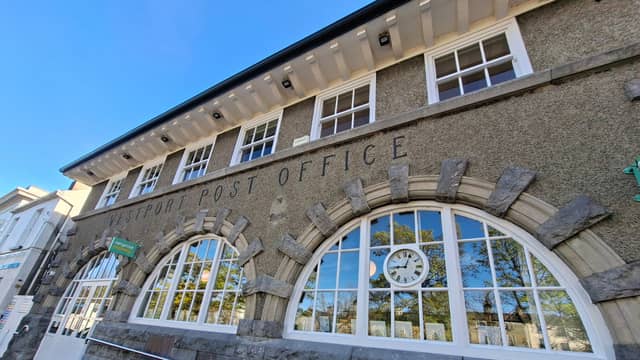

First opened in 1901, the post office reflected the changing ways of communicating from its days as a telephone exchange to now handling DHL parcels
For 125 years, the elegant limestone facade of Westport's post office has stood as one of the most recognisable landmarks on the North Mall. Its three sweeping semi-circular arches ― a nod to the arched market houses that line the Mall ― have watched over generations of Westport life: the anxious dispatch of Christmas parcels to Bradford and Leeds, the crackle of telephone exchanges, the quiet dignity of pensioners collecting their first old age payments. Now, after more than a century of service, the building's time as a post office is drawing to a close.
An Post has confirmed that postal services will relocate to a new, modern facility within the local SuperValu, bringing to an end one of the most storied chapters in the town's commercial and social history.
A building born of ambition
The post office on North Mall was built in 1899, at a moment when Ireland's larger towns were beginning to take civic pride seriously enough to commission purpose-built public buildings. It was designed by John Howard Pentland, Senior Surveyor and later one of the three Principal Surveyors of the Architectural Department of the Board of Works ― a man whose fingerprints are on some of the finest institutional architecture of the late Victorian era in the west of Ireland. He also designed the post office in Castlebar around the same period.
Pentland's love of classical architecture is unmistakable in the Westport building. The well-proportioned arcade across its facade, with three generous semi-circular arches, deliberately echoes the arched market houses for which Westport is already celebrated ― but rendered on a grander, more assertive scale.

You got mail - Westport love stories
To understand what this building meant to Westport is to understand what post offices meant to rural Ireland. In 1908, when the old age pension was introduced, it was paid through post offices ― making them, for many people, the most important institution in their daily lives. From 1912, they also took over responsibility for telegraph and telephone services, cementing their role as the communications nerve centre of every town and village. By the 1950s, telephone kiosks had appeared outside post offices across the country, bringing public telephones to communities that had never had them before.
In Westport, the telephone exchange hummed with particular intensity. Richard Joyce, a former postmaster who served at the office, recalled that at its peak the building employed around 40 telephonists working the exchange ― a remarkable figure for a town of Westport's size, and a testament to the postal service's central role in connecting the west of Ireland to the wider world. The telephonists remained until around 1978, when the main exchange relocated to Castlebar.
Among the many memories that the announced move brought back was that of two sisters, working as telephonists, who would ultimately find their future husbands through the post office.
John Moran recalls that both his mother Mary Keirns and aunt Helen met their husbands while working at the post office.
Brendan Moran was working as a post office clerk in the Westport post office when he and Mary fell in love. While Helen’s love story is something straight out of a movie, her relationship with future husband Chris started over the phone, as they were connecting calls from various places, before as John explains that their “love blossomed”.
But it is Joyce's memories of Christmas that paint the most vivid picture of what the old post office was really like at full stretch. Speaking to Westport YouTuber Oliver Whyte in 2015, he recalled the weeks before and after Christmas as nothing short of extraordinary: “Christmas was bedlam. It was what we used to call organised confusion.” Dispatches went out to Leeds, Bradford, Halifax, and multiple London postal districts. The parcels, he remembered, were largely boxes of biscuits ― and turkeys and geese, often unboxed, traveling with nothing more than a label tied around their necks and sometimes, if they were lucky, a canvas bag.
The logistics of the undelivered birds were, by Joyce's account, grimly memorable. Returned after Christmas in varying states of decomposition, some had to be disposed of entirely. At peak times, as many as 400 bags of mail left Westport in the three weeks before Christmas alone.
A stamp of approval
By 1990, the building's place in Irish cultural life was recognised in a way few post offices ever achieve: An Post issued a specially designed postage stamp featuring a drawing of the Westport post office reflected in the river beside it. It was a moment of institutional pride, an acknowledgement that the building was something more than functional.
But the decades that followed brought quiet, incremental change. In 2018, the delivery operation moved out entirely, relocating to a Delivery Service Unit at Westport Industrial Estate. The separation of retail and delivery services ― a shift that reshaped post offices across Ireland ― stripped away much of the behind-the-scenes activity that had once made the building so alive.