

There’s more to St Brigid’s Day than you might think

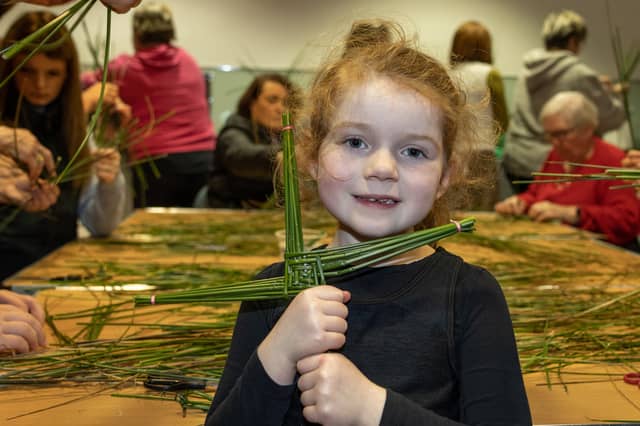

2024 marks the 1,500th anniversary of the death of St Brigid
THIS Thursday is St Brigid’s Day, and like the older Celtic festival Imbolc, it is an import seasonal marker in folk tradition, signifying the start of spring, new life, fertility and growth.
Dedicated to Ireland’s only female patron saint, Lá Fhéile Bríde or St Brigid’s Day is associated with many traditions, including the crafting of St Brigid’s crosses.
Clodagh Doyle, keeper of the Irish folklore collection at the National Museum of Ireland – Country Life in Turlough, explains the origin of this well-known custom: “There is a myth that St Brigid used two pieces of rushes and twisted them into a cross to convert a pagan on his deathbed.”
While the making of St Brigid’s crosses remains a very strong tradition to this day, many might not be aware of the variety of cross forms that exist across country. Often many styles were made in each home, while traditional designs were diamond, interlaced or wheel-shaped, and could have two, three or four arms.
“So many people think that the four-armed cross, which is one of the simple ones to make, is the original Brigid’s cross, but there is no original Brigid’s cross. That four-armed cross was made really popular when RTÉ started as a television station (in the 1960s) and they used it as a symbol for the new station,” Doyle says.
Other classic traditions around St Brigid’s Day include having a festive meal together, but all would take place on the eve of the celebration.
“For St Brigid’s Day, it is a bit like Halloween. All the traditions happen on the evening before. So January 31 would be when we make our crosses, have a meal, and the Biddy Boys would go around dressed in straw and they would collect money for St Brigid. You would bless your crosses with holy water at home as well.”
This year marks the 1,500th anniversary of St Brigid’s death, and to celebrate the occasion, the Museum of Country Life held cross-making workshops last weekend. The museum also has an ongoing exhibit that explores St Brigid’s Day customs, including a temporary display of St Brigid’s crosses that shows how their styles and materials varied throughout Ireland.