

RTÉ's Teresa Mannion on Mayo, retirement and a life spent telling stories from the west


Two decades on the regional beat means two decades of other people's worst days, and Mannion doesn't shy away from how much of that weighs on a reporter long after the cameras stop rolling.
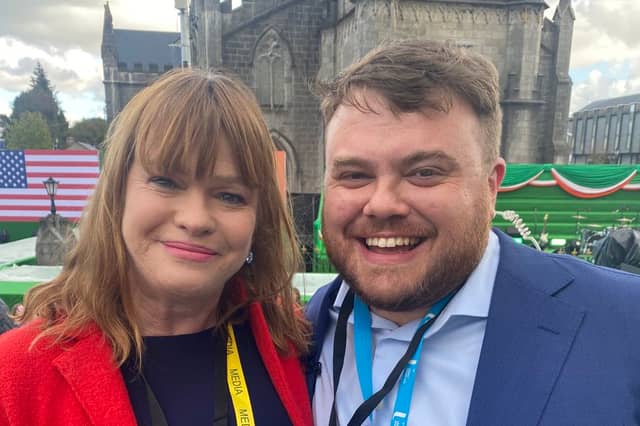
After nearly two decades as RTÉ's regional reporter for the west, Teresa Mannion is preparing to step away from the road she has travelled for so long — and it's Mayo, more than anywhere, that has shaped her final reflections on the job.
Mannion turns 65 in September, but “I will probably be gone around the middle of August,” she tells The Mayo News, adding “so it's sort of formally officially signing off in September.”
Mannion was appointed RTÉ's regional reporter for the west in 2007, and in the years since she has covered Galway, Mayo and beyond in equal measure. But it's Mayo that holds a particularly deep pull for her — in childhood summers spent on a relative's farm.
Her uncle, former councillor Jimmy Mannion, farmed in Mayo, and as a child Mannion and her siblings would take the train from Dublin to Claremorris to visit family. She remembers believing she was making herself useful.
“I used to think I was actually helping save the hay,” she says, “and cut turf and milk cows, but I was a hindrance — I think the Dubs were always a hindrance!”
That early affection followed her into her working life. “I actually found myself in Mayo as much as Galway,” she reflects, “and I'm very fond of Mayo.”
Two decades on the regional beat means two decades of other people's worst days, and Mannion doesn't shy away from how much of that weighs on a reporter long after the cameras stop rolling.
She recalls the deaths of university students from NUI Galway who were killed in a car crash close to Ballindine, in atrocious weather. Four died at the scene; a fifth survived with life-altering injuries. The stretch of road, she says, is now well lit and signposted after years of campaigning, and a small memorial garden at the university keeps their names close by. “There's a little memorial garden in the university,” she says, “and I sometimes just stop and see their names on little bricks in this flower garden — and they were all in and around 21 years of age.”
Human stories
Mayo's own tragedies are never far from her mind either, chief among them the Rescue 116 helicopter disaster off Blacksod. She has stayed in touch with some of the families involved, who she says still return to Blacksod for private moments of remembrance.
It's the human cost behind breaking news that Mannion says only really lands once the day's work is done. In the moment, she explains, the job is about logistics — getting to the scene, gathering footage, confirming names, making deadlines. “It's only when you actually drive home later,” she says, “that you think, oh my god — have I just seen what these people that are speaking to you, and they're numb.”
No conversation with Mannion is complete without mention of the moment that turned her into a household name well beyond broadcasting circles — her 2017 live report on Storm Desmond, in which she urged people to avoid “unnecessary journeys.” The phrase became an instant, and enduring, piece of Irish popular culture.
“The 'unnecessary journeys' quote is with me for life," she says now. “Hardly a day goes by that someone doesn't say it to me. It's the gift that keeps giving. And now it's almost a cultural reference point.”
READ NEXT: Weather warnings demand decisive action
That same year, Mannion swapped the newsroom for the ballroom, taking part in RTÉ's Dancing with the Stars — a rare turn in front of the cameras rather than behind the microphone.
‘I felt privileged’
For all the heartbreak she has documented, Mannion is emphatic that the job has brought her enormous fulfilment too. Regional reporting, she says, is built on trust — on people opening their front rooms and their lives to a reporter with a microphone.
“It's been a lot of fun as well,” she says. “There's been a lot of great stories. I felt privileged, actually, to be out and about, meeting people all the time, sitting in people's front rooms, telling me their most personal stories — or just wonderful campaigners, people who do stuff for their communities. You either like the road or you don't, you know. And I definitely like the road.”
She points to one of her most recent assignments as a perfect distillation of what she'll miss: a day spent in a Galway bog during a heatwave with two elderly turf-cutters, Packy and John, aged 85 and 86. Mannion found herself marvelling at their stamina and their lifelong connection to the land. “They've been doing it since they were 14,” she says, “and I just thought, God, this is actually a moment in time that I won't see again.” The resulting piece became one of the most-read stories on the RTÉ website that day.
As her departure approaches, Mannion speaks with gratitude for a career spent documenting the small and large moments of life in the west — the tragedies that never fully leave her, and the quieter, joyful encounters with campaigners, farmers and communities that reminded her why she chose the road in the first place.