

Success story

County View It’s over 20 years since I got to first know John Concannon, a farmer-turned-potential-inventor from Kilconly.
When they say it can’t be done
County View
John Healy
IT’S over 20 years since I first got to know John Concannon, a farmer-turned-potential-inventor from Kilconly, outside Tuam. He used to call to my workplace with some new, sure-fire invention designed to make road maintenance easier, cheaper and more efficient.
He was a regular type of guy then, and I’m sure he’s the same now. Likeable, down-to-earth, no pretensions, salt of the earth. Not taking himself too seriously, but seriously enough for me to sense that here was a man who one day would hit the jackpot.
That was then. Today, his company, JFC, has its headquarters in Tuam, three plants in the UK, a distribution office in Holland and a full manufacturing plant in Poland. John Concannon employs 300 people, and his annual turnover is €45 million. And he hasn’t changed a bit.
It had all started with the lucky break on the Late Late Show in the mid 80s, when Gay Byrne was giving time and publicity to new inventors. True to his farming roots, John Concannon had come up with a practical solution to a very definite problem if you happened to be a small farmer – how do you bucket feed six hungry calves, all at the same time and all in one go, without a lot of difficulty. Concannon’s solution, in the best ‘eureka!’ tradition, was blindingly simple: You make a contraption where three buckets are joined together with a plastic holder and, using two of them, you feed six calves at the same time.
Whether it was the novelty of the invention or the sheer good humoured enthusiasm of John Concannon, Gay Byrne really enjoyed this quaint piece of rural life come to the RTÉ studio. By the time the slot was over, Concannon had made his pitch, Gay had a hugely entertaining interview out on air and the farmers of Ireland had a man whose bright ideas would make a name for himself in the years ahead.
John Concannon’s lack of pretensions comes through in his telling of how, as his business developed, he went in search of a plastic moulding machine to boost production. His search brought him to Scotland, where a company called McAlpines was disposing of exactly the kind of machine he needed.
“Write us a letter of offer,” they told him. But the Tuam man, in his own words, didn’t know how to write a letter of offer.
“So I went down to Easons, and I bought this book called ‘How to Write a Business Letter’,” he says. “Lo and behold inside was a sample letter of offer for a sewing machine. I just changed the words ‘sewing machine’ for ‘rotation machine’, offered £4,000 and sent it off – with a closing line that this offer would run out on the 15th of the following month.”
He bought the machine, went into production, and never looked back.
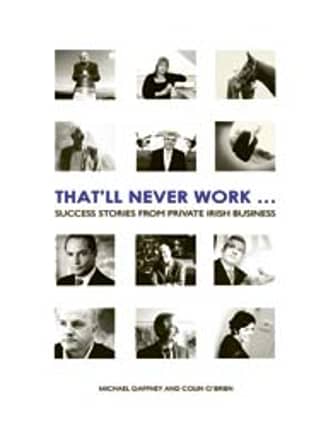
The story of John Concannon’s success is one of 12 stories in a new book called ‘That’ll Never Work – Success Stories from Private Irish Business.’
Written by Michael Gaffney and Colin O’Brien and published by KPMG, it is an engaging retelling of the personal stories of innovation, risk taking, perseverance, disappointment and ultimate success for 12 extraordinary Irish people.
The stories provide a really valuable insight into the world of entrepreneurship – what worked, what didn’t, the heartbreak, frustrations, setbacks and achievements of those driven to succeed and never contemplating failure.
‘That’ll Never Work’ brings John Concannon into the company of business luminaries as Padraic O’Ceidigh (Aer Arann), Richard Barrett (Treasury Holdings) and Ivan Yates (Celtic Bookmakers). The book can be read as a compliment to people who had an idea, or several ideas, and who just persevered and persevered until eventually they reached the finishing line.
In John Concannon’s case, it came from knocking time after time on the door of the Late Late Show research department; calling in with an (unwanted) gift of three plastic feeding buckets every time he was in Dublin; and seizing the opportunity when it finally came his way.
‘That’ll Never Work’ should be required reading for every entrepreneur looking for a break, for every school leaver with an eye to initiative and innovation and for every business course in every college across the land.
Breaking boundaries north and south
Another breakthrough in the warming of relationships between this island’s north and south has been achieved by the ‘Dissolving Boundaries’ project undertaken by two primary schools.
St Patrick’s NS in Castlebar has teamed up with Omagh County Primary School for the project, which is aimed at creating links between schools at all levels – primary, secondary and special-needs schools.
A November visit from the pupils of Omagh was followed by a return trip north to Tyrone by the Castlebar boys. Both were, by all accounts, positive opening experiences for the two sets of schoolchildren, with tours of the respective schools supplemented by visits to local attractions.
In the case of the Castlebar boys, it was a visit to the highly praised Ulster American Folk Park that left a deep impression. The museum tells the story of emigration from Ulster to America in the 18th and 19th centuries. The pupils were introduced to an 18th-century school, a tenant’s cottage, a landlord’s house, a weaver’s cottage, a printing shop and a forge. At each house, costumed guides took on the various roles of the people who lived there and told the children what life was like for them back then.
Later came a visit to the dockyard to explore an 18th century sailboat before it set out on its voyage westwards to the Americas. The pupils then got to visit a reproduction of a typical American destination for the emigrants, including a farmhouse, log cabins and the local provisions store, which was the centre of community and social life in those early days when roots were being put down.
And while the St Patrick’s boys were fascinated by what they were shown on their visit, the sense of discovery worked both ways. The Omagh youngsters were equally impressed by what they found at the Museum of Country Life in Turlough, not least the similiarities that they saw between turn of the century rural life in Mayo and the folklore of their own County Tyrone.
Walking for hospice
A WORD of reminder that this coming Sunday sees the annual Walk of Remembrance in support of the excellent Mayo/Roscommon Hospice.
Starting from the Supervalu car park in Castlebar, the 10k walk attracts hundreds of participants each year. There is a €10 entrance fee, while sponsorship cards are available from the Hospice Office at 094 9388666.
The Walk of Remembrance is organised by the tireless Frankie Forde-Waldron, and will be a prelude to the Cape Cod Walk, also in aid of hospice, and which celebrates its tenth year in this coming month.
You are invited to come along on Sunday at 2pm to show your support for Mayo/Roscommon Hospice. The Walk of Remembrance is willingly supported by Supervalu in Castlebar, whose co-operation deserves to be acknowledged. The store will provide tea and refreshments to all those taking part.
A return for the bittern?
He shall not hear the bittern cry
In the wild sky, where he is lain
Nor voices of the sweeter birds
Above the wailing of the rain
FRANCIS Ledwidge’s lament for Thomas McDonagh, famous in the annals of Irish poetry, paid tribute to one of our native wild birds when, even then, the species was nearing extinction.
A century earlier, as generations of school children will remember, the poet Cathal Buí Mac Giolla Ghunna was moved to words of requiem over the dead bird he came across on a woodland path:
A bhonnáin bhuí ‘s é mo léan do luí
‘S do chnámha sínte tar éis do ghrinn
The last-known yellow bittern in Mayo was shot at Turlough in 1890 probably in the grounds of the Fitzgerald estate. It is now preserved in its glass case at Turlough Park House.
With the news that the yellow bittern has been reintroduced in England, where it can be seen at Rodipole lake in Dorset, a group of local wildlife enthusiasts are asking whether the reintroduction of the yellow bittern of Mayo might not be appropriate.
The success of the reintroduction of extinct bird species in various parts of Ireland lends weight to that proposal. The Golden Eagle has recently been brought back to its old habitat at Glenbeigh National Park. Another eagle species has taken up residence after a gap of over a century at Killarney National Park.
The case for Turlough Park as the habitat of the yellow bittern is a strong one. Apart from its glass-cased reminder of the beautiful bird, Turlough with is lake and parkland has a large population of bird life, with swans, herons, moor hens and ducks having made the grounds their home.
The Irish Wildlife Service should consider taking the lead now, and bring the yellow bittern back to Mayo.