

FITNESS The importance of stability training
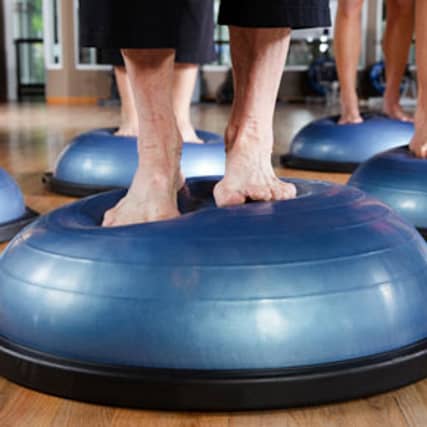

Personal trainer Paul O’Brien looks at stability training, which works the whole body, especially the core muscles
Everything hangs in the balance
Paul O'Brien
Stability training
Stability training – which, paradoxically, involves training on unstable surfaces – is an important component of an exercise program, working the whole body, especially the all-important core muscles.
Stability and the core
The core muscles play a vital role in almost every kind of exercise, but more importantly they are also key to efficient daily functional performance. Of course you don’t think about the work your core is doing when you’re lifting that box, pushing that trolley or maybe even making that crunching rugby tackle. Yet a trained mid-section will make these and many other tasks safer, more efficient and, perhaps, even enjoyable.
The core muscles of the abdomen and lower back help to hold your body in the correct position when performing a multitude of tasks. They also improve the efficiency of energy transfer between your lower and upper body, resulting in more power to perform daily manual tasks and complex lifts in your training, such as squats and power lifts.
Stability and whole-body training
Another application of stability training is in injury rehabilitation, where low-level stability work can help strengthen the integrity of an ankle or knee-joint for example. Training on unstable surfaces will also make your muscles work harder to stabilise your body while performing an exercise, leading to a higher work rate.
The real win with stability training is that it gives you the functional strength that you won’t get from training on any machine. When you are lifting a weight in the real world, or charging into that tackle, you won’t have the platform of a fixed machine to support you. Nor will your body move in a single plain of motion as it will do with most machines. Stability training trains the body to work as a whole unit, which is, after all, how we are designed to work.
What’s involved?
Stability training is carried out on an unstable surface, such as a stability ball, medicine ball or stability board. Ask at your local gym for some basic exercises to get you going or consult a personal trainer for a detailed and progressive program, just be clear about what you want your stability training to achieve for you. Do you want to improve your daily functional capacity or make your job easier, or are you training for a sport? Once this is estalished, a good trainer will show you the way.
Next Week Debunking some fitness myths
Exercise of the week
The oblique plank
A great exercise to work your torso and increase the muscular endurance of the core. To make this a stability exercise, progress to leaning on a stability ball.
- Start lying on one side. Support your body weight on your elbow and the side of your foot
- Ensure your body forms a straight line from head to foot.
- Hold for 20 to 30 seconds and switch sides.
- Do three reps each side.
Paul O’Brien is a certified personal trainer with the American Council on Exercise and a qualified life coach. He runs his own business in Westport and is the creator of Bootcamp West, an exciting and challenging exercise programme in Westport. For details of upcoming classes, visit www.bootcampwest.com or e-mail [email protected] or telephone 086 1674515.