

Panti Bliss to perform her famous show in Westport for Mayo Pride
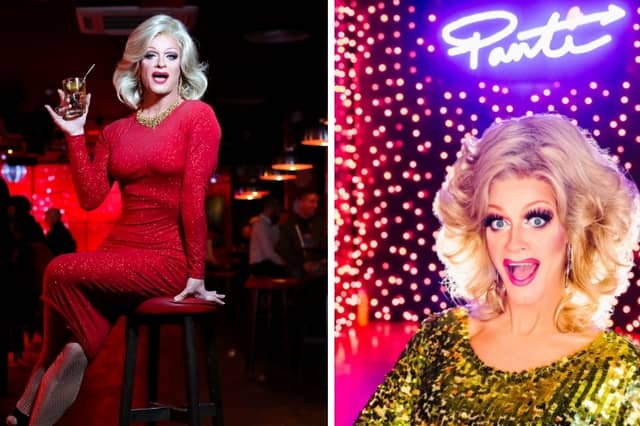

Panti Bliss will hit the stage to perform ‘If these wigs could talk’ in Westport to kick-off Mayo Pride bringing her long-running show to an end
The show called ‘If these wigs could talk’, has been running for a while, and actually, Rory O’Neill, known as Panti Bliss, had already toyed with the idea of putting it to bed and write a new one, as he admits, speaking to The Mayo News.
Someone from the Mayo Pride committee got on to him because this particular show ends with an incident that happened at a Mayo Pride event a few years ago.
“So he thought it would be fun to have the show in Westport and I thought, well, that would be a fitting end to touring this show,” O’Neill explained.
Especially as it hasn’t been brought to an audience in the West, yet. So he thought, it could be fun doing it in Mayo. It’s where O’Neill is from after all, from Ballinrobe to be precise.
And the show is rooted in his own family history and his own relationship with growing up in Mayo.
“The show is partly about getting older. It’s partly about my dad who passed away just over a year ago. I wrote the show four years ago when he was still with us, but wasn’s also about where I’ve come from and where I ended up and how those things happen through a confluence of your own decisions, but also sort of accidents and accidents of birth and all of that.”
O’Neill says it’s specifically about growing old in Ireland. He is 57 now, so he grew up in the 1970s and 80s. A didferent place from what the country is now.
Back then, he “definitely felt like a square peg in a round hole. Like a lot of young people, I thought Ireland was very small. And at the time I thought it was very backward and I wanted to get out.”
He remembers, the only foreigners he was seeing when he was a kid were French, German and Dutch tourists, that was as exotic as it got in Ballinrobe in the 1970s.
“And they came over because they thought it was all very clean and backward, and they liked it, but I hated it.”
By his own accounts, Rory ran out of Ireland as soon as he could. When he left the country after college, homosexuality was a criminal offence still in this country. So when he was a college student, he spent every weekend going out trying to break the law.
But that had all changed by the time he returned in the mid 1990s. He described it a very exciting time to be in Ireland. Rory often thinks about the way that Ireland changed very much like the way Ballinrobe and County Mayo got a modern telephone exchange.
“When I was a kid, in order to use the telephone in Ballinrobe, we had to pick up the handle and then we had to crank a small other handle, turn it. And it would then ring Anne down in the little telephone exchange. And then Anne would answer your cranking and you’d say, ‘Anne, can I speak to the O’Connors?’ And then a few years later, we got new telephones where we didn’t have to crank the handle. You just picked up the handle and it automatically called Anne down in the telephone exchange.”
Rory states, it was then very excited going to visit his grandmother in Dublin because she had an old rotary phone where he could dial the number with his finger. He thought that was very modern.
“But then when digital telephone exchanges arrived, modern telephone exchanges, Ballinrobe was one of the first places in the whole country to get one because ours was so far in the past that we were chosen first to kind of be given the modern push button digital telephone exchange.”
So progress leapfrogged the whole middle section. Things changed quite dramatically in a short period of time, in Ireland as a whole.
LEAVING AND RETURNING
But as Rory left the country after college, he would not experience the whole change himself. He went on a long journey.
It was 1990, and he had read a book by travel writer Paul Theroux about train journeys in China. So he decided to go even a little further: A train journey to Japan. Obviously, some boats involved, but he crossed Europe and Asia via train.
It was pre-internet days. The journey took about eight months, because Rory had to get across the Soviet Union on board the Trans-Siberian Express.
I mean, I was an idiot, but I was a very lucky idiot.”
“Luckily for me, in retrospect, the Soviet Union was collapsing at the time. And so they weren’t very organised because I didn’t really have proper visas or anything. But I managed to do all of that.
I mean, I was an idiot, but I was a very lucky idiot.” Rory ended up in Japan and would stay there for almost five years.
“To be honest, at the time, I really thought I would never go back to Ireland,” he confesses: “And I had bad feelings about Ireland. I blamed Ireland for a lot of things at the time. I never wanted to meet an Irish person in Japan then.”
He felt very rejected and driven out by the country. So he returned the favour.
The relationship with Ireland has been complicated and surprising for him, because now he’s been back for 30 years.
“And I couldn’t imagine living anywhere else. But that’s not because I changed, really. It’s because Ireland changed.”
Rory has even found himself, being able to live all those things, that once he hated about Ireland.
For example the sense of community, knowing your neighbours. I live right in the heart of Dublin, Dublin 1. Often in the media or people really separate Ireland into rural and the city or whatever. But I think that’s absolutely bullshit because the things that I like about rural Ireland are very much alive and well here in the middle of Dublin 1. You know, knowing your neighbours and the local shops and, you know, the local businesses around you.
GROWING OLD
Rory states, he got into drag when he was a young person. And it’s mostly a kind of young person’s game.
A lot of late nights and running around, being paid to be the life and soul of the party and all of that. “And I’m 57 now, you know. So I think everybody, as they get older, has to sort of reassess where they are and what they want and what they’re doing. And drag queens are forced to consider that even more than many other people.”
Behind the glamour and being in the limelight, it’s a tough job. And Rory has been reassessing where he was in the world and what he was going to be doing with my life around the same time that him and his family were having to look after his father.
He slowly left this world and April last year, Rory’s father died.
“The weather was spectacular. And so all the wake was basically out in the garden. We even considered having his casket out in the garden, but my mother was worried about flies. He was in the living room in his best suit and all of that. I love that whole tradition.”
Just a few weeks ago, Rory was back in Ballinrobe for his Dad’s anniversary mass. And it’s still surprising for him and also lovely to experience, to be in mass and seeing people of all different colours from all parts of the world, in Ballinrobe. I would have been absolutely thrilled to see that when I was 15, but it just didn’t exist then.”
His Dad, also called Rory, was the local vet. And in the 1970s and 80s, Dutch people who had sort of made money in life, in book publishing or television or something, retired to the West of Ireland, Rory junior recalls.
He says they would raise Icelandic sheep for example and it all seemed very unusual and exotic to us. But that was about as unusual as it got in Ballinrobe then.
Ireland has become very diverse now, in almost every corner of the country. These are all changes that some people would like to complain about, but to Rory it’s absolutely magnificent.
“I love it. In some ways, my father was a very good example for Ireland in the sense that, he was a very traditional man. His father had been a Garda. He was a vet, on the side of a mountain in County Mayo, very much part of the church. And he used to kneel down and say his prayers by his bed every evening. So having a son who was a gay and then became a drag queen and all that, was a lot for him.”
But he always took all of these things with an incredibly relaxed attitude. None of these things ever bothered him.
Rory used to think sometimes that maybe it was about being a vet. Because vets really understand that the world doesn’t fit neatly into little boxes.
“Vets see nature up very close and understand that it’s beautiful and amazing, but it’s also gross and disgusting and incredible and difficult, and not neat. My dad would be pulling lambs out of sheep and the lambs have two heads or five legs or whatever.”
Rory says his Dad was never judgemental about him. As long as his son was happy, Rory senior was fine.
And that ties in with Rory’s thoughts about Ireland. He thinks, this society has a very strong live and let live attitude in reality.
He surmises, that maybe the reason the church was so hard here was because they were afraid of exactly that live and let live attitude. And that will be on full display when Mayo Pride rolls into Westport town for the June Bank Holiday weekend. But also, it’ll be a testament of how much society has changed since the early 1990s.
“If you had told 20 year old me that there would be a Mayo Pride, I would have told you to f**k off.”
His show ‘If these wigs could talk’, on stage as Panti Bliss, will come to a fitting conclusion on Friday, May 29. It’ll be about being proud of Ireland and what Ireland has done and how it has changed.
It’ll also serve as a warning about the aggressive forces in the world, about not going backwards.
Panti Bliss will perform her show ‘If these wigs could talk’ on Friday, May 29, in the Marine Hotel Westport, at 9pm.
BUY TICKETS HERE.