

Finding Home in Mayo: Director Daniel Baldwin on 'Safe Unsound'


The documentary follows three Ukrainian families as they rebuild their lives in rural Mayo. Wrapped in the support of the local community, their stories prove that strength and courage know no borders.
When filmmaker Daniel Baldwin first arrived in County Mayo in May 2022, he had no intention of making a feature documentary. But watching Ukrainian families cook soup for the first time in weeks—after fleeing their homes and spending months on trains and in temporary shelters—changed everything.
This Sunday, the fruits of that decision come to fruition as The W Cinema in Westport hosts the world premiere of Safe Unsound, a documentary filmed over two years that follows three Ukrainian families as they navigate displacement, language barriers, and the challenge of rebuilding lives in rural Ireland.

An Unexpected Journey
The path to Mayo was itself almost random—mirroring the families' own experiences. Baldwin was invited by colleague Steve Lacey, who runs a research agency championing marginalised voices and had connections to local charities helping resettle Ukrainian refugees in the early days of the crisis, before formal state responses were established.
"Steve had a feeling that people were going all over the place at random," Baldwin explains. "They weren't choosing locations because they necessarily wanted to go there—they were just going anywhere they could. He thought it might be interesting to explore what happens when people find themselves in a really remote rural community."
That intuition proved prescient. Over six filming trips across 18 months, Baldwin and his director of photography documented three families initially hosted by Lough Lannagh—Victor and his family, Maryna and her children, and Kate, a trained lawyer who spoke English.
Beyond Language Barriers
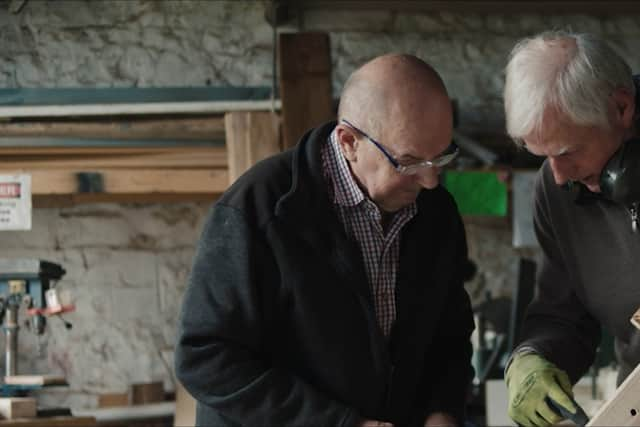
Yet Victor found connection through the Castlebar Men's Shed, where members worked through communication barriers with patience and Google Translate, inviting him to woodworking sessions and trips. "There's a sadness in Victor's story because he's lonely," Baldwin reflects, "but actually he's trying. And these guys at the Men's Shed were really open."

Kate, meanwhile, initially worked shifts in local coffee shops before retraining as a lawyer and eventually securing a position with a Dublin law firm, though she had sacrificed her career to bring her children somewhere safe.
A Collaborative Approach
Crucially, Baldwin worked closely with Daria Korsak, a 23-year-old Ukrainian refugee living in London who served as translator and editor. "I was very careful that my approach as director was in collaboration with someone whose lived experience this was," he says. "It wasn't just me observing a story."
That collaboration shaped the film's deliberately gentle, observational style—a conscious departure from algorithm-driven short-form content. "Their story is powerful as it is," Baldwin emphasizes. "I didn't want to crank up the dramatic tension unnecessarily. We observe, we don't sensationalise."
For Korsak, the project was both powerful and triggering as she worked through her own experiences while helping shape the families' stories. "She was very strong and brave doing it," Baldwin says with evident respect.
A Community Effort
The film was funded largely through Kickstarter and donations rather than commercial backing—"a community effort," as Baldwin describes it. That spirit extends to Sunday's premiere, which will bring together not just the three families, but members of the Castlebar Men's Shed, Paul and Geraldine from Lough Lannagh, and other locals who supported both the families and the film.
Looking ahead, Baldwin hopes to create an impact campaign, potentially bringing the film on a roadshow to spark discussions across Ireland. "The whole reason we made it was for it to get seen by as many people as possible," he says.
As for the film's purpose? Baldwin is clear: "We wanted to make a very human film, a window into worlds that, unless you spend time really trying to understand, you don't know what it's like to be in their shoes. These people weren't shouting or complaining—they just put their heads down, were grateful for being taken in by Ireland, and wanted to contribute and assimilate."
Three years after those first families arrived, they're all still in Mayo—testament to the connections they've built and the community that embraced them.