

West Mayo town to hold Solar Eclipse Viewing Party

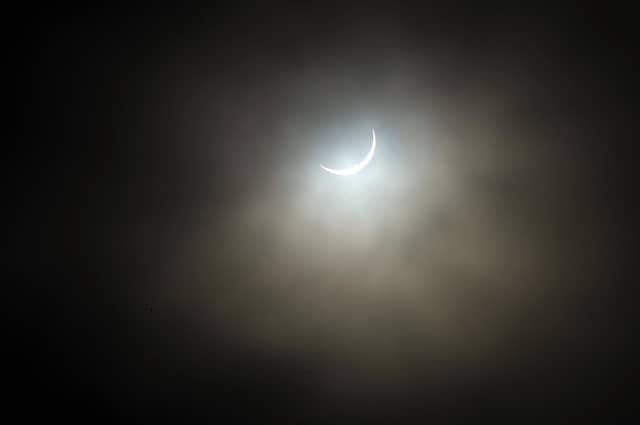

Newport Astronomy Club are holding a solar eclipse viewing party with 96 percent of the sun expected be covered along the west of Mayo
A west Mayo town is holding a Solar Eclipse Viewing Party to witness an eclipse of the sun which will pass over the North Atlantic on Wednesday.
The first total solar eclipse to take place on mainland Europe since 1999 will occur on Wednesday, August 12 and will sweep down from Greenland and Iceland and across the North Atlantic Ocean before making landfall in northern Spain.
A solar eclipse is a natural event where the moon passes directly between the sun and Earth, blocking the sun's light.
While the total solar eclipse will take place approximately 350km west of Ireland, it is expected that 96 percent of the sun will be covered along the west of Mayo, making it one of the best places in Ireland to witness a solar eclipse.
Newport Astronomy Club are inviting members of the public to 'an unforgettable' Solar Eclipse Viewing Party on the Railway Bridge in Newport to experience one of nature's most spectacular events together.
They will meet at the bridge at 5.45pm on Wednesday with the eclipse set to start at 6.12pm with the maximum eclipse at around 7.10pm and the end of the eclipse at 8.05pm.
“Whether you're a seasoned stargazer or it's your first eclipse, everyone is welcome! Bring your family and friends and enjoy this incredible celestial event with fellow astronomy enthusiasts,” they stated on their Facebook page.
At the time of the eclipse, the sun will be low in the west-northwest position, so viewers will need a clear, unobstructed view toward the horizon and it is recommended that protected eclipse glasses are worn to look at the sun without damaging your eyes.
In Ireland, where the eclipse is deep but not total, it is expected that the dimming of the light should be noticeable without becoming full darkness.
As an added treat for star gazers around Mayo, the spectacular Perseid meteor shower is expected to be seen across the county on the evening of August 12 and into the morning of August 13.
The event is associated with the dusty debris left by Comet Swift-Tuttle, which orbits the sun once every 133 years. The meteoroids from the comet, mostly no bigger than a grain of sand, burn up as they hit the Earth's atmosphere at 36 miles per second, to produce a shooting stream of light in the sky.