

The traditional wren
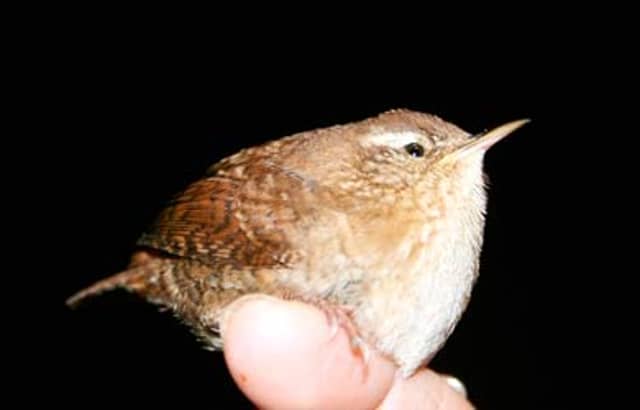

Country Sights and Sounds The wren is a bird with something of an ignoble reputation, but we view ours with sympathy.
“The little bird fled into the darkness outside. It must have found itself blinded by the sudden absence of light, for it flew straight into the glass of the kitchen window”
Country Sights and Sounds
John Shelley
HAVING been negligent by day, I found myself forced to spend the early hours of darkness in the woodshed, wielding the axe. We had inherited some softwood poles, the largest of which were a foot or so thick. My initial impulse was to use them to construct something, but closer inspection showed they have been affected by the damp. Fungus has been at work and decomposition was, if not advanced, certainly notable. They were fit only for firewood.
An hour’s work with the chainsaw put them into rounds, but then the real work started, for the wood was full of tough knots that held each log together until repeated blows removed one piece of usable size after another. Much work remains to be done. Chopping wood by artificial light is far from an ideal arrangement. Shadows blend with colour to make the target indistinct so that more than once the axe skipped as it fell. An hour was enough. Besides we had a small diversion that provided us with alternative entertainment.
The shed has long been used a roosting place by a solitary wren, that had taken to hiding itself away in an empty flower pot. My persistent chopping had proved tolerable for only so long and eventually the little bird fled from the lamp-lit interior of the shed into the darkness outside. It must have found itself blinded by the sudden absence of light, for it flew straight into the glass of the kitchen window.
It made quite a thump and knocked itself out. As it lay in my wife’s hand, tiny eyes closed and a spot of yellow fluid weeping from the corner of its open beak, I was certain that it was dead. We examined it, noting the perfectly formed features, the tiny claws, the rich colours of that immeasurably soft plumage …
The faintest flicker of an eyelid kept me from disposing of the body. Instead, Stella cupped it in her hands to keep it warm, for the combination of cold and shock is a killer. Ten minutes later one eye was open, though the other remained steadfastly closed. Shortly after that the wren could sit up, but was evidently badly concussed. It fluttered its wings as if to fly so we placed it on an upturned pallet, where it slowly came to its senses. Twenty minutes after first hitting the window, it slowly made its way into a more comfortable position out of the light. We saw it again the next day, apparently none the worse for its little adventure.
Others might not have been as accommodating, for the wren has something of an ignoble reputation and so has been persecuted by tradition. It is several years since I saw the ‘wren boys’ abroad on St Stephen's Day, but doubtless the custom of catching, imprisoning and demanding a ransom for one or more of these birds persists in many localities.
According to Charles Swainson, the wren’s descent into ignominy began on the occasion of Jesus’ hiding from the servants of the High Priest. The wren, by its noisy chirping, revealed his place of concealment. Not content with this, when Jesus’ disciple Stephen was being led to his place of execution, his attempt at escape was thwarted by the noisy administrations of another of the wren family. Stephen was stoned to death, and the wren has ever since been hunted with sticks on the supposed day of Stephen’s martyrdom.
Closer to home, when the Danes laid siege to the town of Doolin, the locals had opportunity to turn the tables as the invaders took rest from their insurgency. However, a wren scuppered their plans, alerting the Danes by hopping up and down on a drum.
Another account tells of the occasion when troops of King James II were on the verge of launching a surprise dawn attack on King William’s Orangemen. Finding its traitorous habit a hard one to get out of, one influential wren summoned others to the scene to form a herd (otherwise a chime, a flock, or a family) which alerted the latter by pecking noisily at the Orange drums.
More practically, we view our own wren with sympathy, and would not see him in any way persecuted. Last spring he built several makeshift nests around the place, but eventually his mate settled on somewhere more secretive to raise their family.