

“The people of Mayo have been with me every step of the way” : Gena Heraty

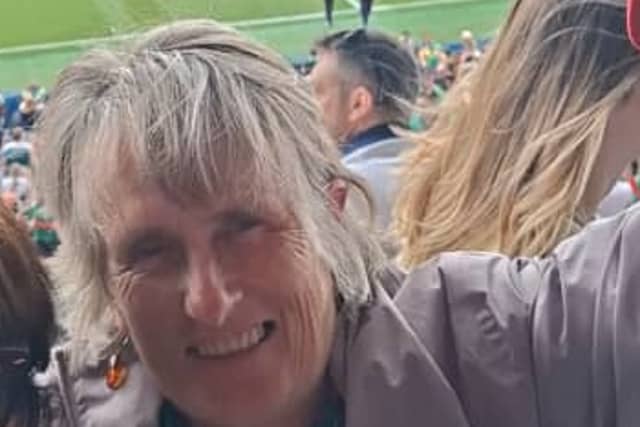

The Mayo missionary reflects on 27 days held by an armed gang and why Mayo’s All-Ireland win gave her something to cheer
Relief flooded the Sacred Heart Church in Cushlough on Friday, August 29 of last year, when the news came through that Gena Heraty had finally been freed.
The humanitarian widely described as a ‘living saint’, had been kidnapped while running an orphanage for children with special needs in Haiti on August 3 by one of the many gangs operating in Haiti.
Next Saturday marks a year since the Westport woman, who has devoted more than three decades of her life to Haiti’s most vulnerable children, was taken from the grounds of the Sainte-Hélène orphanage in Kenscoff, along with seven of her colleagues.
Twelve months on, and with Mayo footballers freshly crowned All-Ireland champions, Gena spoke to The Mayo News about the ordeal, the country she still refuses to leave, and the community back home that carried her through it.
Gena first travelled to Haiti in 1993, having spent 14 months working with the Simon Community in Ireland beforehand — preparation, she has said, for the work that would come to define her life. She now serves as Director of Special Needs Programmes with Nos Petits Frères et Sœurs (NPFS), part of the wider NPH network, caring for children and young adults with disabilities who have nowhere else to go.
That commitment has only hardened since the kidnapping. Even as gang violence has forced her and her colleagues to abandon the mountain home they lived in for over 32 years, Gena has taken in two more children with disabilities from an NPFS-run hospital rather than pull back.
“The forces of darkness are bigger than just the individuals that choose to do bad,” she tells The Mayo News. “I thought, this is going to be my statement: instead of cowering down and getting despondent, I’m going to do even more. So we have to do even more because there’s more need now. Haiti doesn’t give you a chance to feel sorry for yourself. You just have to get on with it.”
I’m from Mayo, we never give up hope
Long before the kidnapping made headlines, Gena says, Mayo had been walking the journey with her — initially through The Mayo News, later through Midwest Radio, through her home parish. That connection, she says, only deepened through the earthquake, the hurricanes, and now the gang violence gripping Haiti.
“I feel very much that I’m representing Mayo people,” she says. “And I think Mayo people have really, really — and not just Mayo people, there’s a lot of wonderful people in Ireland — have been with us every step of the way.”
A self-described ‘mad Mayo woman’, Gena listened to all of the Mayo GAA games on Midwest radio in Haiti.
For all the darkness of the past twelve months, Gena has found room for a very different kind of emotion this summer: pure, unfiltered pride in her beloved Mayo footballers.
Hearing the games, as opposed to watching them, she says that “you pick up on little things” and she remembers Jordan Flynn’s name sticking in her head as “he seemed to be kicking from out the field,” with two pointers proving to be a key new weapon for the Green and Red army.
“We have great players,” she says. “I said all along to anyone that had listened to me, which wasn’t that many,” she laughs, “this might be our year. When we lost against Roscommon, everybody was so disgusted. I thought, great, it’s a big loss, and we learn from it. I was determined in my head that we were going to be in the final.”
Gena was delighted to be in Croke Park to see Mayo captain Jack Coyne lift the Sam Maguire trophy after such a long wait.
“Mayo won the All-Ireland, and like all Mayo people, I am sticking my chest out and I am proud to be from Mayo. Thank you Andy Moran, the team, and all involved with Mayo football all down the years. Thank you for not giving up. Mayo people don’t give up."
Getting over the line after such a wait and so many near misses is “such a lesson for anybody”, she says and when “people would say to me in Haiti all over the years, how do you not lose hope?”, she would respond that “I’m from Mayo, we never give up hope. How can we give up? You have to always have hope. So now I’m hopeful that Haiti will get better because Mayo won.
“I’m still watching the clips, like everybody from Mayo, wherever we are. You know, I think we’re all the same, you know. I think we’re all so happy, and I still cry every time you listen to the speech, because how could you not?”
‘They went through so much’
What made the pilgrimage to Croke Park all the more special was being there with her siblings, niece and nephews and getting the bus up from Westport.
Seeing the toll her kidnapping had taken on her family was, she admits, one of the hardest parts of the whole experience.
“I felt so bad that they had to go through all of this because of my choice,” she says. “In some ways I feel it was worse for the people who worried about us, because at least we knew how we were. When people didn’t know, they went through so much.”
Having had friends who were kidnapped before, she knows first-hand “that worry and that stress when there’s no news. Every day you’re wondering and you’re worrying and you’re imagining the worst. I’d been through all of that myself here, and so you never want your family to have to go through that.”
She says it was wonderful to see her family when she returned to Ireland and that “living in Haiti, we’re always so aware of life and death because so many people we know die before their time.
“So we’re always very close to that reality, and you learn to appreciate everything every single day, you know, and you’re more aware, but you don’t take things for granted,” she tells The Mayo News.
Contrasting the reality with Ireland, she explains that while there are lots of stresses and worries, “they’re not worried they’re going to be kidnapped. They’re not worried that they’re going to be woken up to gunshots in the middle of the night and have to run and leave their homes.”
‘Censored version’
The kidnapping did not happen in isolation. While back home in Mayo earlier this summer to celebrate her sister Kay’s birthday, Gena received a text that the same gang network struck the village neighbouring the orphanage grounds, forcing residents from their homes in the middle of the night under heavy gunfire.
“At least ten of my employees would live in that area,” she recalls. “They were all forced out of their houses at half one, two o’clock in the morning because of massive gunfire — the same gangs that took us. There was a massacre. We don’t even know how many people were killed.”
She is careful about how much she shares of what she witnessed and heard while in captivity. “I usually write the censored version, because you can’t unhear it,” she says. “You tell somebody something, and then some people, they’ll be thinking about it all night. There have been some barbaric things happening in Haiti — frightful, what people have done to people. But they do it to terrorise people.”
“You try to protect people from awful things. I’d never want them to have to go through that, whatever about us having to go through it.”
The property in the mountains that was her home for over three decades remains out of reach. “We can’t go back now because there’s nobody living in that area, and the gangs are still — they’re not on the property, but they’re very close to it,” she says. Even if it were safe, she doubts the children in her care could face returning. “The fact that your home is invaded by over 20 armed, aggressive men with massive guns — they’re not going to get over that so easily.”
Faith, famine ridges, and Saint Patrick
Held in a small room with nothing to occupy the hours, Gena says her mind turned instinctively to home — and to Ireland’s own history of survival.
“You see the famine ridges etched out in the land, and I always feel a connection to people gone by,” she says. “I was thinking of all the struggles, all the people that we are related to — the strength they had to muster together to survive and get through the day-to-day during the famine. This is my difficult moment, but I can get through this. I said to Saint Patrick — I never really prayed to you, but I know you were there, and you didn’t have it easy either. If there’s anything you can do for us.”
She is candid about the fear that never left her. “I was absolutely petrified every single day, every moment of every day,” she says. “But I did expect to get out. You’re carrying your fear and your hope together — which I think is part of life anyway.”
Gena speaks of her captors with a complicated mixture of anger, fear and pity, rather than hatred. She recalls a young gang member who told her his own mother would not speak to him because of the life he had chosen, and a teenager who came to a window one day to tell her that a young woman she had spoken with days before had been killed in a confrontation with police.
“A part of me was like, oh my God, what a waste,” she says. “These young men and women — this is the life they have, because they’re all going to end up dead. There’s no way out for them. And then a part of you is feeling, these could be my nieces, my nephews. You don’t know where you’re going to be born.”
Reflecting on more than three decades in the country, she says she has never seen the Haitian state prioritise its poorest citizens. “When you have massive unemployment, people that are hungry, and these youngsters that are easily influenced… the whole country is poor, and thankfully not everybody goes into gangs. I think that’s too big for my mind to handle. It is shocking — but not just in Haiti. All around the world there are people that are cruel to other people.”
Carrying fear and hope together
A year on, Gena says she has changed in small, practical ways — she avoids unnecessary trips into Port-au-Prince, and lets staff run errands she once did herself — but her sense of purpose in Haiti hasn’t wavered. “I firmly believe I was placed in Haiti in direct response to asking God for a job many years ago,” she says. “This is my spot in the world.”
She urges everyone to keep faith with the country and the people she has given her life to. “Let us continue to pray for all those that are suffering, for all that are kidnapped. Let us pray also for those that are in gangs and those that bring so much pain to lives all over the world. Let us keep praying. Keep lighting the candle. Keep believing that things can be better. Keep making things better.”