

‘Taj Mahal’ of dereliction to be added to Mayo’s dereliction sites register

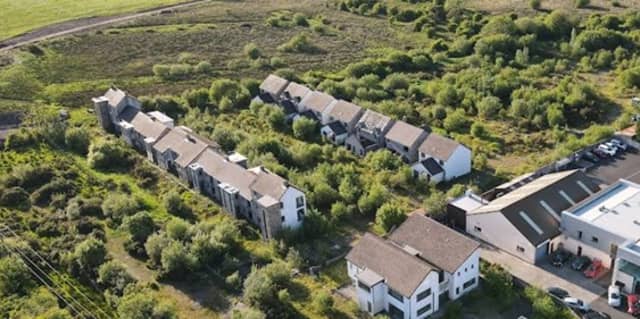

Waterways Estate in Castlebar was the subject of national media coverage last week
Nearly two decades after planning permission was first granted, the Waterways housing estate on the Ballinrobe Road in Castlebar is finally to be placed on Mayo County Council's derelict sites register — a move that councillors hope will mark the beginning of accountability for one of the county's most visible Celtic Tiger ghost estates.
The 77-unit development, which received planning permission in 2006, never came close to being completed.
In a widely read Irish Times feature on "the Taj Mahal of dereliction" last week, a drone video shows that all that remains on the site are approximately a dozen dilapidated, partially-built structures.
READ NEXT: Dark Christmas ahead for Westport
The commitment to register the site came during Thursday's Housing SPC meeting of Mayo County Council, where Independent councillor Michael Kilcoyne again raised the long-running issue. Kilcoyne, who has been a persistent voice on the Waterways estate for over 15 years, expressed frustration at the lack of progress.
“There are 77 units on the Ballinrobe Road, which I've raised on many occasions,” he told the meeting. “Are we going to do anything about it? Still not on the derelict register after being almost 20 years derelict. I think it's a shame that it's the way it is.”
Oversight
Catherine McConnell, Director of Services for Housing and Town Centre Development with Mayo County Council, confirmed the council's intention to act, acknowledging the oversight. “We are going to put that on the derelict sites register. I don't understand why it wasn't now, but we are putting it on the derelict sites register.” She described it as “only one very small action”, but noted it would trigger the collection of derelict site levies. Kilcoyne welcomed the development, remarking simply: “It does smarten them up.”
READ NEXT: Is affordable housing on the way in Mayo ?
McConnell was frank about the wider complexities surrounding the site, however. “It is an extremely complex situation here, and one that, if we were to wade in, the risk is enormous,” she said. “But we will continue to push and keep an eye on the machinations that are going on there — it is a real troublesome site.”
The registration on the derelict sites register will not solve those problems overnight, and all parties acknowledge it is far from a resolution. But after nearly 20 years of inaction on a site that has come to symbolise the failures of the boom era, even a small administrative step is being welcomed as better than nothing.
Funded by the Local Democracy Reporting Scheme