

Sticker campaign
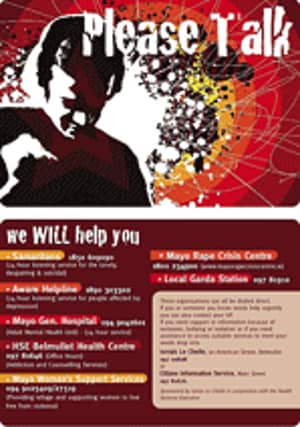

AN information sticker campaign has been launched in Erris to help those who feel isolated.
Sticker campaign urges more talk
Anton McNulty
AN information sticker campaign has been launched in Erris to make people who may feel isolated or suicidal aware of the services that are available to help them.
The ‘Please Talk – We Will Help You’ campaign was launched last month and the information stickers are designed to go on the back of all toilet doors in the Erris area that will be used by the public. The stickers display information about and contact details for services that people may want to avail of.
Please Talk is a joint initiative between Iorras le Chéile, HSE Belmullet Health Centre, and the HSE Suicide Prevention Department in Galway. Rose Walsh of Iorras Le Chéile said the issuing of the stickers is the first initiative of a Positive Mental Health Working group set up in the Erris area.
Rose explained that Erris is no different to any other area in Ireland when it comes to mental health issues and suicide and she hopes this new initiative will encourage people to talk and seek help.
“Suicide is most prominent among young men aged between 18 and 35 years old, but in rural areas the number of middle-aged men committing suicide is worryingly high. We believe the only long-term solution to suicide intervention and prevention is for agencies and statutory bodies to work in conjunction with the local community. The local community are the best people that know what are the challenges affecting the quality of people’s lives.”
Acknowledging that there are often no obvious signs that someone may be feeling suicidal, Rose believes that creating general awareness in society can make a big difference.
“There are very many reasons why people feel that they don’t want to go on living and families are often left searching for a reason. Sometimes there may be signs that people are thinking about ending their life but more often than not there is no sign at all. Personally, I had a friend I knew in London, from Wexford, who was 26 when she ended her own life. She was a brilliant footballer and camogie player and in every way the life and soul of the party. She ended her own life on the second attempt and and I often think what could I have done to help her and prevent it. It is an issue that is very important to me,” she said.
International research has established links between poor mental health and social and demographic factors. Unemployment, poverty, low educational attainment, discrimination, inequality and exclusion and isolation are just some of causes and consequences cited.
The main aims of the Positive Mental Health Working group are to promote positive mental health in the area, to work with voluntary and statutory organisations to promote greater cohesion and to break down the stigma attached to mental health illness.
Last year, 52 people in the local area completed an Applied Suicide Intervention Skills Training programme and Rose believes these people will know what to do if they are faced with people who are contemplating ending their own life. She admitted though that it is difficult for teachers and parents to distinguish between someone who is just having a bad day and someone who may be depressed.
“The first thing people can do to help someone is to talk to them and try to see what is upsetting them. They should encourage them to see a GP or contact some of the services. Hopefully with this new initiative it will get more people talking and make them realise there is help available.”
> If you do not yet have these stickers displayed on your premises and would like, or would like to be involved with the working group, please telephone Rose Walsh, Iorras Le Chéile on 097 20828 or Maureen Gallagher, HSE on 097 81646.