

Seven days in Ethiopia

When Ballinrobe journalist Liam Horan recently visited Ethiopia, he was pleasantly surprised to find many signs of progress in this once famine-torn country
Seven days in Ethiopia
When Ballinrobe journalist Liam Horan recently visited Ethiopa, 24 years after famine first struck, he was pleasantly surprised to find many signs
of progress in this once famine-torn country
Day One
The health of the populace is a key issue in Ethiopia. The country has not escaped the HIV/AIDS problem which is so prevalent all over Africa. In rural areas, a key priority for an organisation like Self Help Africa is to provide maternity facilities close by where people live. At this clinic in the Sodo region, mothers receive basic treatment before and after the birth of their child. Without this, they would have nowhere to turn. All over Ethiopia, clinics like this play a vital role.
Day Two
Education is central to Ethiopia’s development. These teenagers attend Ligaba Hitosa High School in the Hiruta District. The school was built just two years ago with significant Irish funding from Self Help Africa and the One51 Charitable Foundation. Now children don’t have to walk 11km to school anymore. Two Kildare teachers – Annette Kavanagh-Bracken and Rachel McGrath – marked the visit by formally establishing a partnership with their school, St Wolstan’s Community School, Celbridge. It is hoped children in both schools can benefit from the tie-up.
Day Three
Intensive stock-fattening is an opportunity that doesn’t come to every Ethiopian. Self Help Africa is involved in empowering farmers to get the maximum return from their stock. These animals are being fed indoors in a bid to beef them up. The family live in the same building.
Day Four
Amarach Doya is a mother-of-six who also runs her own farm. Thanks to a line of credit from Self Help Africa’s credit co-operative, she has transformed her life in a few short years: she has branched out into dairy and vegetable farming, bee-farming, and other cash-generating enterprises. She has purchased her own water pump to save a six-mile round trip every day. “My future looks much better,” she says.
Day Five
Nothing comes easy in Ethiopia. Farmers must mind their stock carefully. There are very few tractors in the country. This man is walking his stock to a nearby market where he hopes to secure a good price. He will put the cash to good use as he keeps his family fed. The donkeys play a crucial beast-of-burden role too.
Day Six
Like so many African countries, Ethiopia has a major HIV/AIDS problem. At ground level, Self Help Africa is engaged in an education programme. Here, the simple matter of a Suggestions Box hammers home the reality of how far into rural society HIV/AIDS has permeated in the country.
Day Seven
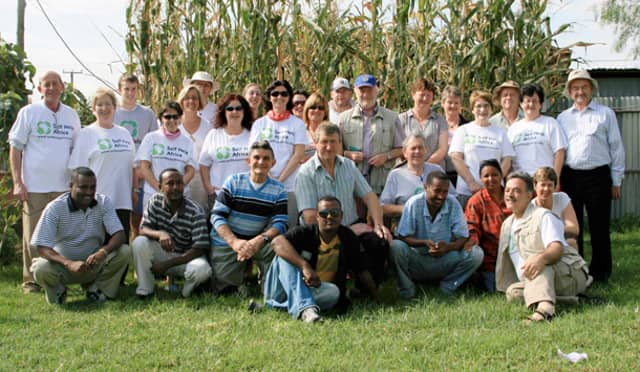
After a full week visiting all manner of farms, schools, health clinics, hospitals, and other programmes, the Irish group – many of whom are farmers – gather for a final group photo. “We have learned so much about Ethiopia, and the resilience of the people. Great strides have been made in this country since 1984, and more can be done as practices improve thanks to funding from developed countries,” says Patsy Toland, Self Help Africa.
Self Help Africa is an Irish development agency working to improve food and livelihood security in nine countries in Africa. The organisation is currently embarked on a nationwide campaign to raise public awareness, and funding for its work. For further details visit www.selfhelpafrica.com.