

Rare endangered pearl mussels airlifted to Mayo in conservation effort

The freshwater pearl mussel (Margaritifera margaritifera) is one of the world's most endangered species.
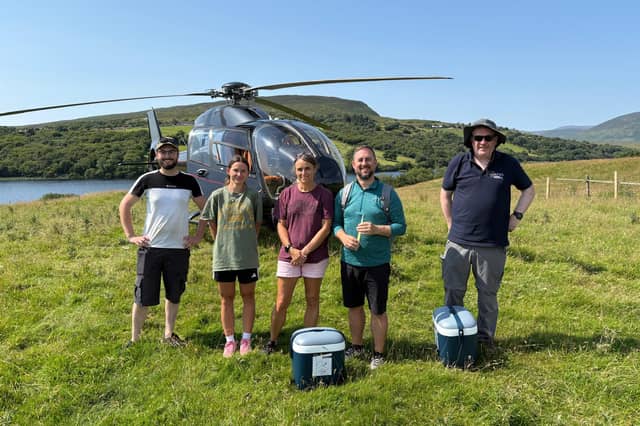
Twenty of Ireland’s rarest freshwater pearl mussels were carefully transported by air from the Owenmore River on the north side of the Dingle Peninsula to the Marine Institute’s Research Facility at Furnace, Newport, Mayo.
The mussels are native to the Owenmore in the Mount Brandon Special Area of Conservation and the newly created Páirc Náisiúnta na Mara and will join mussels from the Newport River, Mayo, the Owenea River, Donegal and the Owenriff River, Galway.
The transfer is part of a conservation breeding programme led by the Marine Institute in collaboration with the National Parks and Wildlife Service of the Department of Housing, Local Government and Heritage, and Moorkens & Associates.
A species under pressure
The freshwater pearl mussel (Margaritifera margaritifera) is one of the world's most endangered species. Native to Irish rivers and lakes, it is protected under the Wildlife Act 1976 and listed under the EU Habitats Directive.
The species is particularly vulnerable because of its complex life cycle and sensitivity to changes in water quality and river conditions. Adult mussels can live for more than 100 years, but young mussels spend their first five or more years buried in riverbed gravel, where they are especially susceptible to pollution and changes in habitat.
The Owenmore population is now critically endangered and continues to decline. Surveys indicate that fewer than 800 mussels may remain in the river, compared with approximately 3,000 recorded in 1999. In 2010, the then Department of Environment, Heritage and Local Government warned that, without intervention, the population could disappear within decades.
The main pressures facing freshwater pearl mussels include sedimentation and nutrient pollution associated with upstream land use. These pressures can degrade the clean, well-oxygenated riverbed habitats that the species needs to survive.
The mussels were transported under carefully controlled conditions, with the journey time reduced as much as possible to minimise stress.
Buying time for conservation
While efforts to restore Irish river catchments continue, captive breeding provides an additional tool to safeguard severely declining populations and produce juvenile mussels for eventual release back into their native rivers.
“Captive breeding gives us a window of opportunity for very vulnerable populations of mussels, where habitat restoration will take several decades,” said Elvira de Eyto of the Marine Institute.
“Captive breeding works alongside habitat restoration, not instead of it. By preserving the genetic potential of existing populations, we can buy time for restoration efforts to work, helping to secure a future for this species that plays such a key role in our freshwater ecosystems.”
Freshwater pearl mussels are often described as a keystone species because their natural filtering activity contributes to healthy river ecosystems. However, as populations have declined to a fraction of their former numbers, this ecological function has also been diminished.
Ireland's National Conservation Strategy for Freshwater Pearl Mussels recognises conservation captive breeding as an important tool in preventing the loss of severely declining populations.
A remarkable life cycle
One of the most unusual stages of the freshwater pearl mussel's life cycle involves young salmon and trout.
Microscopic mussel larvae, known as glochidia, temporarily attach themselves to the gills of suitable host fish. They can remain there for up to nine months before dropping into the riverbed gravel, where they continue their development.
This complex relationship means that successful conservation breeding requires facilities capable of supporting both adult mussels and healthy host fish.
At Furnace, Newport, the Marine Institute operates a regulated freshwater salmonid rearing facility, providing the conditions needed to support this stage of the mussel's life cycle.
Progress since 2020
The Marine Institute's conservation breeding programme was established in 2020 and has made significant progress in understanding freshwater pearl mussel lifecycles under hatchery conditions.
Researchers have identified preferred host fish, refined handling techniques and developed methods aimed at improving juvenile survival and production.
Juveniles have already been successfully harvested from the 2024/2025 and 2025/2026 cohorts. The results have allowed researchers to further refine breeding and rearing methods and move closer to developing a consistent and scalable approach to freshwater pearl mussel conservation.
The latest arrivals from the Owenmore will now form part of this wider effort.
The programme's ultimate goal is to produce substantial numbers of juvenile mussels that can eventually be returned to their native rivers, helping to strengthen wild populations and restore the species' ecological role.
The juveniles will be carefully reared under controlled conditions for up to eight years before being considered for reintroduction into suitable river habitats.
For a species capable of living for more than a century, conservation is necessarily a long-term undertaking. The transfer of these 20 mussels represents one step in an effort to preserve the genetic diversity of the Owenmore population and give future generations of freshwater pearl mussels a chance to return to Ireland's rivers.