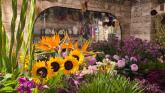
Hans Wieland outlines the steps you should take now if you plan to grow your own vegetables this year.
Prepare for the new growing season
Growing
Hans WielandThe days are getting longer and the new growing season is starting soon, so we all better get prepared. Well-renowned organic gardener Joy Larkcom writes in her wonderful book ‘Grow Your Own Vegetables’: “The newcomer to vegetable growing is sometimes at a loss as to how to start. This is hardly surprising: What works well one year may fail the next.
A real gardener is inevitably an experimenter, constantly trying out different ideas until he discovers what is best for him.”
Your soilThe soil is the soul of any garden. Good, healthy, organic soil full of nutrients produces healthy, nutritious vegetables.
Although you can improve soil, it’s obviously easier to start with a loamy (well-structured) soil. Neutral to slightly alkaline soil (PH 7-8) suits most vegetables. Sandy soils are well drained, easy to dig and warm up quickly in spring, but they lose nutrients quickly and don’t hold water well. Clay soils are sticky, cold and wet, but can hold reserves of plant nutrients. You cannot change the soil from clay to sandy or vice versa, but you can improve it by adding organic matter in the form of farmyard manure and loads of compost from your own compost heap. (I will cover the basics of composting in a later article).
Your siteMany gardening books recommend a site on ‘a gentle south facing slope’. Given the choice, a slope is best – cold air runs off just like water – but most of us are forced to grow on the flat. Maximising sunlight is important, so the garden should be south facing. Shade is never a good choice.
Another crucial factor is water. Rainwater is preferable to mains water because of its suitable pH level and lack of chlorine. Shelter from wind is important too, as the majority of vegetable crops don’t thrive in windy conditions. So plan your hedges now or start off with a wind break.
Make sure you have a supply of electricity, if needed for propagation purposes, in a little greenhouse or a polytunnel.
Your plotNow is the time to start new or extend your existing plot or change your garden. You can grow vegetables at any size, in pots and fish boxes, in raised beds or a full-size kitchen garden. My tip: start small and keep control!
You could start with four beds, 1.20m wide and 5m long, which is a plot of around 40 square meters, including foot paths. For the more ambitious amongst you, just double it up.
It is best to start with four or eight beds so you can easily establish a four-year rotation between potatoes, cabbages, peas and beans and carrots and onions.
Measure your site, mark the beds or construct raised beds with timber, put farmyard manure and compost on top and cover with black plastic until you start sowing or planting.
Your tools For starting a small vegetable garden there is no need to buy a large range of fancy garden tools. The only advice I give is not to buy cheap tools. You’ll need to get a good spade with a stainless-steel blade for digging and planting; a garden fork for handling compost, loosening and aerating the soil and digging out root crops; and a rake with a smooth and long-enough handle for levelling soil, breaking down lumps and weeding.
You’ll also need a hoe. Hoeing, which is only done in dry weather, is probably one of the most important gardening activities in terms of bed preparation, planting and weeding.
Take a good look at round hoes, oscillating hoes and draw hoes, get some advice and buy one. My wife’s favourite is a trenching hoe with a light ash handle that has two sturdy prongs on one side to break up compacted soil and a heart-shaped blade for making drills and general hoeing. My favourite hoe is actually a rake.
Last but not least, you’ll need a hand trowel, a quality watering can, a 5m-long rope and a measuring tape.
When starting out, get advice, attend a course or join a community garden group. The knowledge of others will help you succeed!
Next time Raising plants from seed, Part 1
Hans Wieland is joint manager of The Organic Centre, Rossinver, Co Leitrim, which offers courses, training and information in organic growing, and runs an Eco Shop and an online gardening store. For more information, visit
www.theorganiccentre.ie, e-mail
info@theorganiccentre.ie or phone 071 9854338.
Questions or comments? Contact Hans at
living@mayonews.ie.