

OPINION: Nature is winning the erosion battle
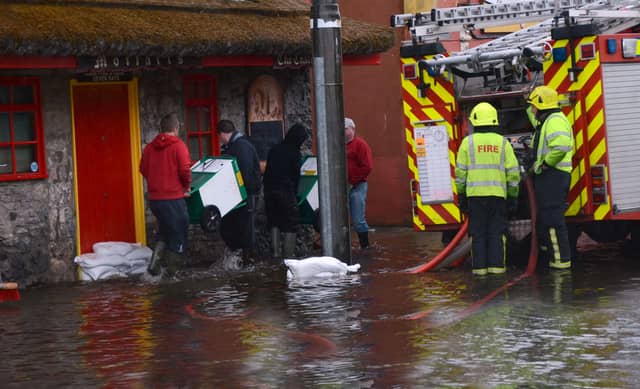

In the clearest sign yet that nature is winning the battle of coastal erosion, the government has conceded that 'managed retreat' will be the preferred option for those who live in areas threatened by the encroaching ocean. The warning, issued just this week, says that thousands of homeowners and businesses will have to abandon their properties and move inland to drier ground before sea water levels leave them with no other choice.
Rising sea levels and weather extremes will see increased rates of coastal erosion and inundation, meaning that property owners will see themselves denied cover by insurers, even if they should decide to stay put in defiance of the power of the surging oceans.
The statistics tell a stark story. Nearly 40 percent of the island’s population live within three miles of the coast; 40,000 people live within a hundred metres of the shoreline. Mayo has nearly 1,200 kilometres of coastline, with nearly 700 kilometres - according to OPW figures - at risk of coastal erosion. That exposure, combined with the increased ferocity of the Atlantic weather, spells ominous news for those living on that fringe which extends from the south tip of Clew Bay to the northernmost point of the Erris peninsula.
The national coastal risk survey of six years ago had already identified the Clew Bay fringe as being specially vulnerable. A littoral necklace of land from Rosmalley to Rosbeg, to Roman Island and Westport Quay, and north again to Achill, had been red flagged for submersion under the relentless rise in sea levels. Even Bertra beach and dunes, long thought to be the natural barrier to protect Murrisk and Westport Quay, has been found unable to cope with higher tides, Atlantic swell, and the storm force winds which now recur with worrying regularity. What were once exceptional, once in a decade occurrences of extreme weather, have now become so common that the shoreline does not have the time recover before it is subjected to the next, even more violent, pounding.
All of this comes at a time when the country is experiencing floods and rainfall of biblical proportions. The scenes of devastation from Midleton and Newry and Carlingford and Enniscorthy, where overflowing rivers decimate homes and business premises is a portent of worse to come. For those lucky enough to have been spared such ruination, the impact on local communities is hard to imagine; but for those who have been hit, it means the loss of everything - their livelihoods, their homes, their future.
It is not as if we have not been down this road before. Five years ago or so, Mayo got its first taste of what fluvial flooding can do. In Foxford, fifty elderly residents of a nursing home had to be evacuated when the Moy overflowed; in Crossmolina, the Deel cascaded from its bed, wreaking havoc; south of Ballinrobe, householders were cut off and an elderly woman sat trapped for hours in her car as the flood waters rose around her vehicle. In Ballina, the residents of Clare Street and Bachelors’ Walk counted the cost of repair as their homes were inundated with the swollen river waters. (Ironically, an emergency flood relief scheme, drawn up at the time for Ballina, remains at preliminary design stage).
The optimistic scenario is that those communities most at risk can be protected by flood relief schemes. The reality is that we are already playing catch up. Flood defences take decades to construct; and they require a level of investment which the exchequer, quite clearly, is unable or unwilling to afford. Which may well explain why 'managed retreat' is being seen as the most sensible, and probably the only, option.