

Mayo calligrapher creates stunning artwork to commemorate 1926 Census

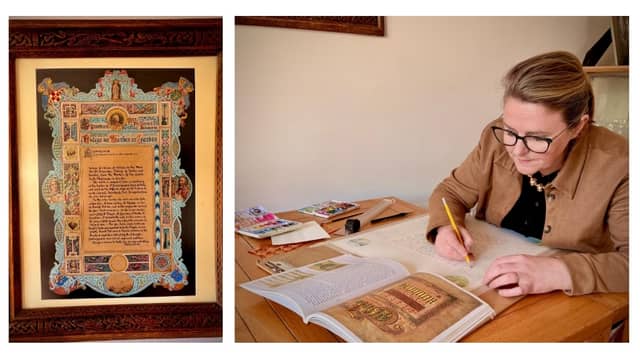

“My grand-father William Brett was from a line of artists himself" says calligrapher Karen Brennan
ONE might be tempted to say, there’s ink running through her veins. When your great-great-grandfather was a painter, and your grand-father was a talented calligrapher, then it’s no understatement to say that you’ve got the talent in your genes.
Mayo woman Karen Brennan has 35 years of experience in traditional penmanship and illuminated lettering. Originally hailing from Castlebar, Brennan lives and works in Dublin now. Her artistic roots reach far back.
“My grand-father William Brett was from a line of artists himself. We actually have a photograph of his grandfather who’s holding a palette and that would have been kind of the 1860s. He’s holding a paint palette and he’s surrounded by his family and I often think that that’s going back to the Famine times. The art is so strong in our family still because it probably kept the family alive back in Famine times.”
Brennan reckons he was probably painting for the church or from some noble person, getting paid to be an artist. “So the art has stayed very strongly in our family DNA and I’m just carrying that on today.”
Especially as Karen Brennan grew up with her grand-father’s extraordinary piece of art on the wall in the house. She explains, that it has so much intricacy in it. “One can literally stare at it for hours and find new things in it”, Brennan says.
And it references the Gospels, it references the saints, Colmcille, as well as a certain Joan of Arc. She states, that she can see his hand coming out in the way I express myself artistically as well. William Brett was a contemporary of the stained glass artist Harry Clarke and the both collaborated on works for St Patrick’s Church in Newport.
HISTORIC REVEAL
ON Saturday, April 18, the historic first census of an independent Irish state was made available to the public. Up until recently, the files were controlled by the Central Statistics Office. The 700,000 return sheets have been transferred to the National Archives.
For the first time, Mayo people can learn now first-hand about the way their ancestors lived a century ago.
Enough motivation for Karen Brennan to start working on an artwork of decorative script to go along with this occasion: “It’s such a historical census because it’s the first time that Ireland ever counted itself properly. We were kind of under British rule before that, so it would have been the King’s Census, whereas this was the first time we actually counted ourselves. So it’s a really important first census for the Irish Free State, and I wanted to reference a lot of very key Irish pieces of art in that.”
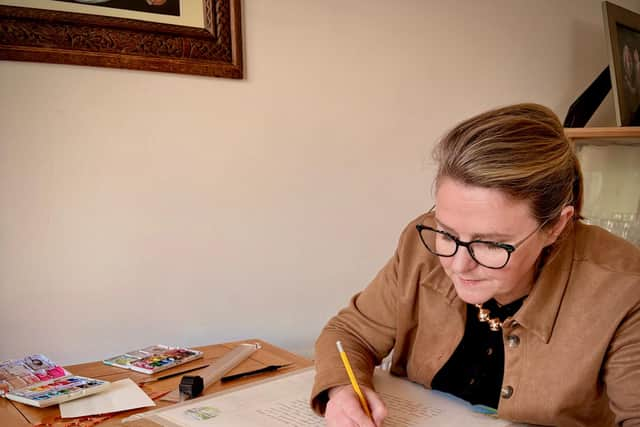
commemorating the 1926 Census publication.
In order to bring her work up to date, Brennan has incorporated a strand of DNA running through a double helix, running through one of the words in the right-hand panel so that it kind of modernises it a little bit because it is very traditional.
“I think also in referencing all our DNA, all our shared DNA, people who’ve been here who were born here or who have left from here, all the diaspora who are all over the world as well.”
Brennan feels the huge responsibility to get it right. She was working six days on it before any ink went on any page because of the planning that goes into it.
And even though one can’t see it, there’s 120 tiny, fine lines to mark out the calligraphy. Modern calligraphers use lasers but Brennan wanted to work in the same traditional style as her great grandfather, who inspires her so much.
“I hand lined the paper. You kind of have to not breathe very much when you’re doing the calligraphy because you put so much work into getting ready to get the pen on the paper, you just have to relax and trust the process that it’ll all work.”
It’s a very conscious decision to create genuine artwork by hand. Especially in an age where everything computer generated or AI. Brennan points out, that she took it very seriously that this is a very important moment in Irish history: “We’re getting to see the first real snapshot of what Ireland was like.”
Brennan explains that the text is very emotional, about a sense of belonging and claiming Irishness. And for Ireland to reclaim the people who have gone too, that they can get that sense of belonging.
This is the text of the wording for the 1926 Census Illuminated Manuscript which Karen Brennan is creating:
In the year of our Lord, Nineteen Hundred and Twenty-Six, the fledgling Irish Free State undertook a most distinguished endeavour, the faithful recording of her people in the first great census of this sovereign nation. One hundred years hence, in the year Two Thousand and Twenty-Six, this precious record is at last restored to the generations. To those rooted upon this ancient soil and to the countless sons and daughters who have carried her spirit to distant shores. This enumeration stands as a joyful declaration to all that Ireland and her people wherever they may dwell are known, counted, and celebrated. Among the esteemed names so honoured within this record, we are proud to count
(family name(s) to be inserted here in calligraphy)
and her grandfather's work on the wall.