

BOOK TALK: Stories and questions to ponder

Iris Murdoch’s novels and essays still enthrall
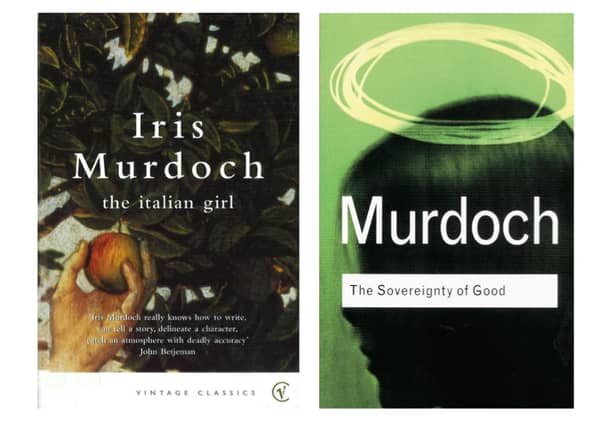
On a much treasured day off when the sun came out finally, a deck chair, the birds singing and ‘The Italian Girl’, by Iris Murdoch, in tow, I am in heaven.
Murdoch has been one of those authors on my list to read. I hadn’t realised she was born in 1919 Phibsborough in Dublin, where I too was born, a lot later. Her mother was from Dublin and her father from Co Down, they moved to London when she was just a few weeks old.
She attended both Oxford and Cambridge Universities. She worked for United Nations Relief and Rehabilitation Administration, based in Graz in Austria in a refugee camp in 1945. She went on to teach philosophy and became known for her work on moral philosophy, which was somewhat eclipsed by her success as a novelist with 26 prize-winning novels, among them ‘The Sea, The Sea’, which won the Booker Prize in 1978.
‘The Italian Girl’ is short at 170 pages, so perfect for a summer read. Two pages in and I know so much about the narrator already and I am dying to know more. Every word is carefully chosen, crafted. Like a sculptor she creates the outline and we are there with her as she creates the final piece.
Edmund, the narrator, returns home to an old rectory in the north of England on news of the death of his estranged mother, to attend her cremation. He had escaped the dominance of his mother and led a lonely existence as an engraver in London.
The story of his childhood and the aftermath of their family life are laid out before him on his arrival. We are introduced to his brother, Otto, who stayed behind continuing under the influence of the now deceased mother, and Otto’s wife and daughter, and to the strange and somewhat crazy life they continued to live after Edmund left home.
The Italian girl, we find out, is not one girl but a series of Italian girls who were nannies and housekeepers throughout their childhood. The brothers speak fluent Italian. Edmund is seen as always taking the moral high ground but this is challenged immensely as events unfold over the course of his visit.
Moral exploration
Alongside this I read one of Murdoch’s philosophy books, ‘The Sovereignty of Good’, published by Routledge. It consists of three essays entitled ‘The Idea of Perfection’, ‘On ‘God’ and ‘Good’’ and the ‘Sovereignty of Good over Other Concepts’. They are based on lectures given by Murdoch in which she continues in her exploration of what is good and whether it transcends everything, even God. The Boston Review hailed these essays as her most influential pieces of philosophy.
She starts with the job of philosophy as such; where it is sometimes said that ‘philosophy makes no progress’. She holds with this, in the sense that it is necessary to move towards the building of theories but also to return to the beginning, to the essence. Her essays look at that movement away from core facts and holds in mind that an unexamined life can still be virtuous and to remind us of the fact that love is a central fact in morals.
What does ‘good’ mean? “Good is indefinable… because judgements of value depend upon the will and choice of the individual”. Are we an “obscure system of energy” out of which we make choices and visible acts of will that emerge at intervals in ways that are unclear and “dependent on the condition of the system in between the moments of choice”? If this is so, then one of the main problems of “moral philosophy” could be formulated as techniques for the reorientation of an energy that is inherently selfish so that in moments of choice we are able to act rightly. Familiar to us are the techniques of religion and the idea of prayer; an attention to God, a form of grace and of love. And what becomes of this in a world without God?
Reading Iris Murdoch reminds me why I love literature and the exploration of our deeper philosophical selves; her ability to make one’s heart soar and one’s mind curious.
Bríd Conroy and her husband, Neil Paul, run Tertulia bookshop at The Quay, Westport.