

An alien invader is threatening our honeybees and pollinators
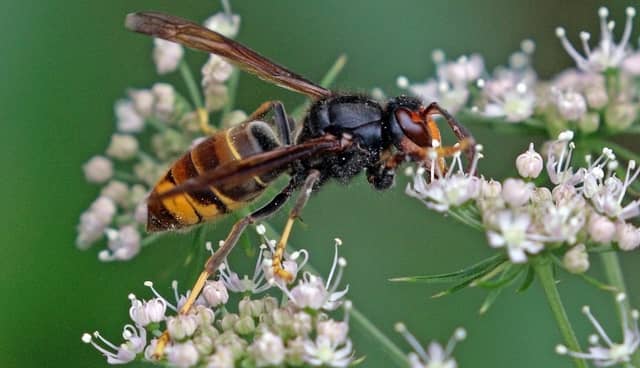

The Westport Beekeepers’ Association is calling on everyone to keep a look out for the voracious Asian hornet
The Asian hornet (Vespa vilutina), introduced by accident into France in 2004, has become the nightmare of beekeepers, wherever it has spread. In France, the situation is so bad that over 40 percent of beekeepers have given up on their craft, and in Portugal the hornet traps catch the hornets in bucketfuls.
In our last meeting, our Westport beekeepers had the privilege of being introduced to the subject by Mary Walsh from Belmullet. Mary has strong connections to the beekeepers in London. The Asian hornet was first spotted in England in 2016 and has since spread further into the country – by around 70 miles every year.
Here in Ireland, a first nest was discovered in 2021, and although there have been no sightings since, the insects might have started colonising Ireland as well. They like rivers and lakes, bogs, stone walls and brambles, all of which we have here in abundance.
Queen machines
So, who are these invaders, and why do they pose such a serious threat?
The Asian hornet is slightly smaller than the European hornet and slightly larger than a wasp. It is mainly black, with yellow tips to the legs, while the fourth segment of the abdomen is orange.
The queens overwinter in sheltered spots, sheds, stone walls, wood stacks and the like, emerging when the temperature reaches 13°C for three consecutive days. The hornet queen then seeks out feed, a behaviour that has enabled folks to monitor any emerging queens by putting out bait stations. These are simply jam jars filled with a lure (for example a mix of fruit juice, wine, and beer) which has a zig-zag folded jay cloth stuck through a hole in the lid. As the cloth absorbs the lure it rises to the surface of the cloth and will be used by insects to feed. Therefore, no pollinators are killed, yet the gardener is able to observe the insects.
Apart from the lure jars, beekeepers in other European countries have also resorted to hornet traps, which are constructed in a way that will enable native pollinators to escape.
The queen builds two nests a year, the first one with four combs for about 200 workers, the second for raising drones and new queens. If the nest is not discovered and destroyed, one hornet can produce up to 700 new queens, who in their turn will go on to reproduce next year.
Plight of our pollinators
The Asian hornet is a voracious consumer of other insects. In one hornets’ nest, 11.3kg of dead pollinators (including bees, wasps, butterflies and bumble bees), which is equivalent to 25 pounds of insects, was found.
On a summer’s day between 30 to 50 Asian worker hornets could start hawking a beehive. One Asian hornet alone can catch 30 or more honeybees a day. The bee colonies experience losses they cannot sustain. The rate of destruction is devastating for all flying pollinators, and as we know, all our fruit, vegetables and berries depend on flying pollinators.
In Korea, where this hornet is also not native, it has completely wiped out the native honeybee. It is imperative, therefore, to prevent it from spreading here where it could do the same.
People are encouraged to photograph any suspected Asian hornet and send the picture to the Department of Agriculture, Food and the Marine at [email protected], where the insect will be identified. While the hornets feed, they can be approached, but it is not advisable to approach the nest directly, as even a bee suit is no protection against hornet stings.
In the coming weeks, the Westport Beekeepers Association will distribute information sheets to local schools to encourage children in hornet spotting. If we all work together, our honeybees might have a chance!
Julia McMaster is a member of Westport Beekeepers Association (www.wbkc.info). All sightings of the Asian hornet should be reported to [email protected], or contact Westport Beekeepers at [email protected] for more information.