

Keogh raises school transport challenges facing rural Mayo families
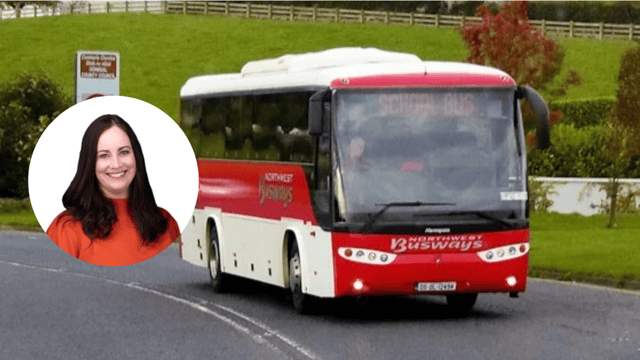

Deputy Keira Keogh calls for greater flexibility around feeder schools and rural travel routes
The unique challenges facing families in rural Mayo under the school transport scheme were highlighted in the Dáil last Thursday (April 23) by local TD Keira Keogh.
Deputy Keogh called on the Department of Education to take greater account of local realities, particularly the traditional links between primary schools and their feeder secondary schools, rather than relying solely on distance-based criteria.
She said the current system can create significant financial burdens for families, especially in rural communities where established school attendance patterns are not always reflected in official transport rules.
One example raised by Deputy Keogh was the long-standing transport route from Westport to Sancta Maria College Louisburgh. She noted that two buses travel the route every day, yet some parents are still paying approximately €850 annually due to eligibility criteria.
“Traditionally, students from Westport have attended either schools in Westport or Louisburgh,” she said. “A year later, parents are still facing substantial costs despite this being a well-established pattern.”
She also pointed to areas such as Newport and Glenhest, where pupils often attend schools in Westport, Achill or Louisburgh, even though other schools may technically be closer by distance.
Deputy Keogh argued that in rural areas, the Department should work more closely with local primary schools to identify where students traditionally progress for second-level education.
“If primary schools can clearly show where their pupils are going, that should be taken into account,” she said. “A school may be geographically closer, but if students are not attending it, the current criteria simply do not reflect reality.”
Responding on behalf of the Minister for Education, Minister of State Michael Moynihan acknowledged the issue and said feeder school arrangements remain under active review.
He noted that the school transport scheme has expanded significantly in recent years, with the number of pupils using the service increasing from 120,000 to 181,000. State investment has also risen sharply, from €200 million to €537 million in 2025.
Mr Moynihan said pilot projects are currently examining ways to improve the system, including how feeder school patterns might be better accommodated. Fourteen pilot schemes were conducted last year, with a further 11 underway this year.
“Co Mayo has been mentioned a number of times, and we will certainly review the situation,” he said.