

How some dogs go to heaven
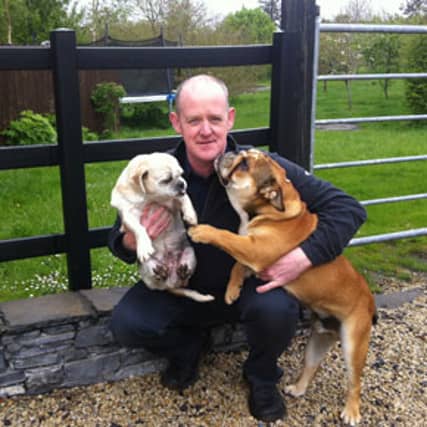

A crematorium for pets has opened outside Castlebar and demand is proving strong
A MAN AND HIS DOGS?Vet and Mayo Pet Crematorium owner Niall Curran pictured at his home with two of his dogs, both very much alive and well, Paddy the shih tzu and Dutch the bulldog.
How some dogs go to heaven
A crematorium for pets has opened in Castlebar and demand is proving strong
Edwin McGreal
Aghna Flynn admits she might be a bit ‘obsessed’ about dogs.
“You feel you can’t mention it to some people because they will think you’re mad,” she tells The Mayo News.
And she’s right. Some people will read this piece and wonder aloud. They won’t get it. But there’s more who will empathise.
Pets have become a huge part in many people and families’ lives in the 21st century. And when they die, it doesn’t end there.
A retired nun in Castlebar came to vet Niall Curran a number of years ago to request a coffin for her dead pet. He thought it was a crazy suggestion, but as he’d an interest in carpentry he decided to make a coffin.
It got him thinking. Pet cremations were becoming more and more popular. He saw it directly in the practice he and his brother Ronan operate in Castlebar. They would send the remains of some pets they had to put down to a pet crematorium in Northern Ireland.
Was there room for such a business in Mayo? It seems so. Since setting up last October, there have been 100 cremations at Mayo Pet Crematorium, which is situated beside Niall’s home at Cloonkeen, Castlebar. It’s the third pet crematorium in the republic, with the other two in Kerry and Meath.
“There are different types of people who opt for it. There are older people who may not be able to dig a grave in the garden and may be more emotionally attached to their pet than a family with young children might be.
“You have people who live in flats or rented accommodation who simply cannot bury their pet or people living in the suburbs for whom it is not easy to dig a three feet hole in their garden. Then you have people who want to keep a memento or to scatter their ashes in their favourite place in the garden,” he told The Mayo News.
Just last month Aghna Flynn had to make the trip Cloonkeen after her six year old working cocker spaniel Grouse died after being ill with cancer for just under one year. She finds cremation a way to keep Grouse with her.
“I find it an enormous solace to be able to put my hand over the box where the ashes are. I couldn’t scatter the ashes. It would feel like part of her was gone forever,” she admits.
And Ms Flynn admits she sometimes finds it difficult to talk about the loss of her dog. She felt co-workers who had lost family members might find it inappropriate.
“I think unless you’ve had a dog and realise they are part of the family, you can’t understand the bond. They are not a child, obviously, but there is a massive void when they go; it’s a huge loss.”
Grouse, or Grousey as Aghna calls her, was the fourth dog she has had cremated and found the process has changed for the better. Where as once ‘there was no respect to the dog’, the dogs are now ‘treated with such dignity’, she explains, adding that the vet and staff understood ‘how much she meant to me’.
Niall Curran says dogs account for 75 percent of the pets which he cremates, cats for another 20 percent with the final 5 percent consisting of guinea pigs, rabbits and a parrot. Of their trade, 95 percent comes from pets sent from veterinary practices along the western seaboard who send pets that have been put down to Niall for cremation. They have had five ‘private’ cremations, where people have come directly to him.
Depending on the size of the animal, the cremation can cost between €190 and €350, including a casket and engraving or a scatter tube.
The cremation machine itself cost the practice €15,000. It has two chambers; the first is where the bodies get burned and reduced to ashes. The ashes consists of only bone and is a white, calcium powder.
Every other part of the body is evaporated to the second chamber which can reach up to 1200 degrees centigrade.
Only gas leaves from there, and the Environment Protection Agency (EPA) has told Niall that it produces less emissions than the average home oil burner.
The biggest animal they’ve cremated was a massive 80kg German Shepherd/Labrador cross, while the smallest was an 800 grams guinea pig.
It might seem like a lot of effort and expense for a dead animal, but Aghna Flynn’s love for her dogs helps to explain the reasoning behind it.
Her dog Grouse was one of three sisters from the same litter. Grouse’s sisters, Codlagh and Adve, are still with Aghna, and she admits that cushions the loss.
“They are absolutely wonderful. If you leave the room for 20 seconds and go back in they are so excited. They have an amazing way about them. There’s not a bad bone in their bodies. Spaniels never get old. They never lose the zest for life … They bring utter joy into everyday existence.”