

‘Full accountability’ of Mayo town councils ‘has been lost completely’


Killala Cllr objects to return of town councils but calls for ambitious overhaul of local government
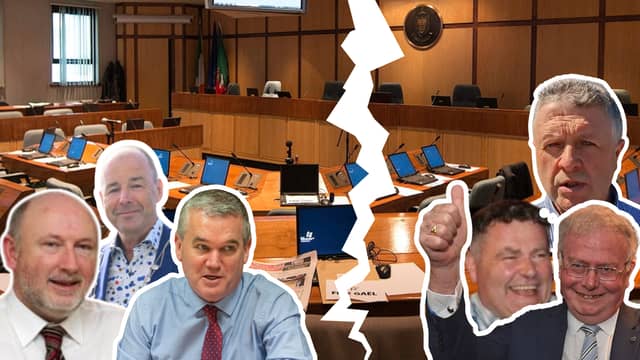
West Mayo councillors have hit back at the findings of an expert group that unanimously rejected the return of town councils, with elected members arguing the committee lacked the credibility to make such a judgement.
The Mayo towns of Westport, Castlebar and Ballina previously had town councils up until they were abolished in 2014 by the then Minister for Local Government, Phil Hogan.
The Mayo News reported earlier this week that an expert task force established to examine local government reform has unanimously recommended against restoring town councils.
Westport-based County Councillor Peter Flynn was among the most pointed in his criticism, noting that members of the task force had passed judgment on an institution they had no personal experience of.
"The councillors that were on the task force never actually were a member of a town council," he said. "So it was kind of hard to listen to county councillors around the country talking about ineffective town councils when they never actually were part of them."
Cllr Flynn argued that town councils offered a level of accountability and transparency that has since been lost. Under the old system, he said, key council officers - including the town manager, engineer, architect and clerk - were present at every meeting, meaning queries could be answered on the spot.
"There's none of the stuff that you see happening every day now at your county council meeting where they say, 'I'm not in a position to answer that, I have to revert back to such and such a department,'" he said. "We had full accountability at every single town council meeting, and that has been lost completely."
Castlebar-based Councillor Michael Kilcoyne echoed those sentiments, saying the outcome was exactly what he had anticipated. "That's the kind of stuff I expected from them, because there was very little, if any, and I can't recall at the top of my head anyone on that committee that served on a town council," he said.
Cllr Kilcoyne maintained that town councils were simply more efficient, pointing to the more focused geographic remit they operated within. "You were dealing with a town rather than a whole county - every councillor around the town council knew 100% their area and the people in their area. That doesn't happen with the county council."
He added that ratepayers could clearly see where their money was going under the old system, and pointed to visible decline in Castlebar as evidence of what has been lost since abolition. "Since the town council went, you can see the effects on the town every day," he said.
“We had no huge housing waiting list when we the town council, in my view, the town was run far more efficiently, and there was much more work carried out.”
Westport-based Councillor Brendan Mulroy said it was "a sad day for democracy" when town councils were taken away.
“It's a bit rich people coming in from the outside who never served the town council, because as far as I was concerned, the money was always equally spread, which it was,” Cllr Mulroy said.
“I would argue the point now in the municipal areas that are far worse off, both in the rural area and in the town area. And some of my former colleagues on Mayo County Council would agree with me on that, that the rural areas have suffered as much as the town areas since the town councils were taken out of action,” the Fianna Fáil public representative said.
He called for an end to divisive language around the issue, stressing that urban and rural communities are equally deserving of representation. He suggested there was room for both a reinstated town council and a municipal or borough council, though he acknowledged that current municipal district boundaries are too broad, stretching from Louisburgh all the way to Belmullet.
"I think it's time to stop this conversation, because as far as I'm concerned, all areas are equal," he said. "Politics doesn't need to be divisive. It just needs to be honest with people and make sure people are delivered for."
All three councillors were united in the view that the abolition of town councils in 2014 has left communities worse off, and that the expert group's rejection of their return reflects a disconnect between the decision-makers and those who lived through the town council era firsthand.
‘The plebs, basically’
Killala-based Cllr Jarlath Munnelly opposes the restoration of town councils, arguing instead for a more ambitious overhaul of local government that would benefit communities across the board.
The Fine Gael public representative said he does not support bringing back town councils, describing the debate as missing a more fundamental point about fairness in local representation. "I don't support restoring the town council at all. It kind of misses the point. There was a lack of equity at the heart," he said. "You had towns that had a town council, and they were well served by the town council, and then we had everybody else, like the plebs, basically."
The Killala-based councillor acknowledged the qualities that made town councils popular, but said those benefits could be delivered more equitably through a different structure.
"I looked at the comments that everybody said who wants the town council to come back, and the types of things that they were saying was good about town councils — close to the people, working with the local community, money kept local, much more nimble and able to work with the community in a smaller area. That can all happen," he said. "Our municipal districts should be enhanced and become district councils."
Cllr Munnelly's central argument is that the existing municipal district system, while flawed, at least treats all areas equally — and that restoring town councils would reintroduce a two-tier system.
"The good thing about the municipal district system at the minute is everybody is equally badly served under the current system. There's equity across the system," he said. "Whereas if you bring back the town council, you've got areas that are probably better served and areas that aren't."
Using Ballina as a worked example, he outlined what a district council model could look like in practice. A Ballina District Council would govern the Ballina municipal district, draw up a local development plan, and have powers to set commercial rates and vary the local property tax.
He also suggested increasing the number of elected members, noting that Ireland has far fewer public representatives per capita than most European countries. "You probably would have nine councillors instead of six," he said. "Most European countries would have more public representatives per capita than we do. So that was one of the mistakes about getting rid of all these town councillors — we lost extra representatives."
Under his proposed model, county councils would be retained but with a reduced, more strategic remit - focusing on county-wide matters such as national roads and regional infrastructure, while district councils would handle local issues including housing, parks, amenities and local roads.
Cllr Munnelly's proposal represents a more structural response to the local government debate than the straightforward call for town council restoration favoured by many of his colleagues, offering a model that he argues would deliver local responsiveness without reintroducing inequality between urban and rural communities.