

Gone in seven seconds
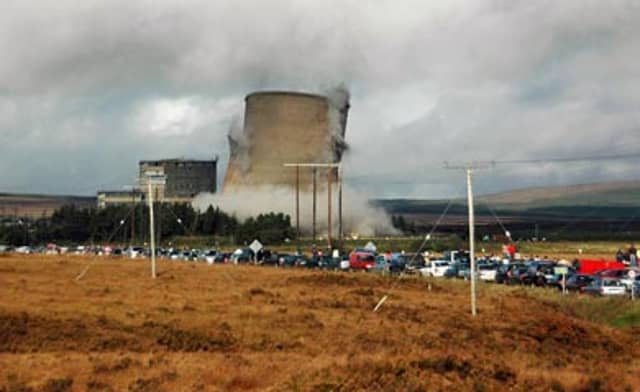

Thousands gathered in Bellacorick to watch the demolition of the storied 300-foot cooling tower
TUMBLING DOWN The Bellacorick power station falling to the ground, removing from the Erris skyline the region's most distinctive landmark
Gone in seven seconds
Anton McNulty
WHAT goes up must come down, and at eleven o’clock on Sunday morning the 300ft Bellacorick cooling tower, which for nearly 50 years marked the gateway into Erris, came crashing down in a cloud of smoke and dust.
The Bellacorick cooling tower was the last of its kind in Ireland and, from early morning, a steady stream of people – numbering close to 3,000 – from all over Erris and Mayo started to descend on Bellacorick, taking up every vantage point they could to see the demolition.
All morning there was an air of excitement, but when a siren rang to mark the impending demolition, a sombre silence came over the land. This was only interrupted by the crack of the explosives and cheers which greeted the seven-second demolition, leaving 4,600 tonnes of rubble on the site of the tower.
The peat-powered electricity station, which was operated by the ESB from 1962, until it was decommissioned in 2004, employed close to 600 people during its four decades in existence.
Further employment was generated by Bord na Móna, who supplied the milled peat which was cultivated from 7,000 acres of developed boglands around Erris.
A number of past employees of both ESB and Bord na Móna were present to watch the demolition, many with fixed feelings about whether it should have been demolished. John Gillespie worked as a fitter with ESB at the plant for 36 years and also lived in the shadow of the tower. A number of his former colleagues gathered at his home to reminisce at the end of an era and to watch the tower come down.
“I watched the tower being built and it is sad to see it come down. I know of the reasons but it was the first thing I saw in the morning and it will be strange to look out the window and not see it. It marked the entry into Erris and for the people of Erris it was more than a tower, it was a landmark,” he said.
When the tower was being constructed, Martin Cooney from Killala had the honour of placing the Tricolour on the tower when the last piece of concrete was being poured. From the top of the tower he could see as far away as Enniscrone and could take in all the sights of north Mayo. After it was constructed, he worked in the ESB station for a further 40 years but, despite his personal attachment to the tower, he was not showing any emotion when it came down.
“It served its purpose and you have to be practical about the situation. At the moment I have no feeling of sadness and it certainly went down a lot quicker than it went up. I was not fussy about whether it should have stayed and that is still my feeling. But it was a great landmark and you always knew you were on the right road when you saw it,” he said.
The demolition was carried out by Leeds-based explosives company, Robinson and Birdsell, who also carried out the demolition jobs at other ESB power stations. An armed Garda presence had been on duty at the plant since last Tuesday (due to the presence of the explosives), and the N59 was closed off at ten o’clock in the morning and reopened a half an hour after the demolition. The demolition cost in the region of €50,000 and 24 of the 36 supporting legs holding up the tower were strapped with explosives, with another band of explosives at the base of the tower.
Kevin McDermott, press officer with the ESB, explained that when the station was decommissioned the concrete started to corrode and a feasibility study found that it would cost €5-8 million just to stabilise the tower. He said, on health and safety grounds alone, they had to demolish the tower.
Cllr Gerry Coyle expressed his disappointment that the tower had to come down and said it was ironic that it was being demolished on ‘Emigrant Sunday’. He said for many years the tower was a symbol for emigrants who were leaving Erris, and for returning emigrants who knew they were nearly home.
Mr Peter Hynes, Director of Services with Mayo County Council, said it was a sad day for Erris but he hoped a gas-powered station would be built in its place in the near future.