

COLUMN: Five places Mayo can improve from Roscommon games before Monaghan tie
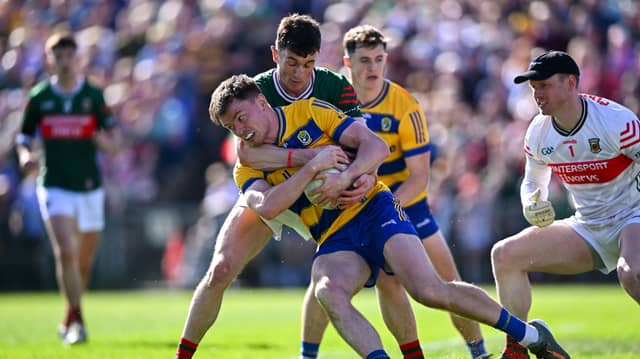

Our columnist, Billy-Joe Padden, touched on the Green and Red's exit from the Connacht Senior and U-20 Championships
There’s no point dressing this up, it’s been a bruising few days for Mayo football.
Two defeats at both Senior and Under-20 level, as well as two performances that fell well short of expectations, means there is a growing sense of frustration among supporters.
There’s annoyance, there’s disappointment, and in some quarters, there’s anger.
And to be fair, that reaction is understandable.
Supporters will always invest when they feel a connection to a team when they see effort, identity, and something they can believe in.
Mayo have long prided themselves on that connection. Big crowds, strong backing, a sense of unity.
But when performances don’t match expectation, that connection weakens. A crowd of 15,000 at a championship game tells its own story, regardless of the reasons behind it.
Still, emotion alone won’t fix anything. The more useful exercise is to step back, take both games, and ask a simple question: were there common themes?
The answer is yes.
If you strip both performances back, there are clear correlations in where Mayo fell short, and they’re not overly complicated.
The first is ball security.
In both games, Mayo struggled to retain possession under pressure.
That showed up in different ways - loose handling, carrying the ball too openly into contact, or simply not protecting it well enough when a tackle came.
Roscommon were sharp in this area. Their tackling was aggressive but controlled, and time and again they disrupted Mayo’s possession.
At this level, that’s fatal. If you can’t secure your own ball, you can’t build anything.
CO-ORDINATION
The second issue was lack of coordination in attack.
Too often, Mayo’s play became individual rather than collective. There was a reliance on carrying the ball into traffic, taking on defenders, or trying to force openings that weren’t there.
What was missing, particularly in the second half of the senior game, was any real sense of pattern or cohesion.
The best inter-county teams don’t rely on one player beating two or three men.
They create space through movement, support runs, and quick combinations. That wasn’t happening often enough.
Then there’s the most glaring issue of all: physicality and breaks.
In particular in the Senior game, Roscommon were better in the air, more aggressive around the breaking ball, and quicker to react when possession was contested.
That’s not just a midfield issue. It’s a whole-team responsibility.
Breaking ball isn’t won by chance. It’s won by anticipation, by numbers around the contest, and by a willingness to attack the ball.
Too often, Roscommon had that edge. They swarmed the breaking ball, while Mayo were reacting a step too late.
Closely tied to that is sharpness in first touch.
There were multiple moments across both games where Mayo players were favourite to win possession, in 70/30 situations, and didn’t secure it cleanly.
A heavy touch, a bobble, or a slight delay allowed Roscommon to close in and turn defence into attack.
At inter-county level, those small margins are everything.
The difference between clean possession and a turnover can be the difference between scoring and conceding.
Finally, there’s the issue of scoring spread.
Roscommon looked like a team with multiple threats. In the under-20 game in particular, their scoring came from across the pitch.
In contrast, Mayo were overly reliant on a small number of players. At senior level, much of the burden fell on key forwards, and when that supply line was disrupted, the attack struggled to adapt.
That points to a broader issue. Mayo didn’t look like a fully connected attacking unit.
Now, none of this is particularly revolutionary. Most people watching the games will have seen the same things.
The more difficult question is why these issues are there and how quickly they can be addressed.
Because the truth is, these are not problems without solutions.
Physicality, aggression, work rate - these are areas where improvement can be immediate if the mindset is right.
You can’t transform your shooting overnight, but you can decide to be more aggressive, to compete harder, to swarm the ball and make life difficult for the opposition.
Defensive structure is another area where gains can be made quickly. In both games, there were too many gaps, too much space between players, and not enough cohesion when defending as a unit. That’s fixable through organisation and clarity of roles.
When you defend as a connected group, protecting the central channel, forcing play wide, supporting each other, you make the game far more manageable.
And it’s important to say this too: all is not lost.
There is still talent within this Mayo setup. At underage level, there are forwards with real quality.
At senior level, there are players capable of performing at a high standard. But talent on its own isn’t enough. It has to be supported by structure, intensity, and a collective understanding of how the team wants to play.
That’s now the responsibility of management.
They have to identify these weaknesses clearly and more importantly, prioritise them. You can’t fix everything at once, but you can start with the fundamentals: physicality, defensive shape, and winning primary possession.
From there, everything else becomes easier.
LONG-TERM
There’s also a longer-term conversation here. The style of play, the attributes being developed, the type of player coming through — these things don’t happen by accident. They’re shaped over time by coaching and by the demands of the senior game.
And the modern game is clear in what it requires: pace, aggression, decision-making under pressure, and technical security.
Mayo will need to align with that.
But in the short term, the focus is simpler.
This is a moment where the group can go one of two ways. They can retreat, lose confidence, and allow doubt to grow — or they can respond.
History suggests that teams often find clarity when they’re under pressure. There’s a ‘backs to the wall’ mentality that can be powerful if it’s harnessed properly.
And if there’s one encouraging aspect to all of this, it’s that some of the biggest issues identified are also the most controllable.
Work rate. Aggression. Physical commitment. Those are choices.