

Digging furrows for future
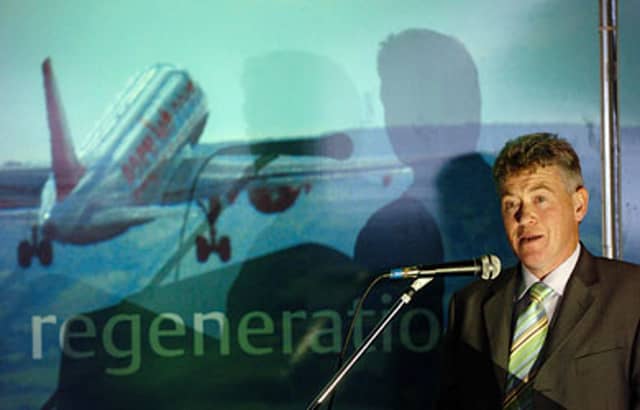

The Interview Having made changes to his life, Liam Scollan is re-energised in his commitment to the west.
Digging furrows for the future
Having made many changes to his life, Liam Scollan is re-energised in his commitment to the west
The Interview
Áine Ryan
IT is over 15 years since a victory speech at a business awards ceremony in Britain, by a leading British entrepreneur, deeply impacted on Liam Scollan. It seems that everyone except Mr Scollan nodded gravely when the winner boasted that 'while he had a broken marriage, it was the price he had paid for success'.
Then three years ago, while Liam Scollan was at his busiest in his role as Managing Director of a burgeoning Ireland West Airport, Knock, the Leitrim native got a serious wake-up call. A diagnosis of cancer challenged him to assess his life, his work-life balance, how he was spending his time.
"For a few weeks Margaret [his wife] and I wondered if it was terminal cancer, and when you face that you realise every minute is precious, every relation you have, every friend, everyone you meet, every event is precious," reflects Liam Scollan.
Fortunately the diagnosis revealed the cancer was not life-threatening. However, that tentative and soul-searching interim, during which Mr Scollan's wife was truly his 'rock', impelled him to reassess just about everything.
When we meet mid-morning on a Tuesday and chat in the character-replete shadows of Mellett's pub in Swinford, Liam Scollan is tanned, upbeat and intense.
"So I really had to appraise where I was, what is best for the airport but also what is best for me. When I thought about it, I found it was simply a question of balance," he said, thoughtfully adding that he would not have had the courage to embrace change without Margaret's encouragement or, moreover, the affirming prospect of sharing their future as a couple.
Significantly, the prospect of a healthier work-life balance for this successful executive also led him to reflect on and re-evaluate his vision for the future of the west of Ireland. In a nutshell: 'a western centric', rather than Dublin orientated ideology. He believes we urgently need to 'find a new way of looking at business and development in Ireland' and, furthermore, configure a new language to talk about it. He is also emphatic that time is of the essence in the challenge and urgency of our 'stepping back' and 'taking a good long, hard look at society'.
"Our model for our region must be, first and foremost, attractive for us to live in, as well as for drawing tourists. We need to build our towns and villages with all-year-round facilities – cinemas, swimming pools etc," he urges.
"We have, for instance, to bring the environment, and the quality of life we are creating around us, to the core of our thinking and talk in terms of quality of this living ecology, not just about more houses, bigger roads," explains Scollan.
The dregs in our coffee cups long cold, Liam Scollan is unbridled in his convictions, uncompromising in his viewpoint.
"Equally, we have to find a new way of talking about the west and east divide, without being divisive. I think there has been a catastrophic failure in Dublin to share the benefits of its growth with the people who actually live there. Residents in Ballyfermot and Tallaght and many north-side estates simply have not benefited from the huge economic growth in the city. The contrast between rich and poor in Dublin and the variations in quality of life there are far greater than the contrast between development in Dublin and under-development in the west of Ireland.
"That is not to say that the west has not a strong case for more Government investment but it is absolutely futile to argue for more cash for investment unless we are very clear about what type of society we want and, indeed, will be allowed, in 30 years’ time."
"Our challenge in modern day Ireland is to actually say Céad Míle Fáilte to people and to direct it particularly at the have-nots in our society."
Liam Scollan draws a breath, but only momentarily. You see, he believes since the early 1970s, when we joined the EU, we have gradually replaced important lynchpins of our national identity with the mesmeric lure of material wealth and all its blinding trappings.
"When we had the depression of the 1970s to the mid-80s, it was jobs at any cost and as much EU money as we could find to develop everything we could get our hands on. When the EU money drained away, we had the booming economy and the attitude was 'fair dues to us Irish', let's show everyone we can build big and as fast," he continues.
"Our success in attracting inward investment from foreign multi-nationals took away from our sense of urgency about getting our own natural, indigenous development under way. This society has talked down land and especially land in the west of Ireland when, in fact, it will become a vital resource in our society that, in the near future, will head more towards organic food and energy crops."
He highlights the irony of the fact that the west's extensive under-development currently provides an invaluable window of opportunity 'now that the lens on the future' and, furthermore, the imperative of sustainable growth, has become clearer.
"The under-development of not just our land, but of our cultural heritage, our lived-in environment, our transport systems, actually presents us with more of an opportunity to get it right for the future now," he claims enthusiastically.
"Our communities which, through depression times, have been so active and which have become so skilled in the process are well-equipped to now look at how they can make their areas more self-sufficient in energy, food and even entertainment."
The huge advantage that the west of Ireland still has – and albeit may take for granted – is its rich natural and built heritage. This asset potentially fulfills one of the biggest cravings of the majority of tourists: the search for 'time' and 'space'.
"The west of Ireland can be an iconic destination, not just relevant for people seeking traditional, religious experiences but also broader, mediative experiences," he suggests, juxtaposing Knock and Croagh Patrick. “Again it was fashionable to put a lot of this talk aside as we embraced the economic boom. We need to put that centre stage again and not apologise for our religious past."
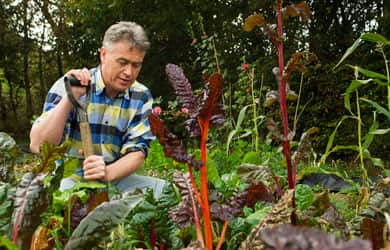
His commitments to sustainable living, the preservation and harnessing of our rich cultural heritage, our elemental energies, are by no means mere philosophical lip service. He and his family are currently building a low-energy house while much of his and Margaret's spare time is spent tending to their organic fruit and vegetable garden. Meanwhile the family – the couple have three daughters – are committed to walking, cycling and the use of public transport as often as is feasible. Scollan is also committed to learning new skills and is a board member of the Rosinver Organic Centre.
The innovative centre is a non-profit organisation established in 1995, aiming to provide public education, training and information about organic growing and sustainable living. A recognised eco-tourism destination, the 19-acre site has outreach centres in Clare and Wicklow. It runs workshops on organic horticulture, gardening, green building, alternative energy and artisan food production, and also offers a year-long organic horticulture training programme .
Of course, while Liam Scollan's recently restructured work-load at IWAK has freed him to indulge in his pastimes and undergo a part-time homeopathy course, he still holds the demanding and challenging position of Group Managing Director. He's emphatic that this high-flying position does not implicitly contradict the fabric of his personal convictions. "Since 2004 we've had a policy of driving down CO2 emissions and plan to be CO2 neutral in about 15 to 20 years’ time. We also aim to have the airport's proposed business park as an eco-friendly park," he explains. Clarifying that he is referring to the airport's many buildings and not the planes, he observes, however, the development of the aviation aspect of the airport is not specifically about 'more and more planes'. "We are committed to 'a more thoughtful development' with a high level of connectivity with Great Britain, increased inbound tourism and transatlantic traffic, and gateways to the key hubs at Heathrow and Charles de Gaulle airports that give us global connectivity," he says, emphasising that it was 'more important to have the choice of connectivity than more and more planes'.
Knock's meteoric business development story, though, still leaves much room for increased services per capita of population to balance what's available in the east of the country. In the meantime, a simple logic underpins Scollan's plans for the airport – an economic hub stimulating much ancillary growth while leaving the smallest possible trace, while maximising environmental benefits.
A favourite pastime of Scollan's is to don his leisure gear and cycling helmet to cruise and climb the hills and boreens of Achill Island. Obviously, the dramatic land and seascapes provide spiritual nurture and intellectual relief. They also stimulate further thoughts and ideas about the looming prospects of global warming, climate change and the sustainability of our society. Scollan no longer takes anything for granted.
"Until recently, we have taken our beautiful heritage, our islands, our lakes, for granted. But now, people can buy our islands, they can build on our mountains, they can take away their accessibility, pollute our rivers and lakes," concludes Liam Scollan.

Contact
MJM FINANCE
MJ McGreal
Address
Ellison Street,
Castlebar
Telephone
094 9027488