

COUNTY VIEW: Remembering the papal visit to Mayo and the transport fiasco
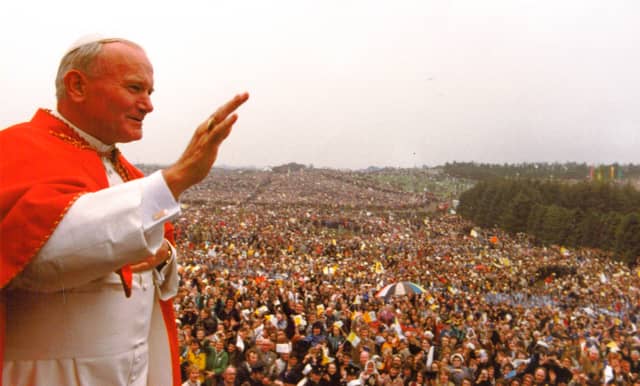

Pope John Paul II’s 1979 visit to Knock Shrine left many disappointed
Forty-five years ago this week, the people of Mayo were still reflecting on the agony and the ecstasy of the visit to Knock Shrine of Pope John Paul II. Because rarely did euphoria turn to disillusion and heartbreak so quickly as it did on that September Sunday in 1979.
It had all started so well. A year before, the Pontiff had announced his intention to visit Ireland and, in particular, Knock, the goal of his visit, where the Apparition had occurred a hundred years earlier.
And so the plans were laid for what would be the most logistically challenging three-days operation ever undertaken on Irish soil. On that Sunday, the Pope would helicopter to Ballybrit in Galway for a youth Mass; he would then proceed to Knock, where he would bless the sick and celebrate Mass. Then he would travel by the Popemobile, an open vehicle, through the crowds over the specially laid gravel paths and along the corrals where the pilgrims would have taken their place several hours earlier.
The transport arrangements were worked out in fine detail. Pilgrims were encouraged to make the journey by rail and bus, rather than private cars. Trains from all over the country would ferry the faithful to Claremorris, from where a fleet of shuttle buses would convey them to a central point some half a mile from Knock Shrine.
But the best-laid plans can go awry, and on that Sunday they did so with a vengeance.
The event in Galway went way beyond schedule mainly due, it was said, to the theatricals of the Bishop of Galway, Eamon Casey, and his side kick, the singing priest, Fr Michael Cleary. By the time the Pope left for Knock, he was more than an hour behind schedule. And the autumn evening was growing ominously dark and overcast.
But for now, the massive crowds on the hills were patient; cold perhaps, and wet, and tired, but buoyed in the belief that, in time, His Holiness would be among them, close enough to touch his garments. When his red helicopter appeared out of the clouds, the welcome was rapturous, the emotional level sky high. And when the formal ceremonies were concluded – throughout which, for many, the Pope was but a white speck in the distance – they waited. And waited. But there was no Popemobile, no drive through the crowds.
And then came the sight of the helicopter climbing into the sky and heading eastwards to Dublin. A timid voice over the tannoy declared, to the few who could hear it, that ‘the Holy Father has now departed’.
The reaction was one of utter, painful disbelief. The sense of a congregation deceived was palpable. Tears flowed freely as those who had spent the long, wet, cold hours on the hillsides felt tricked. The rest were too stunned to do anything other than to continue to stare into the darkening sky.
But worse was to follow.
As the thousands upon thousands spilled out on to the narrow roadway, the shuttle bus service that had operated so well a few hours beforehand, turned into a fiasco. It was now dark, and a surging mass of humanity descended on the bus park vainly searching for their own bus. A vast concourse, in heavy rain and the pitch dark, was forced to walk, and stumble, the seven miles to Claremorris.
There, the trains were held up, since sitting in Platform One was the special to take the Cardinals and Bishops back to Dublin, and until it moved, nothing else could. The Hierarchy finally arrived by special coach from Knock at 1.30am. Slowly, trains began to depart for all parts of the country.
Those from Westport who had opted for public transport finally arrived home at 5.15am.