

Driving the message home

On the doorsteps Last week was officially designated as Global Road Safety week by the United Nations.
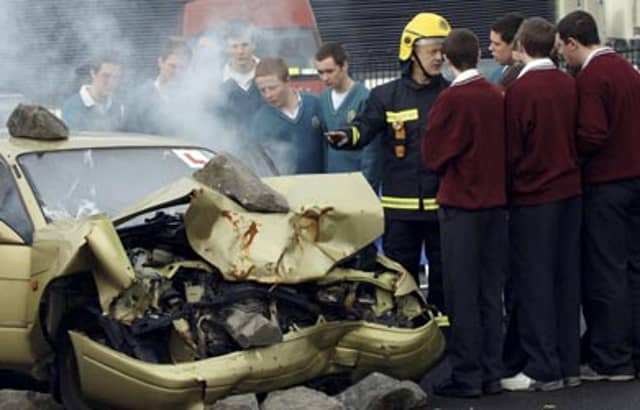
LESSON FOR LIFE Mayo County Council have used tactics, like the AXA Roadsafe Roadshow, to educate the county’s teenagers about Road Safety. Here, Fire Officer Noel Cunningham, imparts some knowledge to interested second level students. Pic: Keith Heneghan/Phocus
Driving the message home
Road safety
Claire Egan
LAST WEEK was officially designated as Global Road Safety week by the United Nations. In a response to this, local authority safety departments placed mangled crashed cars in garage forecourts across the country.
The ‘shock’ tactic aimed to bring home the message to motorists of the huge responsibility that driving entails and the consequences of their actions.
However, on a day when Global Road Safety officially commenced, a 24 year old man died in Killarney after his car struck a council traffic cone. The following day, Tuesday April 24 three people were killed – an elderly lady in Limerick while two men died after their car was involved in a collision on the N11, south of Wicklow.
The question therefore arises – despite increased media campaigns, an officially designated Road Safety Authority and tougher road traffic legislation for errant motorists, will the road safety message ever come home to roost?
“The biggest problem is trying to change attitudes. It can be extremely difficult when campaigns are being launched in the face of road fatalities. Change in attitudes and driving habits will be a long drawn out process and is not something that is going to happen overnight. We have started to focus attention on primary and post primary schools in order to educate young people about the responsibilities and issues of road safety. The RSA is also looking at overhauling the driving test system, using a graduated approach based on age, engine sizes and years spent driving,” said Mr Noel Gibbons, Road Safety Authority officer with Mayo County Council.
A myriad of points have been highlighted as contributory factors in road death fatalities. For instance, a single carriageway stretch of the N11 was pinpointed as a prime factor in last week’s double fatality. However, according to Noel Gibbons categorising road infrastructure as a significant factor in road deaths is an argument that does not hold.
“Research has shown that 95% of road incidents are down to driver error. I take on board the issue of infrastructure but according to the figures it is driver error which is the dominant contributory factor. The other issue that has been highlighted is of course younger drivers. While young drivers are responsible for a proportion of road fatalities it is also the responsibility of older and more experienced drivers to take responsibility, avoid talking on mobiles, speeding and basically try and lead by example,” explained Noel.
The establishment of the Road Safety Authority, under the stewardship of Mayo man, Mr Noel Brett has been seen as a hugely positive development. Furthermore, the introduction of mandatory breath testing has heightened driver awareness.
“Drink driving has become completely socially unacceptable and with the random breath testing by Gardaí and tougher legislation to prosecute drivers there is a concerted effort to eliminate the practice of drink driving and its role in road deaths,” explained Noel.
However, huge concerns remain over our attitudes to speed and the impatient ‘road rage’ approach which infuses daily motoring. Despite the initial impact of the penalty points system in 2002/2003 nationwide concern with the ‘Get the point and not the points’ is tapering off.
“Penalty points worked very well when they first started, however now it seems drivers are not overly concerned if they get a few points on their license, while our increased wealth means that a fine is now of little concern to us. As I mentioned drink driving has now become completely socially unacceptable and the target remains to have the whole area of speeding equally frowned upon by society. The introduction of privatised speed detector companies who will work in tandem with the Gardaí will help to slowly eradicate this,” explained Noel.
The challenge now remains to bring Ireland into line with our Swedish and Australian counterparts who through an intensive educational campaign and stringent road traffic legislation enforcement boast the best road safety records internationally.
To date, in Ireland 114 people have died in road traffic accidents in contrast to 136 at this juncture in 2006. It must be acknowledged that for the families of the deceased such statistics are of cold comfort.
In Response
Dr Jerry Cowley ind
“The quality and conditions of roads, road markings and correct signage needs to be addressed. Certainly people need to take personal responsibility but people also deserve to drive on roads which are fully developed and completed by the local authority. There have been inquiries into the deaths of Ashling Gallagher in Achill and Sinead McDaid in Donegal who died in accidents owing to the condition of the roads. There are not sufficient audits done on the contributory factors to road traffic accidents and this needs to be addressed.
Mandatory breath testing needs to be introduced at the scene of a fatal traffic accident as well. It should happen directly at the scene while drug testing should also be undertaken.”
Frank Chambers FF
“The relationship between the Road Safety Authority, Mayo County Council and schools in Mayo needs to be expanded. The biggest issue is education and there is a need for a greater expansion of the TY curriculum to incorporate road safety. More resources need to be put into our schools to implement an educational road safety campaign.
Furthermore, all drivers should be more aware of the responsibility that driving entails, the mechanics of their vehicle and the importance of respecting their role as a driver.”