

'I was not allowed to tell anyone' - Mayo native remembers Pulitzer Prize news

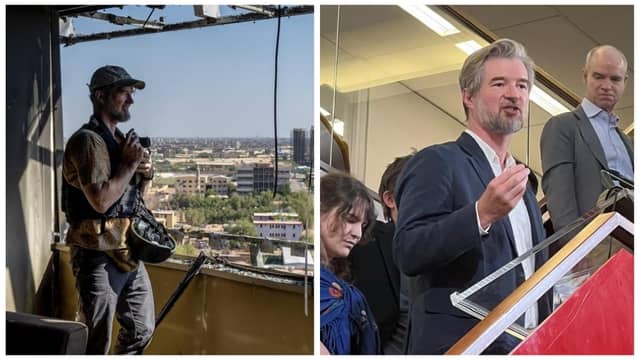

Ballina native Declan Walsh received the Pulitzer Prize together with New York Times staff for their reporting on the Sudanese civil war.
It's obviously not every day, you win a Pulitzer Price. But when Mayo native Declan Walsh found out, that he did, he wasn't in a position to share the good news.
“The news came through while I was at a wedding in London with my wife,” stated Declan Walsh, speaking to The Mayo News, while waiting for plane at Heathrow Airport London.
“It was in the middle of the speeches, and I got a message from work saying that I had to get on a call with the editor of the New York Times and some of my colleagues. So I went outside, took this video call. He told us, the some good news, that we won a Pulitzer for international reporting.”
Fantastic news, but unfortunately at the time, not meant for the public, as winners are usually informed before the official announcement. A bit of a pickle for Declan:
“Then the hardest part was, that I had to go back into the wedding where things were still going on and I was not allowed to tell anyone what had happened. Obviously, I told my wife and then we had to sort of sit there at a table with other journalists and, make small talk about weddings and listen to the speeches and stuff. There could be worse problems, of course, but it was kind of fun.”
Declan, who hails from North Mayo town Ballina, won the Pulitzer Prize, together with New York Times staff for their reporting on the civil war in Sudan. A conflict, that is still going on. Declan Walsh's work is far from over.
"Even as we were getting, news about this prize, there was a big ceremony at the New York Times on Monday at headquarters and the war in Sudan was taking another turn with drone strikes against the main civilian airport in the country and international flights being closed off and so on."
The civil war in Sudan might seem far away, but the conflict might very well have geopolitical consequences.
"Sudan is located on the Red Sea, which is a major shipping lane. On the other side of the Red Sea, the Americans are carrying out a very intensive bombing campaign against the Houthis in Yemen. So from a sort of geostrategic lens, there's lots of reasons why it would make sense for anyone really to worry about the fate of Sudan."
Walsh states the possible implications of a huge country like Sudan going 'off the rails'. From a European Union perspective, he said, there is a focus on the migration issue.
"We should also care because of our common humanity. I mean, it's, you know, for the same reason that Irish people were so captivated and moved by what was happening in Ethiopia in the 1980s."
Walsh is a graduate from St Muredach's College Ballina. He currently works as Chief Africa correspondent for The New York Times. He lives with his wife and kids in Nairobi, Kenya.