

Achill’s ‘ticking time bomb’
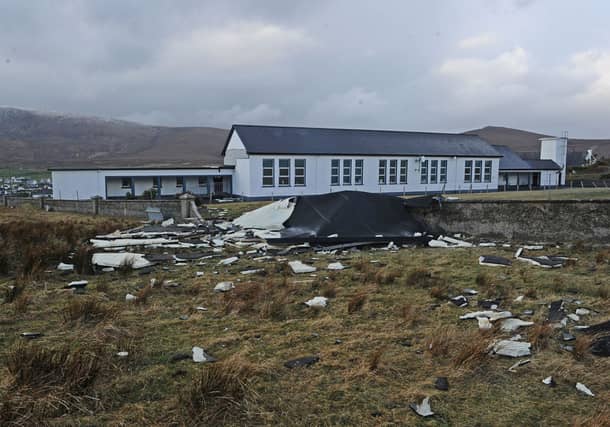

Councillor says three storms so far this year reveal the need for much swifter responses to the problem of coastal erosion
Coastal erosion needs ‘urgent’ action
Edwin McGreal
Three storms so far this year reveal the need for much swifter responses to the problem of coastal erosion.
That’s according to Achill-based Cllr Paul McNamara, who described coastal erosion as ‘Achill’s ticking time bomb’.
Cllr McNamara was speaking after yesterday’s (Monday) monthly meeting of the West Mayo Municipal District where he called for an emergency fund for speedy repairs to flood defences.
He also called for more ‘decisiveness’ at national level to tackle the impact of ever increasing storms. He referred to the damage caused by Storms Brendan, Ciara and Dennis in recent weeks.
Cllr McNamara told the meeting that two beaches in Achill – Keel and Dooagh – are in danger of being washed away after the recent storms. Sand and stone barriers at the back of Keel beach have been ‘virtually flattened’, he said, and the wider village was now at a greater risk of flooding.
The slow pace of action to repair damage caused by storms was exacerbating the problem, he added.
“We need an emergency fund in place that if you have a heavy storm and high tides, that the next day we can put it right straightaway. We’ve had three storms this year and no action has been taken yet.
“The council are often waiting 12 weeks for emergency funding to come through and in that timeframe you could have total destruction and devastation and it might not be fit to be repaired by the time the funding comes through.
“There’s a possibility now that the campsite in Keel will flood, down into the lower end of Keel will flood and all of that area is in danger whereas if the defences were repaired and replaced as soon as the damage was done, it will serve as a barrier for the next storm instead of being greatly weakened,” he told The Mayo News.
A feature in The Mayo News earlier this year revealed areas set to be below the high tide line as a result of rising seas by 2050. Keel and Dooagh were among them.
“You can bring that forward by about 20 years,” Cllr McNamara said.
“At a national level we’ve been very slow to react. We need to act with a much greater level of urgency and decisiveness. We’ve an area in Dooagh that is very low lying. We’ve the same in Dooega. It is only going to take one big storm to do a lot of damage when there’s no coastal protection. Coastal erosion in Achill is a ticking time bomb.”
‘Critical decisions’
Cllr Peter Flynn said that while he agreed with Cllr McNamara, there needed to be firm action taken at national level, first and foremost.
“The damage climate change can do is becoming abundantly clear. We can close our eyes to it or make critical decisions to counteract. In the UK and France people are being compensated to leave their coastal homes behind and move inland.
“Here in West Mayo we will also have to deal with special areas of conservation when undertaking coastal works. Achill is a very obvious pressure point but we’ve seen it all along the coast from Thallabawn into Carrowniskey in Louisburgh, Bertra (beach, in Murrisk) is disappearing before our eyes, some roads in Kilmeena are frequently impassable.
“At a county council level we need a floods programme like we currently have a roads programme. The storms will continue to come,” said Cllr Flynn.
Cllr SeΡn Carey and Cllr Gerry Coyle concurred, saying vast parts of coastal Erris were heavily flooded and vulnerable.
Head of West Mayo Municipal District Padraig Walsh said coastal erosion is ‘a difficult problem’ that requires a definite national policy.
“It is difficult to see a situation where we will be able to protect all of the coastline because of the scale of the cost,” he said.
He said the council don’t have a ‘contingency fund’ and said he was unsure how they could access such a fund suggested by Cllr McNamara. He said he would speak to the council’s environment and climate change section about the issue.
He said the council can apply to the Department of Transport if roads are affected by storm damage while funding from the Office of Public Works can be sought for houses or land affected but added this was not without difficulties.
He said funding from the OPW would only amount for 75 percent of the cost and, as well, a cost benefit analysis would be undertaken before any money could be secured. He said if it was only land affected – and not homes – it would be difficult to obtain any funding from the OPW.