

A special birthday
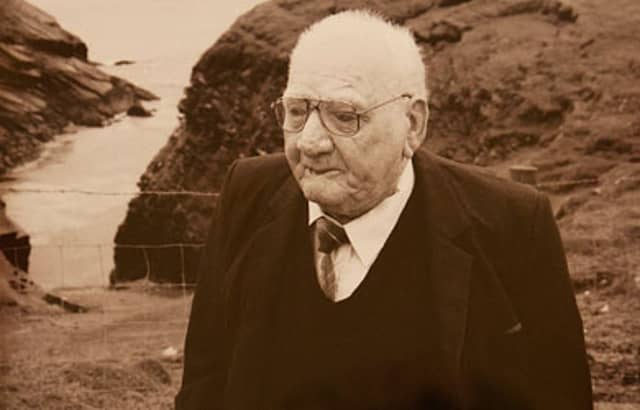

Inishkea’s Pat ‘Rua’ Reilly reflects on a century laden with triumph and tragedy.
A lifelong voyage
In his 100 years, Pat ‘Rua’ Reilly, the last living survivor of the Inishkea boating tragedy, has lived by the sea and seen death by the sea
Kevin Hegarty
1907. King Edward VII, an ageing playboy, sat on the throne of Great Britain and Ireland. Sir Henry Campbell-Bannerman was the Prime Minister. The leading nationalist politician in Ireland, John Redmond, was campaigning vigourously for Home Rule. Wilhelm II, the Kaiser, was preparing his army to push for German mastery of Europe. Arthur Girffish founded Sinn Féin. The Vatican issued its infamous ‘Ne Temere’ decree which sought to compel couples in mixed marriages to bring up their children as Roman Catholics. William Butler Yeats was continuing his doomed pursuit of the hand of Maud Gonne in marriage. And to William and Bridget Reilly, from the south island of Inishkea, a child was born, Pat Rua, on August 22.
We gathered on a memorable evening last Wednesday in the Broadhaven Bay Hotel in Belmullet to celebrate Pat’s hundredth birthday. He has lived every one of his 36,525 days to the full. He sat majestically, late into the night, amongst family, friends and neighbours like an old Gaelic Taoiseach.
He is an emperor of the sea who defied death on the ocean twice. He knows the sea, its wonder and majesty, its potential and its fearsome dangers, with an intimacy greater than some of us know our own homes. He has a razor-sharp memory, able to recall events from his life more rapidly than a computer expert can access information on a website. An avid follower of Gaelic football, he can still analyse a game more acutely than even Colm O’Rourke.
The poet, Michael Hartnett, once wrote of old men whom he knew in west Limerick who carried a thousand years of history in the pocket of their coats. One can say the same of Pat Rua. I have pieced together from the wealth of his memories a pen picture of the islands of Inishkea in the early years of the last century. It is a fascinating insight into a world that has disappeared.
The Inishkeas comprise a north and a south island. It was a self-reliant community, dependent on fishing and subsistence farming, augmented for three years, between 1908 and 1911, by a Norwegian Whaling Station, established on Rusheen, a tidal inlet off south Inishkea.
In 1911 the population of both islands totalled 312. There were national schools on both islands, a pub and grocery store on the north island and a shebeen on the south. In 1895 an RIC barracks was established on the north island.
The people lived in two-roomed stone cottages, thatched with the bent that grew on the islands. Every family had their quota of cattle, sheep, pigs, hens, ducks and geese. They grew their own potatoes. Cattle and sheep were transported by currachs to the fairs on the mainland. Potatoes, fish, Indian meal and milk were the dietary staples. A pig was killed for Christmas.
The men of Inishkea wore navy blue homespun from which shirts, vests and trousers were made. Boys, up to the age of 12, wore a kilt-shaped garment, made of red or grey homespun, and buttoned up the back. Older women wore tartan shawls and purple or blue petticoats, often ornamented by a few rows of black braid. Some wore white frilled caps. On Sundays they wore heavy blue cloaks with capes and hoods. Younger women had abandoned these garments in favour of what Pat calls ‘modern fashions’.
Pat’s earliest memories are of playing by the sea shore as a little child. At the weekend the community relaxed. They rarely fished on Sundays. Dances were held every Saturday night, alternately on each island.
There was no resident priest on Inishkea. During the summer many of the men rowed to Portmore, from where they walked to the old church at Tirrane for Mass. On the islands the Rosary was said every Sunday in the national schools. After the rosary there were games by the shore. Among the games they played were rounders, hurling with sea rods and football. Pat played with the Inishkea team that once, famously, defeated the footballers from the metropolis of Belmullet. “That must have been some game.”
Every spring and autumn the priests of the parish paid a two-day visit to the islands to celebrate Mass, hear confessions and visit the sick and housebound. They stayed in Pat’s home. When they departed a dance was held. Somehow one senses a collective sigh of relief!
It was on one of these visits that Pat made his First Communion. He remembers his Confirmation well. On a wet and windy day the children making their Confirmation were brought to Portmore. They walked the four miles to Tirrane Church where Bishop Naughton quizzed them on the catechism and confirmed them. Immediately afterwards they returned to the islands.
Wakes and weddings were celebrated in the traditional manner. Wakes were held for two days. Some of the games enacted at the wakes incited clerical disapproval.
Strawboys came to weddings, disguised in tall conical-shaped straw masks, adorned with strips of red and green cloth, white shirts decorated with coloured ribbons and white or red petticoats. Claiming to be ship-wrecked sailors, they said that they came to dance at the wedding; the captain danced with the bride; the mate with the bridesmaid and the rest of the group with the other girls.
By the age of 12, Pat’s short but happy childhood was over. He joined his father on the sea. So began a career of winning a modest livelihood from the dangerous seas that lasted until well into his seventies. He fished from Clare Island to Downpatrick Head. As a young man he often slept on rocks by the shore when it was too late or dangerous to return home.
Pat will never forget the last Friday of October, 1927. The events of that night are etched on his mind like a permanent nightmare. It was a night when, in the words of a traditional song, the wind gave no rest and death was in the sky. He and his friend, Anthony Monaghan went fishing for mackerel with 20 other currachs. The early evening was quite calm. Suddenly the wind changed and a hurricane struck like ‘a shot out of a gun’. Dominic and John Reilly advised them to make for the shore. He and Anthony managed to pull into a place on the North Island called the ‘Dock’. They were thrown up on it like ‘a box of matches’. The strong wind caught several currachs and swept them towards the mainland.
When the sea calmed the scale of the human disaster was grimly apparent. Ten young men had drowned, among them two of Pat’s brothers, John and Terry.
The tragedy broke the spirit of the islanders, already under economic strain to accede to pressure from government officials and local clergy to settle on the mainland. The Reilly family set up home in Glenlara, under the shadow of Erris Head, near fishing grounds they knew so well.
Pat remembers a parish priest of Belmullet who followed courting couples with a blackthorn stick. He did not allow the prospect of clerical ire to deter him, for soon after coming to the mainland romance entered his life. He went to a dance in Shanahee School where love was in the air. He and Mary McAndrew went out together for two years when they decided to marry. He bought her a gold ring in McIntyre’s of Belmullet.
“It wasn’t enough for her,” he says. “Nothing would have been enough for her. She was worth her weight in gold. She kept the house and I kept working.”
They went to see Canon Kilgallon in Binghamstown to ask him to marry them the next day.
The Canon confined their pre-marriage preparation to one question: did their parents know? The ceremony in Broadhaven Church took ‘five or six minutes’. There followed a merry party in Glenlara. There was music, food, dancing and a barrel of Guinness. The strawboys came. The next day Pat was back fishing.
Their marriage lasted 69 years and ten months, until Mary’s death in June, 2005. It was a relationship earthed in reality but tinged by heaven. They had 12 children. Now there are also 46 grandchildren, 33 great-grandchildren and one great-great-grandchild. They created for their family in the picturesque village of Glenlara a haven of security and love. I will never forget Pat, broken-hearted, clutching at a headstone as her body was laid to rest on a mid-summer Saturday. He had followed her to her final resting place. He had loved her to the end.
Forty-three years after the Inishkea disaster, Pat had another brush with death on the sea. On Tuesday, June 9, 1970, Pat and Henry Martin Gaughan and Henry Joe Gaughan left Burtonport with a new boat, the Sister Thames. They were expected in Broadhaven Bay 14 hours later. Eight miles south of Rathlin O’Beirne lighthouse, the boat developed engine trouble and anchor was dropped. Then a blanket fog came down that lasted five days.
Initially their families were not worried as they believed that they would drop anchor and wait for the fog to lift. By Thursday, the alert was given. Trawlers were asked to look out for them. The Corvette Maeve and a British Army helicopter from Derry were called in to help.
By Friday night they had not been found and worry began to give way to despair. Pat’s son, Liam, who fished out of Burtonport, calculated that the area between Sligo Bay and Killala Bay had not been searched sufficiently. Early on Saturday morning he saw the fog begin to lift. He drove to Sligo and ordered the Corvette Maeve to alter course. While Mass was being celebrated for the recovery of the men, on the Feast of Saint Anthony of Padua, in Shanahee Church, word came that the Corvette Maeve had found the Sister Thames, eight miles off Dromore-West in Sligo. They were saved in the nick of time. They had no water for a whole day. They even had to drink the holy water. They had begun to rub butter on their lips to prevent them cracking. On Sunday bonfires blazed all the way into Belmullet to welcome them home. Ernest Hemingway said true courage is grace under pressure. Pat and his friends exhibited the truth of this maxim during these horrific days.
On the evening before his birthday, a visitor asked Pat would he dance at the celebration. Before he got a chance to answer, a great-grandson piped up ‘no, he is too old’. Pat did not dance on the day but his indomitable spirit continues to dance through the lives of those who know him. To paraphrase some lines from the book of Ecclesiastics, he is an illustrious man of whom a rich inheritance has been born. His glory will not fade.