

A sanctuary from suffering
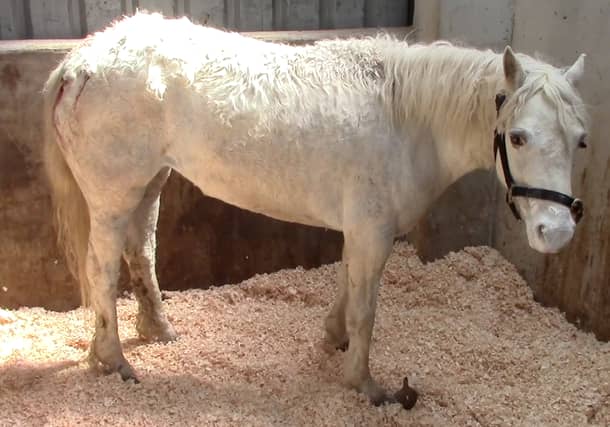

Edwin McGreal visits the North Mayo Horse Sanctuary in Ballina, a sanctuary for neglected and abused animals
The North Mayo Horse Sanctuary in Ballina offers a safe home for horses and donkeys
Edwin McGreal
It’s Wednesday afternoon at the North Mayo Horse Sanctuary at Knockegan outside Ballina and Gerry Ginty, John Redmond and James Ginty have just rescued a horse and a donkey from a field outside Balla.
“The horse is as bad as we’ve ever seen,” Redmond tells The Mayo News. We soon see why. The horse is barely able to stand, so long have its hooves been allowed to grow. Redmond reckons the horse is between seven and ten years old and said it is ‘quite possible’ his hooves have never been trimmed.
Untreated wounds on her back look particularly sore and are ‘badly infected’, her nose is red with sunburn and the horse’s demeanour tells you here is a creature whose nerves are shot and who is clearly in constant pain.
“It will be touch and go whether she will make it,” John Redmond tells us.
“We only take the decision to euthanise a horse or a donkey as a very last resort if they are suffering too much and they cannot be treated. We’ve only lost six horses since we opened in 2012. Hopefully this won’t be the seventh but if she’s in too much pain, there will be no alternative. This is down to nothing but neglect,” he adds.
A vet examined the white horse that night while a farrier was also called to see what could be done about her hooves. As we go to print on Monday evening John Redmond informed us that while the horse is ‘still very weak’, the outlet is more optimistic and ‘she should make it’.
Microchips
Neither the horse nor the donkey were microchipped which Gerry Ginty says came as ‘no surprise’ to them.
It is illegal not to have the horse or donkey microchipped or for the owner not to have an equine premises number (similar to a herd number for cattle) but such breaches are rife.
“These laws are breached all the time and it is easy to see why when there is so little enforcement of them,” argues Gerry Ginty, who is also a Mayo county councillor for the Ballina area.
Such registration costs must be borne by the Sanctuary for the vast majority of horses and donkeys they rescue.
So far this year the Sanctuary have re-homed 37 horses and last year found new homes for approximately 100 horses. They currently have 40 horses and three donkeys. A total of 400 horses have passed through the Sanctuary since 2012, the vast majority of whom have been re-homed.
They also provide educational programmes for handling of horses. They estimate it costs €100,000 per year to run the Sanctuary. The land they used was bought by Gerry Ginty and generously leased back to the Sanctuary rent free. It consists of 16 acres across two holdings and they often have to rent additional land when they go beyond capacity.
They rely on their charity shop in Ballina and private donations to keep them going. As well as that they received a grant of €3,000 from Mayo County Council this year.
“It’s costing us our time and our money to do it but we do it because we get satisfaction from making things better for the animals,” says John Redmond.
“Our view is that the amount of money you get from the Department of Agriculture relates to how many you kill. They would feel that the horse and donkey we took today are not worth saving - although the two inspectors who called us today were not of that view. However one Department officer who came to us one day referred to every animal here as ‘rubbish’. Far too many horses are being euthanised than need to be in pounds around the country,” argues Redmond.
Killing mares in foal
They tell the not-isolated story of one man who was going to kill three adult horses, one ‘six or seven weeks from foaling’, before the Sanctuary were able to intervene.
The mare was in ‘poor shape’ but was was nursed back to health. She gave birth to a healthy foal and they have both now been re-homed in Hollymount.
Since they opened in 2012, the Sanctuary have taken in 10 mares in foal who were in danger of being killed. All were born safely and most have since been re-homed.
John Redmond feels strongly that horses can be used to great effect for therapeutic benefit for children with autism, for adults with addiction issues and people with mental health problems.
“There are huge therapeutic benefits that are only being realised in recent years. The Americans are a step ahead of us,” said Redmond.
Though based in Mayo, Gerry Ginty says they will go wherever they are needed to rescue a horse or donkey. The problem of so many abandoned or neglected horses and donkeys is becoming more and more commonplace. What is the root cause?
“The main problem we see in why horses are neglected or abandoned is ignorance or greed or both. People may not know how to look after a horse or do not want to if that horse has no commercial value.
“We gladly intervene in a case where people are no longer able to look after the horse or donkey, for whatever reason,” Ginty says.
John Redmond argues it is much cheaper to rescue and re-home horses and donkeys than to kill them, if only looked at from an economic standpoint.
“If they covered our costs, it would be cheaper than going to the pound,” said Redmond. He points out they immediately geld a stallion if one comes to them to reduce an over supply of horses.
Gerry Ginty argues that the manner in which Irish people and the Government treat horses and donkeys is a ‘sad reflection’ on a country which prides itself of its equine industry.
“We boast about having the top bloodstock in the world. People go out and pay €1 million for a yearling foal. That amount of money would solve the problem of every stray horse in the country.
“An awful lot of English people ask me why we treat horses and animals so poorly. They can’t understand why such a nice race of people could treat animals so badly. It wouldn’t be tolerated in any other country.”
Campaign continues for ISPCA Inspector for Mayo
A campaign to have an ISPCA Inspector for Mayo is continuing apace. Such a person would have the authority to seize horses, donkeys, and any other animal, without the owner’s consent, if they felt the animal was in distress.
Without such an officer, currently only the Department of Agriculture, the gardaí or the owner itself can permit the likes of the North Mayo Horse Sanctuary to rescue a horse or donkey in need.
“We would support the campaign. However we would like to see the horse or donkey brought to a place like ours rather than to a pound, where the chances of it being euthanised would, we feel, be much greater,” said John Redmond of the North Mayo Horse Sanctuary.
For more on the campaign see www.ispcamayofriends.com.